San Marco in Venezia in Città Metropolitana di Venezia, Venetia, Italy — Southern and Western Europe (Mediterranean)
Antonio Canova
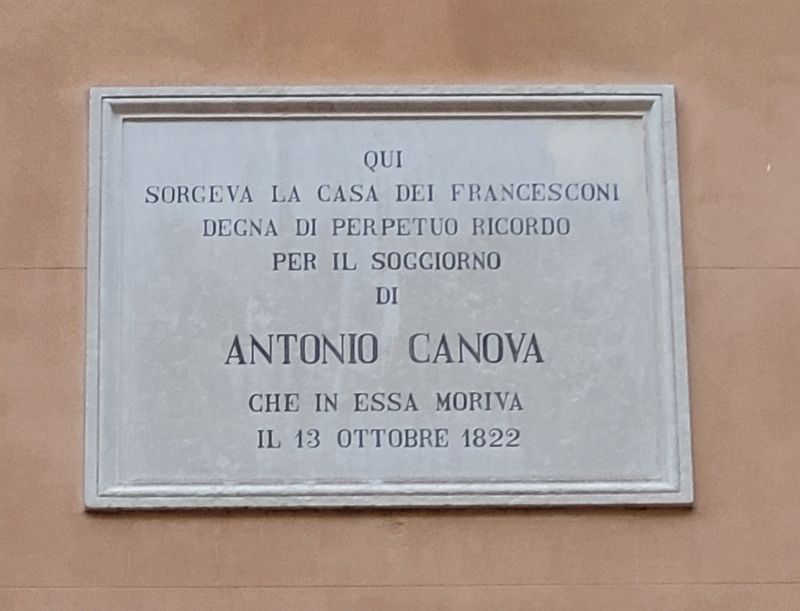
Photographed by James Hulse, March 6, 2024
1. Antonio Canova Marker

Qui sorgeva la casa dei francesconi degna di perpetuo ricordo per il soggiorno di Antonio Canova. Che in essa moriva il 13 ottobre 1822
English Translation:
Here stood the house of the Franciscans worthy of perpetual memory for the stay of Antonio Canova. Who died here on October 13, 1822
Topics. This historical marker is listed in this topic list: Arts, Letters, Music. A significant historical date for this entry is October 13, 1822.
Location. 45° 26.077′ N, 12° 20.186′ E. Marker is in Venezia, Veneto (Venetia), in Città Metropolitana di Venezia. It is in San Marco. It is at the intersection of Calle S. Gallo and Fondamenta Orseolo, on the right when traveling north on Calle S. Gallo. The marker is located on the building along the canal. Touch for map. Marker is in this post office area: Venezia, Veneto 30124, Italy. Touch for directions.

Regionally, it is in Europe, the European Union, the Schengen Area, a coastal Mediterranean country, and the Western World. Historically, it finds itself in what was once the Roman Empire and specifically also the Holy Roman Empire.
Other nearby markers. At least 8 other
this page online
Also see . . . Antonio Canova. Wikipedia
Antonio Canova (1 November 1757 – 13 October 1822) was an Italian Neoclassical sculptor, famous for his marble sculptures. Often regarded as the greatest of the Neoclassical artists,[4] his sculpture was inspired by the Baroque and the classical revival, and has been characterised as having avoided the melodramatics of the former, and the cold artificiality of the latter.(Submitted on May 14, 2024, by James Hulse of Medina, Texas.)
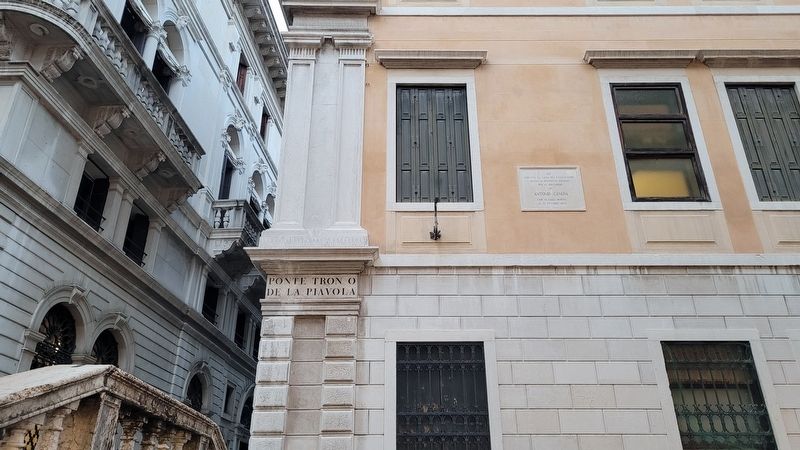
Photographed by James Hulse, March 6, 2024
2. The view of the Antonio Canova Marker along the building.
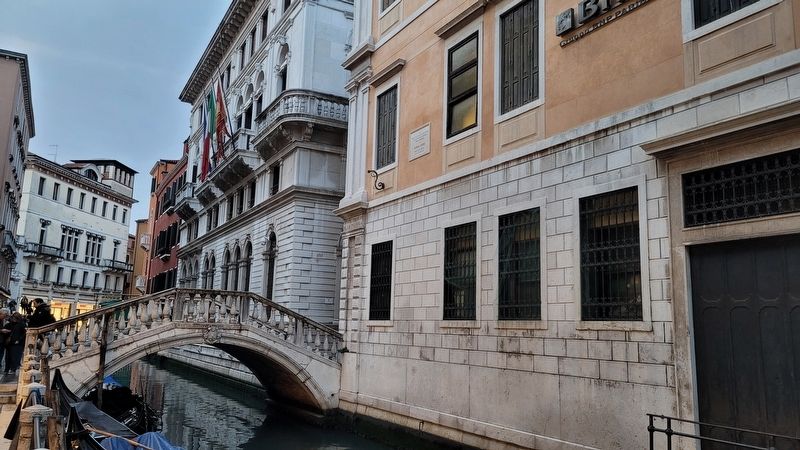
Photographed by James Hulse, March 6, 2024
3. The view of the Antonio Canova Marker along the canal.
Credits. This page was last revised on May 14, 2024. It was originally submitted on May 13, 2024, by James Hulse of Medina, Texas. This page has been viewed 154 times since then and 16 times this year. Photos: 1, 2, 3. submitted on May 14, 2024, by James Hulse of Medina, Texas.
