San Marco in Venezia in Città Metropolitana di Venezia, Venetia, Italy — Southern and Western Europe (Mediterranean)
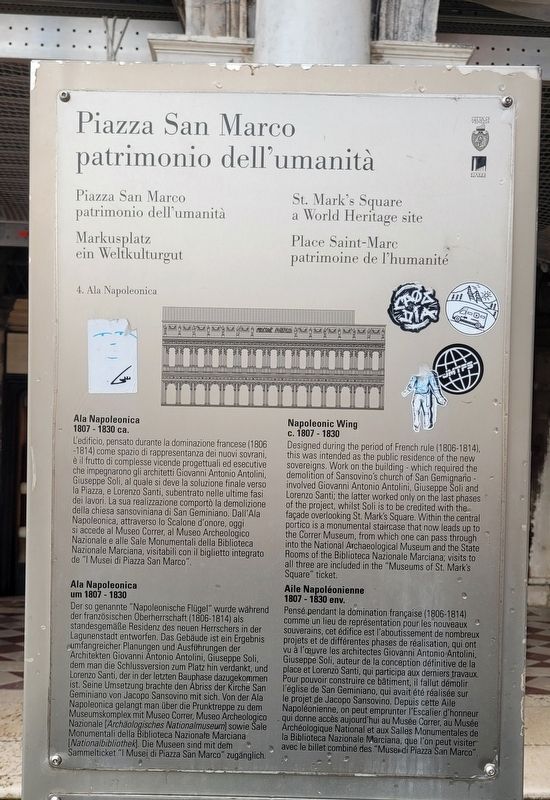
Ala Napoleonica
Piazza San Marco patrimonio dell'umanità
⎯⎯⎯
Napoleonic Wing
St. Mark's Square a World Heritage site
Photographed by James Hulse, March 8, 2024
1. Ala Napoleonica / Napoleonic Wing Marker

Ala Napoleonica
1807-1830 са.
Piazza San Marco patrimonio dell'umanità
L'edificio, pensato durante la dominazione francese (1806-1814) come spazio di rappresentanza dei nuovi sovrani, è il frutto di complesse vicende progettuali ed esecutive che impegnarono gli architetti Giovanni Antonio Antolini, Giuseppe Soli, al quale si deve la soluzione finale verso la Piazza, e Lorenzo Santi, subentrato nelle ultime fasi dei lavori. La sua realizzazione comportò la demolizione della chiesa sansoviniana di San Geminiano. Dall'Ala Napoleonica, attraverso lo Scalone d'onore, oggi si accede al Museo Correr, al Museo Archeologico Nazionale e alle Sale Monumentali della Biblioteca Nazionale Marciana, visitabili con il biglietto integrato de "I Musei di Piazza San Marco".
Napoleonic Wing
c. 1807-1830
St. Mark's Square a World Heritage site
Designed during the period of French rule (1806-1814), this was intended as the public residence of the new sovereigns. Work on the building - which required the demolition of Sansovino's church of San Gemignano - involved Giovanni Antonio Antolini, Giuseppe Soli
this page online
Ala Napoleonica
um 1807-1830
Markusplatz ein Weltkulturgut
Der so genannte "Napoleonische Flügel" wurde während der französischen Oberherrschaft (1806-1814) als standesgemäße Residenz des neuen Herrschers in der Lagunenstadt entworfen. Das Gebäude ist ein Ergebnis umfangreicher Planungen und Ausführungen der Architekten Giovanni Antonio Antolini, Giuseppe Soli, dem man die Schlussversion zum Platz hin verdankt, und Lorenzo Santi, der in der letzten Bauphase dazugekommen ist. Seine Umsetzung brachte den Abriss der Kirche San Geminiano von Jacopo Sansovino mit sich. Von der Ala Napoleonica gelangt man über die Prunktreppe zu dem Museumskomplex mit Museo Correr, Museo Archeologico
Photographed by James Hulse, March 8, 2024
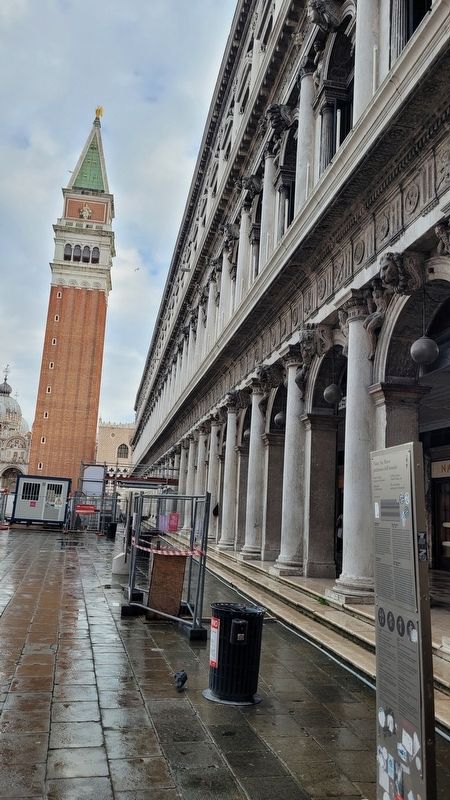
2. The Napoleonic Wing Marker is located in the Piazza San Marcos
Aile Napoléonienne
1807-1830 env.
Place Saint-Marc patrimoine de l'humanité
Pensé pendant la domination française (1806-1814) comme un lieu de représentation pour les nouveaux souverains, cet édifice est l'aboutissement de nombreux projets et de différentes phases de réalisation, qui ont vu à l'œuvre les architectes Giovanni Antonio Antolini, Giuseppe Soli, auteur de la conception définitive de la place et Lorenzo Santi, qui participa aux derniers travaux. Pour pouvoir construire ce bâtiment, il fallut démolir l'église de San Geminiano, qui avait été réalisée sur le projet de Jacopo Sansovino. Depuis cette Aile Napoléonienne, on peut emprunter l'Escalier d'honneur qui donne accès aujourd'hui au Musée Correr, au Musée Archéologique National et aux Salles Monumentales de la Biblioteca Nazionale Marciana, que l'on peut visiter avec le billet combiné des "Musei di Piazza San Marco".
Erected by Città di Venezia. (Marker

Photographed by James Hulse, March 6, 2024
3. The Procuratie - three connected buildings along the perimeter of Piazza San Marcos
Topics. This historical marker is listed in this topic list: Notable Buildings.
Location. 45° 26.021′ N, 12° 20.275′ E. Marker is in Venezia, Veneto (Venetia), in Città Metropolitana di Venezia. It is in San Marco. It is on Piazza San Marco. The marker is located in the southwest section of Piazza San Marcos. Touch for map. Marker is at or near this postal address: Piazza San Marco 72B, Venezia, Veneto 30124, Italy. Touch for directions.

Regionally, it is in Europe, the European Union, the Schengen Area, a coastal Mediterranean country, and the Western World. Historically, it finds itself in what was once the Roman Empire and specifically also the Holy Roman Empire.
Other nearby markers. At least 8 other markers are within walking distance of this marker: Procuratie Vecchie (within shouting distance of this marker); Procuratie Nuove (within shouting distance of this marker); Giovanni Battista Varè (within shouting distance of this marker); Francesco Avesani (within shouting distance of this marker); Giuseppe Sirtori (within shouting distance of this marker); Jacopo Castelli (within shouting distance of this marker); Guglielmo Pepe - Cesare Rossarol - Enrico Cosenza - Carlo Mezzacapo - Girolamo Vllo (within shouting distance of this marker); Alessandro Poerio (within shouting distance of this marker). Touch for a list and map of all markers in Venezia.
Also see . . . Procuratie. Wikipedia
The Procuratie are three connected buildings along the perimeter of Saint Mark's Square in Venice, Italy. Two of the buildings, the Procuratie Vecchie (Old Procuracies) and the Procuratie Nuove (New Procuracies), were constructed by the procurators of Saint Mark, the second-highest dignitaries in the government of the Republic of Venice, who were charged with administering the treasury of the Church of Saint Mark as well as the financial affairs of state wards and trust funds established on behalf of religious and charitable institutions.(Submitted on May 16, 2024, by James Hulse of Medina, Texas.)
Credits. This page was last revised on May 16, 2024. It was originally submitted on May 15, 2024, by James Hulse of Medina, Texas. This page has been viewed 178 times since then and 19 times this year. Photos: 1. submitted on May 15, 2024, by James Hulse of Medina, Texas. 2, 3. submitted on May 16, 2024, by James Hulse of Medina, Texas.
