Cordele in Crisp County, Georgia — The American South (South Atlantic)
Boeing B-29A Superfortress
| — | Georgia Veterans State Park | — |
Photographed by Brandon D Cross
1. Boeing B-29A Superfortress Marker
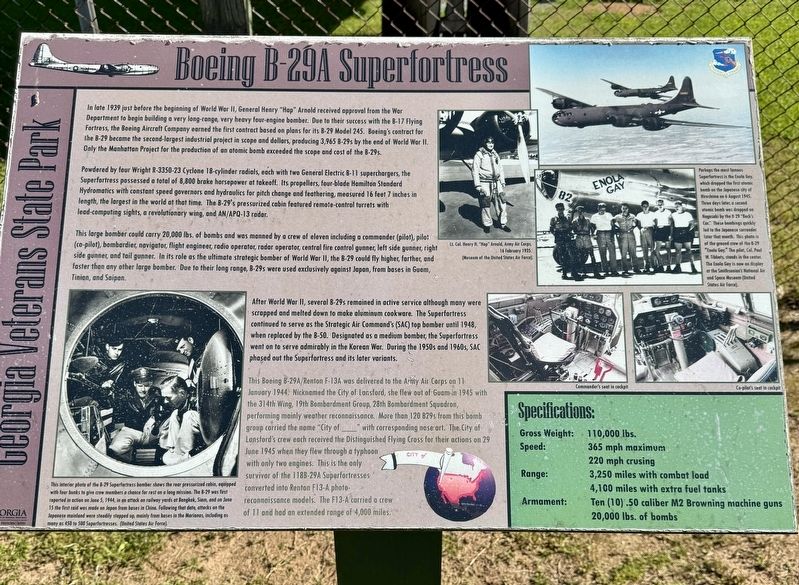
Powdered by four Wright R-3350-23 Cyclone 18-cylinder radials, each with two General Electric B-11 superchargers, the Superfortress possessed a total of 8,800 brake horsepower at takeoff. Its propellers, four-blade Hamilton Standard Hydromatics with constant speed governors and hydraulics for pitch change and feathering, measured 16 feet 7 inches in length, the largest in the world at that time. The B-29's pressurized cabin featured remote-control turrets with lead-computing sights, a revolutionary wing, and AN/APQ-13 radar.
This large
this page online
After World War II, several B-29s remained in active service although many were scrapped and melted down to make aluminum cookware. The Superfortress continued to serve as the Strategic Air Command's (SAC) top bomber until 1948, when replaced by the B-50. Designated as a medium bomber, the Superfortress went on to serve admirably in the Korean War. During the 1950s and 1960s, SAC phased out the Superfortress and its later variants.
This Boeing B-29A/Renton F-13A was delivered to the Army Air Corps on 11 January 1944. Nicknamed the City of Lansford, she flew out of Guam in 1945 with the 314th Wing, 19th Bombardment

Photographed by Brandon D Cross
2. Boeing B-29A Superfortress Marker
Specifications:
Gross Weight: 110,000 lbs.
Speed: 365 mph maximum
220 mph cruising
Range: 3,250 miles with combat load
4,100 miles with extra fuel tanks
Armament: Ten(10) .50 caliber M2 Browning machine guns
20,000 lbs. of bombs of bombs
(captions)
This interior photo of the B-29 Superfortress bomber shows the rear pressurized cabin, equipped with four bunks to give crew members a chance for rest on a long mission. The B-29 was first reported in action on June 5, 1944, in an attack on railway yards at Bangkok, Siam, and on June 15 the first raid was made on Japan from bases in China. Following that date, attacks on the Japanese mainland were steadily stepped up, mainly from bases in the Marianas, including as many as 450 to 500 Superfortresses. (United States Air Force).
Lt. Col. Henry H. "Hap" Arnold, Army Air Corps,16 February 1935. (Museum of the United States Air Force).
Perhaps the most famous Superfortress is the Enola Gay, which dropped the first atomic bomb on the Japanese city of Hiroshima on 6 August 1945. Three days later, a second atomic bomb was dropped on Nagasaki by the B-29 “Bock's Car." These bombings quickly led to the Japanese surrender later that month. This photo is of the ground crew of the B-29 "Enola Gay." The pilot, Col. Paul W. Tibbets, stands in the center. The Enola Gay is now on display at the Smithsonian's National Air and Space Museum (United States Air Force).
Commander’s seat cockpit
Co-pilot’s seat in cockpit
Erected by Georgia Veterans State Park.
Topics. This historical marker is listed in these topic lists: Air & Space • War, World II.
Location. 31° 57.529′ N, 83° 54.688′ W. Marker is in Cordele, Georgia, in Crisp County. It can be reached from Cannon Road 0.6 miles south of U.S. 280, on the right when traveling south. Located at the Georgia Veterans State Park Visitor Center. Touch for map. Marker is at or near this postal address: 2459 US-280 W, Cordele GA 31015, United States of America. Touch for directions.

Regionally, this marker is in the Piedmont. It is also in the American South and specifically in the Deep South. Globally, it is in North America, the Western Hemisphere, the Western World, and the Anglosphere. Historically, it finds itself in what was once the territory of the Mississippian Culture, one of the original Thirteen Colonies, one of the Confederate States of America, and the Antebellum South.
Other nearby markers. At least 8 other markers are within walking distance of this marker: Lockheed T-33 Shooting Star (a few steps from this marker); North American FJ-4B Fury (a few steps from this marker); 114th Aviation Company (within shouting distance of this marker); M47 Patton Medium Tank (within shouting distance of this marker); Bell UH-ID Iroquois “Huey” (within shouting distance of this marker); M4A2E8 Sherman Medium Tank (within shouting distance of this marker); LVTP-5A1 Landing Vehicle Tracked Personnel (within shouting distance of this marker); LVT-3C Bushmaster (within shouting distance of this marker). Touch for a list and map of all markers in Cordele.
Also see . . . Boeing B-29 Superfortress. (Submitted on May 25, 2024, by Brandon D Cross of Flagler Beach, Florida.)
Credits. This page was last revised on May 27, 2024. It was originally submitted on May 25, 2024, by Brandon D Cross of Flagler Beach, Florida. This page has been viewed 526 times since then and 68 times this year. Photos: 1, 2. submitted on May 25, 2024, by Brandon D Cross of Flagler Beach, Florida. • Bernard Fisher was the editor who published this page.
