
Schoharie in Schoharie County, New York — The American Northeast (Mid-Atlantic)
Old Stone Fort Museum
| — | Revolutionary War Heritage Trail | — |
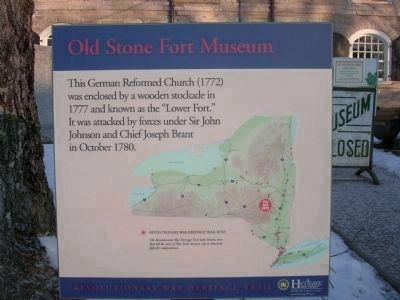
Photographed by Howard C. Ohlhous, March 29, 2008
1. Old Stone Fort Museum
Revolutionary War Haritage Trail Marker
Revolutionary War Haritage Trail Marker
The Revolutionary War Heritage Trail links historic sites that tell the story of New York's decisive role in America's fight for independance.
This German Reformed Church (1772)
was enclosed by a wooden stockade in
1777 and known as the "Lower Fort."
It was attacked by forces under Sir John
Johnson and Chief Joseph Brant
in October 1780.
Erected by Heritage New York.
Topics. This historical marker is listed in these topic lists: Notable Buildings • Patriots & Patriotism • Religion & Religious Structures • War, US Revolutionary. A significant historical month for this entry is October 1780.
Location. 42° 40.625′ N, 74° 18.109′ W. Marker is in Schoharie, New York, in Schoharie County. It is on Fort Road, on the right when traveling south. This Revolutionary War Heritage Trail Marker is posted beside the sidewalk leading to the museum door from the road. Touch for map. Marker is at or near this postal address: 145 Fort Road, Schoharie NY 12157, United States of America. Touch for directions.

Regionally, this marker is in Upstate New York and in the Mohawk Valley. It is also in the American Northeast, in the Mid-Atlantic, in Appalachia, and specifically in Northern Appalachia. Globally, it is in North America, the Western Hemisphere, the Western
this page online
Other nearby markers. At least 8 other markers are within walking distance of this marker: War in Schoharie County (a few steps from this marker); Revolution in the Mohawk Valley (a few steps from this marker); Memorial to David Ellerson (a few steps from this marker); Colonel John Harper (a few steps from this marker); David Williams Memorial (within shouting distance of this marker); David Williams (within shouting distance of this marker); Civil War Nurse (within shouting distance of this marker); Col. Peter Vroman (about 400 feet away, measured in a direct line). Touch for a list and map of all markers in Schoharie.
Regarding Old Stone Fort Museum. The Old Stone Fort was originally constructed as the Reformed Dutch Church in 1772. The building remains a rare and distinguished example of vernacular stone masonry architecture of the colonial period in the Schoharie Valley. Fortified during the Revolutionary War, the church building became the principle
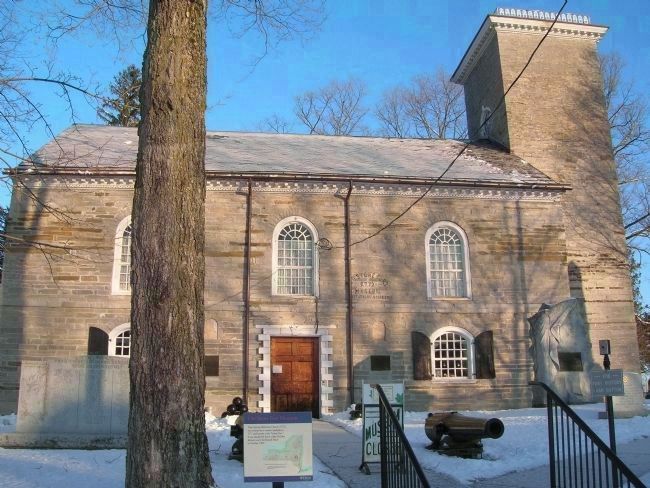
Photographed by Howard C. Ohlhous, March 29, 2008
2. Old Stone Fort Museum Marker
The Old Stone Fort Museum complex celebrates and preserves the rich, historic legacy of New York's beautiful Schoharie Valley. Buildings include an early 1700's home, 1780's Dutch barn, 1830's law office and 1890's one-room school as well as the 1772 stone church that was fortified and attacked by Tory, British & Indian forces in 1780.
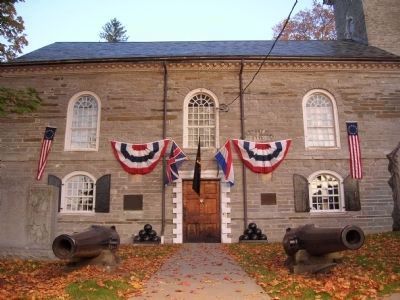
Photographed by Howard C. Ohlhous, October 12, 2008
3. Old Stone Fort Museum
Also see . . . About the Old Stone Fort. (Submitted on November 22, 2009, by Howard C. Ohlhous of Duanesburg, New York.)
Additional keywords. Burning of the Valley Raid
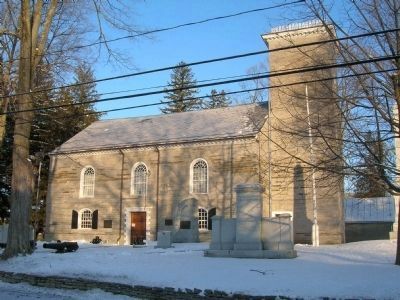
Photographed by Howard C. Ohlhous, March 29, 2008
4. Old Stone Fort Museum
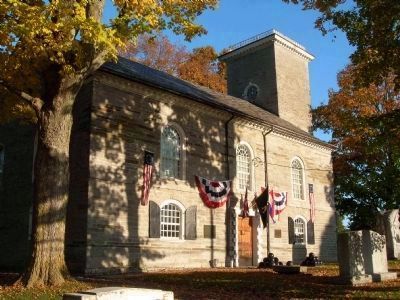
Photographed by Howard C. Ohlhous, October 12, 2008
5. Old Stone Fort Days
Each autumn the Old Stone Fort wears bunting while hosting Stone Fort Days, featuring a Revolutionary War encampment, battle reenactments, historic and educational demonstations and much, much more.
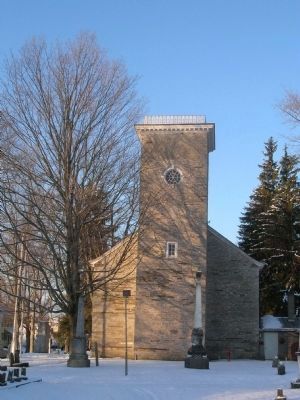
Photographed by Howard C. Ohlhous, March 29, 2008
6. Old Stone Fort Museum
The northern gable end features a three story stone tower.
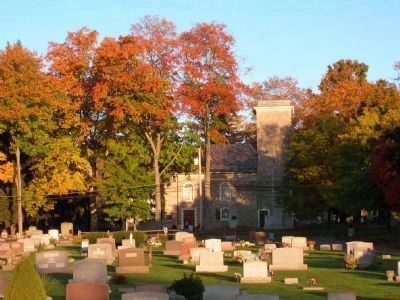
Photographed by Howard C. Ohlhous, October 11, 2008
7. Old Stone Fort Museum Cemetery
The Old Stone Fort seen from the cemetery across Fort Road from the museam. The Old Stone Fort has cemeteries on all 4 sides.
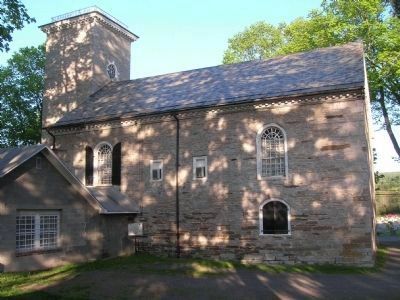
Photographed by Howard C. Ohlhous, May 13, 2009
8. Old Stone Fort Museum
This is the rear (west) side of the building which faces away from the roadway.
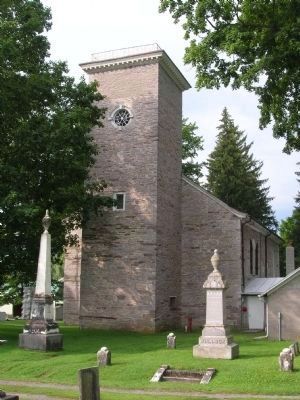
Photographed by Howard C. Ohlhous, August 2, 2008
9. Old Stone Fort Museum
A three-story tower, of approximately 16 feet square, is appended to the north gable end. A wood belfry and tall spire that originally surmounted the tower were removed in 1830.
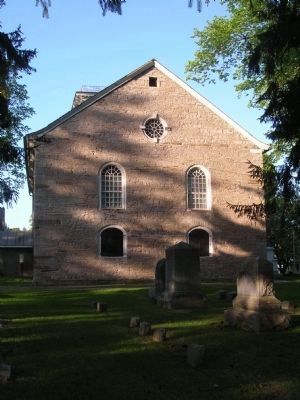
Photographed by Howard C. Ohlhous, May 13, 2008
10. Old Stone Fort Museum
Round windows incorporating keystones are located in the south gable end of the main building as well as the north and south sides of the stone tower.
Photographed by Howard C. Ohlhous, May 13, 2008
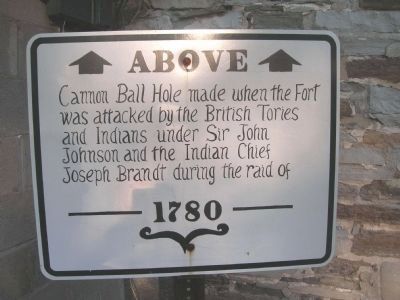
11. Canon Ball Damage Above
This sign behind the building points out a scar in the purlin of the west wall which is by tradition the mark of a cannonball fired from a small field piece used by the Tory attackers on October 17, 1780.
Photographed by Howard C. Ohlhous, June 13, 2008
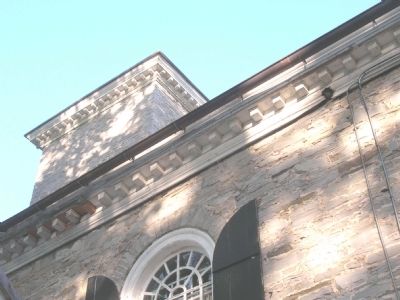
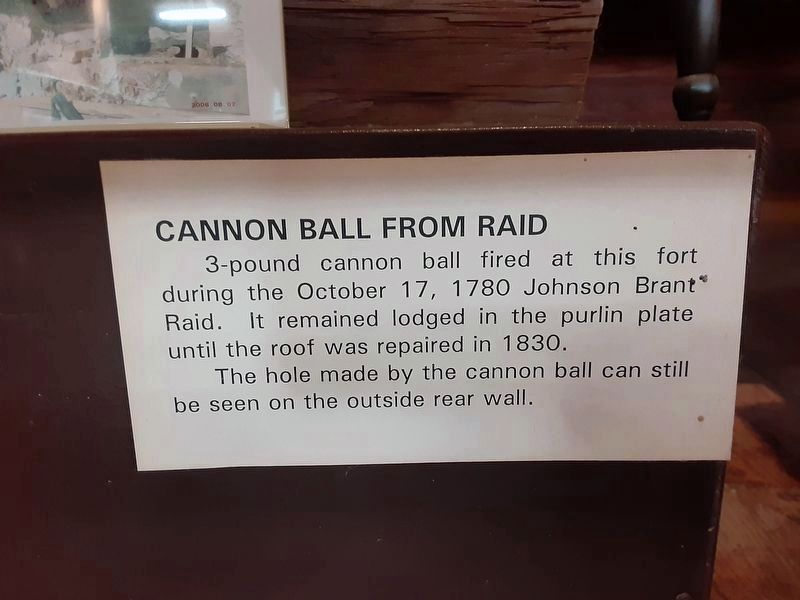
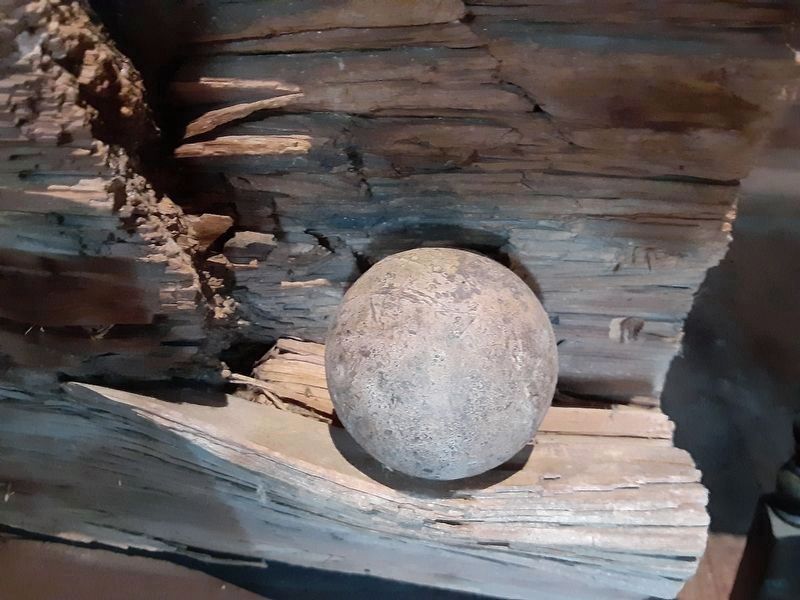
12. Canon Ball Damage
The hole in the trim moulding in the upper right was made by a 3-pound cannon ball fired at the fort during the October 17, 1780 raid. The cannon ball remained lodged in the purlin plate untill the roof was repaired in 1830. The canon ball is now on display in the museum.
Photographed by Howard C. Ohlhous, June 18, 2008
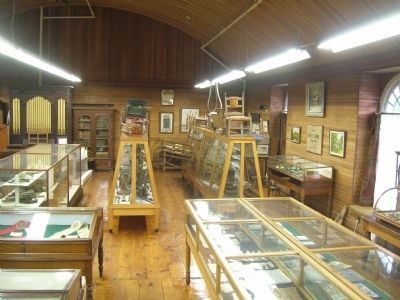
13. Old Stone Fort Museum
This is a portion of the museum's second floor. The museum is a repository and exhibit space for an extensive collection of relics, artifacts and documents relating to the history of the Old Stone Fort and Schoharie.
Photographed by Howard C. Ohlhous, June 18, 2008
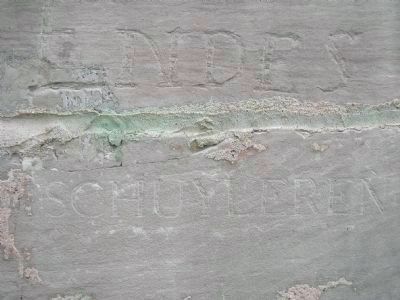
14. Founders Names
The stone for the chuch was taken from several local quarries in 1772. The thick walls were laid up by the Schoharie settlers who were overseen by a master mason, John Schuyler. The names of 49 settlers who helped build the church are recorded as chiseled inscriptions visible on the exterior stone walls. Several black spaces formerly bore the names of others who remained Loyalist during the Revolutionary War; these were subsequently chiseled away by their former Schoharie neighbors.
Photographed by Scott J. Payne, September 17, 2022
15. Old Stone Fort Museum Marker
Photographed by Scott J. Payne, September 17, 2022
16. Old Stone Fort Museum Marker
Credits. This page was last revised on September 18, 2022. It was originally submitted on November 22, 2009, by Howard C. Ohlhous of Duanesburg, New York. This page has been viewed 2,637 times since then and 138 times this year. Photos: 1, 2, 3, 4, 5, 6, 7, 8, 9, 10, 11, 12, 13, 14. submitted on November 22, 2009, by Howard C. Ohlhous of Duanesburg, New York. 15, 16. submitted on September 18, 2022, by Scott J. Payne of Deposit, New York. • Kevin W. was the editor who published this page.
