
Lincoln in Lincolnshire, England, United Kingdom — Northwestern Europe (the British Isles)
Historic Lincoln
Lincoln's Timeline
Photographed by Ray Gurganus, April 15, 2024
1. Historic Lincoln Marker
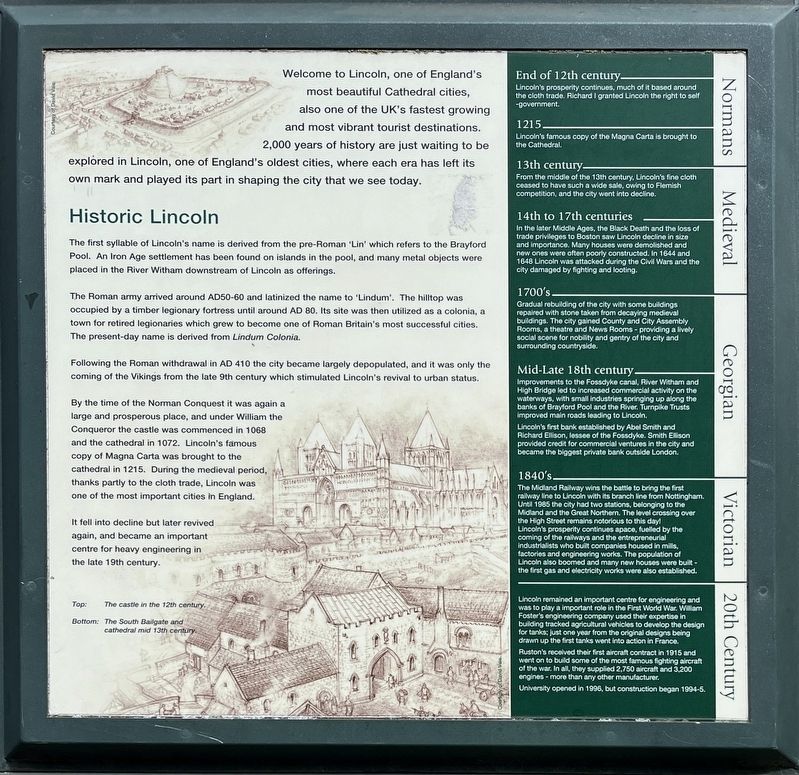
Historic Lincoln
The first syllable of Lincoln's name is derived from the pre Roman 'Lin' which refers to the Brayford Pool. An Iron Age settlement has been found on islands in the pool, and many metal objects were placed in the River Witham downstream of Lincoln as offerings.
The Roman army arrived around AD50-60 and latinized the name to 'Lindum'. The hilltop was occupied by a timber legionary fortress until around AD 80. Its site was then utilized as a colonia, a town for retired legionaries which grew to become one of Roman Britain's most successful cities. The present-day name is derived from Lindum Colonia.
Following the Roman withdrawal in AD 410 the city became largely depopulated, and it was only the coming of the Vikings from the late 9th century which stimulated Lincoln's
this page online
By the time of the Norman Conquest it was again a large and prosperous place, and under William the Conqueror the castle was commenced in 1068 and the cathedral in 1072. Lincoln's famous copy of Magna Carta was brought to the cathedral in 1215. During the medieval period, thanks partly to the cloth trade, Lincoln was one of the most important cities in England.
It fell into decline but later revived. again, and became an important centre for heavy engineering in the late 19th century.
End of 12th Century
Lincoln's prosperity continues, much of it based around the cloth trade. Richard I granted Lincoln the right to self-government.
1215
Lincoln's famous copy of the Magna Carta is brought to the Cathedral.
13th century
From the middle of the 13th century, Lincoln's fine cloth ceased to have such a wide sale, owing to Flemish competition, and the city went into decline.
14th to 17th centuries
In the later Middle Ages, the Black Death and the loss of trade privileges to Boston saw Lincoln decline in size and importance. Many houses were demolished and new ones were often poorly constructed.
Photographed by Ray Gurganus, April 15, 2024
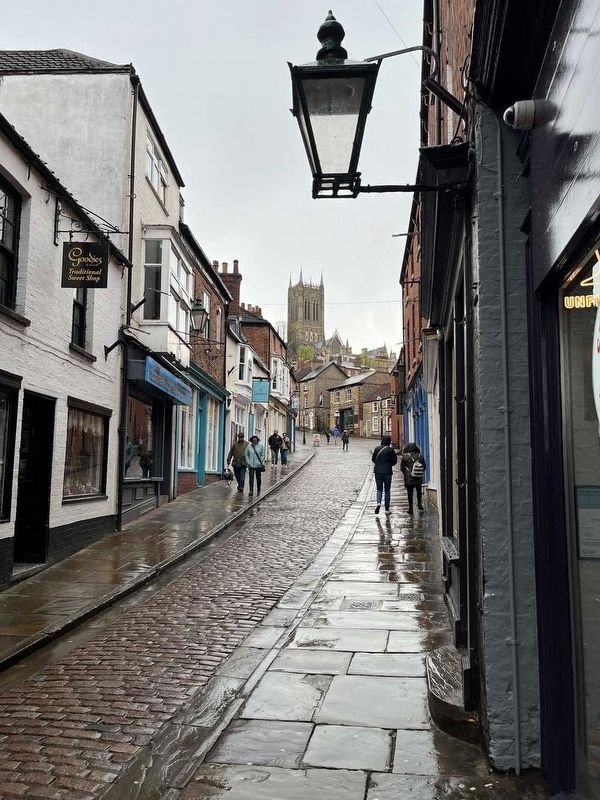
2. The Strait, Lincoln
1700's
Gradual rebuilding of the city with some buildings repaired with stone taken from decaying medieval buildings. The city gained County and City Assembly Rooms, a theatre and News Rooms - providing a lively social scene for nobility and gentry of the city and surrounding countryside.
Mid-Late 18th century
Improvements to the Fossdyke canal, River Witham and High Bridge led to increased commercial activity on the waterways, with small industries springing up along the banks of Brayford Pool and the River. Turnpike Trusts improved main roads leading to Lincoln.
Lincoln's first bank established by Abel Smith and Richard Ellison, lessee of the Fossdyke. Smith Ellison provided credit for commercial ventures in the city and became the biggest private bank outside London.
1840's
The Midland Railway wins the battle to bring the first railway line to Lincoln with its branch line from Nottingham. Until 1985 the city had two stations, belonging to the Midland and the Great Northern. The level crossing over the High Street
circa 1925
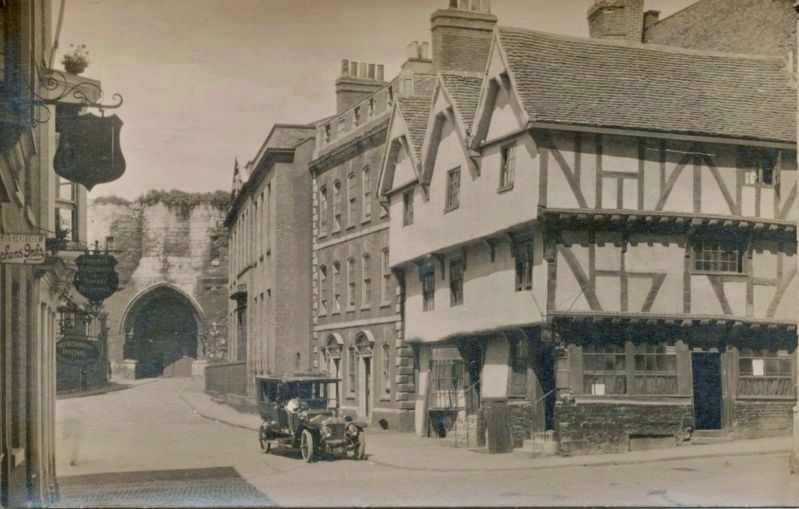
3. Lincoln - looking west from the marker site (albeit about a century earlier), towards East Gate
Ruston's received their first aircraft contract in 1915 and went on to build some of the most famous fighting aircraft of the war. In all, they supplied 2,750 aircraft and 3,200 engines-more than any other manufacturer.
University opened in 1996, but construction began 1994-5.
Topics. This historical marker is listed in these topic lists: Industry & Commerce • Settlements & Settlers.
Location. 53° 14.064′ N, 0° 32.307′ W. Marker is in Lincoln, England, in Lincolnshire. It is on Exchequer Gate, on the right when traveling west. Touch for map. Marker is at or near this postal address: 1-3 Exchequer Gate, Lincoln, England LN1 3AR, United Kingdom. Touch for directions.

Regionally, this marker is in England’s Midlands. Globally, it is on the Atlantic Ocean, in the North Atlantic Region, in Europe, in Atlantic Europe, on one of the British Isles, in the Western World, and in the Anglosphere. Historically, it finds itself in what was once the Roman Empire.
Other nearby markers. At least 8 other markers are within walking distance of this marker: Welcome to the City of Lincoln (here, next to this marker); Lincoln's Character Quarters (here, next to this marker); Magna Carta (here, next to this marker); Medieval Bishop's Palace (here, next to this marker); Castle Hill (here, next to this marker); Welcome to the Cathedral Quarter (here, next to this marker); Leigh-Pemberton House (a few steps from this marker); The Roman Upper South Gate (about 90 meters away, measured in a direct line). Touch for a list and map of all markers in Lincoln.
Credits. This page was last revised on June 1, 2024. It was originally submitted on May 28, 2024, by Ray Gurganus of Washington, District of Columbia. This page has been viewed 169 times since then and 23 times this year. Photos: 1, 2. submitted on May 28, 2024, by Ray Gurganus of Washington, District of Columbia. 3. submitted on June 1, 2024. • Andrew Ruppenstein was the editor who published this page.
Editor’s want-list for this marker. photo of the marker within its surroundings • Can you help?
