Huntsville in Madison County, Alabama — The American South (East South Central)
NASA Lunar Module (LM)
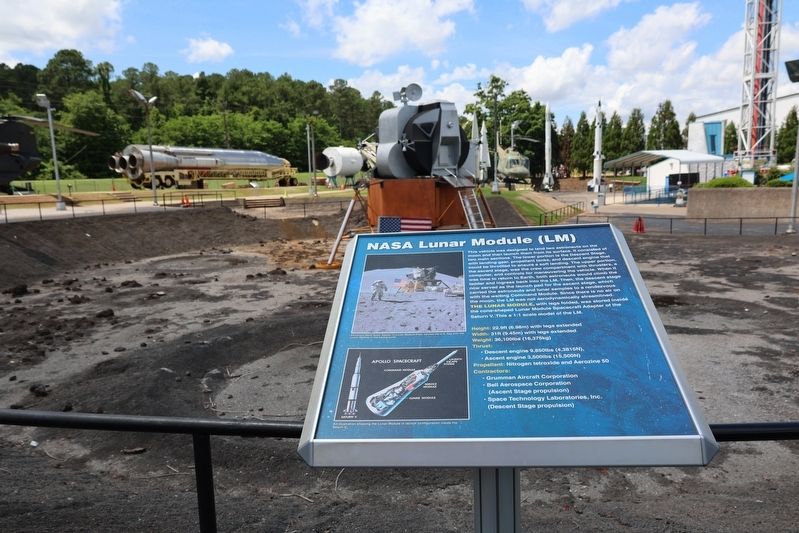
Photographed by Sandra Hughes Tidwell, May 20, 2024
1. NASA Lunar Module (LM) Marker
This vehicle was designed to land two astronauts on the moon and then launch them from its surface. It consisted of two main sections. The lower portion is the Descent Stage, with landing gear, propellant tanks, and a descent engine that could be throttled to ensure a soft landing. The upper portion, the ascent stage, was the crew compartment with thrusters, a computer, and controls for maneuvering the vehicle. When it was time to return to Earth, both astronauts would climb the ladder and ingress back into the LM. Then, the descent stage now served as the launch pad for the ascent stage, which carried the astronauts and lunar samples to a rendezvous with the waiting Command Module. Since there was no air on the moon, the LM was not aerodynamically streamlined. The Lunar Module, with legs folded, was stored inside the cone-shaped Lunar Module Spacecraft Adapter of the Saturn V. This a 1:1 scale model of the LM
Height: 22.9ft (6.98) with legs extended
Width: 31ft (9.45m) with legs extended
Weight: 36,100lbs (16.375kg)
Thrust:
• Descent engine 9,850 (4,3815N)
• Ascent engine 3,500lbs (15,500N)
Propellant:
this page online
Contractors:
• Grumman Aircraft Corporation
• Bell Aerospace Corporation (Ascent Stage propulsion)
• Space Technology Laboratories Inc. (Descent Stage propulsion)
Topics. This historical marker is listed in these topic lists: Air & Space • Exploration.
Location. 34° 42.625′ N, 86° 39.299′ W. Marker is in Huntsville, Alabama, in Madison County. It is on Tranquility Base west of Old Madison Pike. Touch for map. Marker is at or near this postal address: 1 Tranquility Base, Huntsville AL 35805, United States of America. Touch for directions.

Regionally, this marker is in North Alabama. It is also in the American South, specifically in the Deep South, in Appalachia, and specifically in Southern Appalachia. Globally, it is in North America, a Gulf of Mexico state, the Western Hemisphere, the Western World, and the Anglosphere. Historically, it finds itself in what was once the original Cherokee Nation, the territory of the Mississippian Culture, one of the Confederate States of America, and the Antebellum South.
Other nearby markers. At least 8 other markers are within walking distance of this marker: Cosmic Apple Tree (within shouting distance of this marker); Colbert Fossil Plant (within shouting distance of this marker); TVA Coverage Area (within shouting distance of this marker); CH-47D Chinook Helicopter (within shouting distance of this marker); Space Shuttle Main Engine/RS-25 (within shouting distance of this marker); U.S. Air Force SM-65 Atlas-F (within shouting distance of this marker); NASA / U.S. Geological Survey (within shouting distance of this marker); U.S. Army PGM-11 Redstone (within shouting distance of this marker). Touch for a list and map of all markers in Huntsville.
Also see . . . 50 Years Ago: The Apollo Lunar Module. Lunar Module (LM), built by the Grumman Corporation in Bethpage, NY, was the vehicle that would take two astronauts down to the lunar surface and return them to the waiting Command Module in lunar orbit. Before NASA could declare the LM safe for astronauts to fly, however, it had to be tested in Earth orbit without a crew. Grumman delivered the first flight unit, LM-1, to the Kennedy Space Center in June 1967 where workers stacked it on its booster in November. As a weight-saving measure, and because it was not planned to land anywhere, this spacecraft didn’t carry any landing legs. During the flight of Apollo 5, LM-1 would simulate the steps of a lunar landing mission, testing the engines of both the descent stage, used to land the crew on the Moon, and the ascent stage, used to return them back into lunar orbit. (Submitted on May 28, 2024, by Sandra Hughes Tidwell of Killen, Alabama, USA.)
Credits. This page was last revised on November 20, 2024. It was originally submitted on May 28, 2024, by Sandra Hughes Tidwell of Killen, Alabama, USA. This page has been viewed 293 times since then and 21 times this year. Photo 1. submitted on May 28, 2024, by Sandra Hughes Tidwell of Killen, Alabama, USA. • James Hulse was the editor who published this page.
