Riad Zitoun Jdid in Marrakesh, Marrakesh-Safi, Morocco — Africa (Northern Africa)
Bahia Palace
Architectural masterpiece of the Echerki Al-Bukhari family

Photographed by J. Makali Bruton, May 19, 2024
1. Bahia Palace Marker
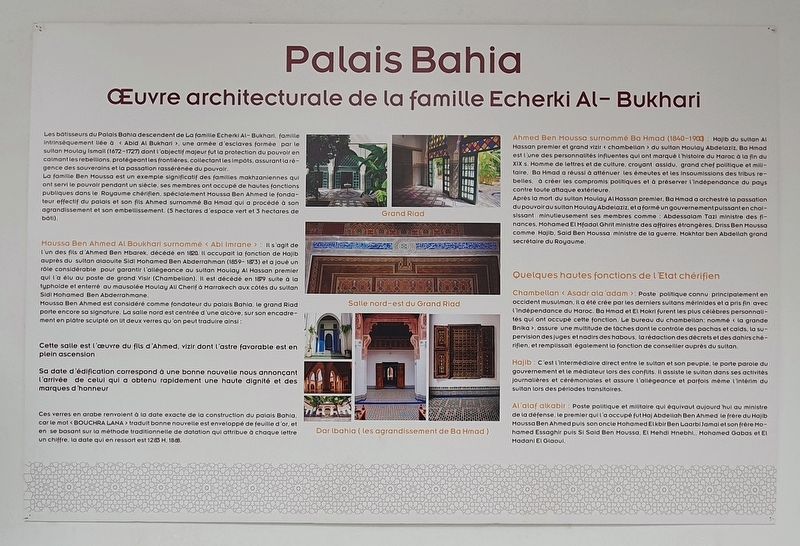
Bahia Palace
The builders of Bahia Palace are descendants of the Echerki Al-Bukhari family, a family intrinsically linked to "Abid Al Bukhari," an army of slaves formed by Sultan Moulay Ismail (1672-1727) whose main objective was to protect the power by calming the repeated desertions of tribes, protecting the borders, collecting taxes, ensuring the regency of the sovereigns, and facilitating a peaceful transition of power. The Ben Moussa family is a significant example of the Makhzan families who served the power for a century. Its members held high public positions in the Cherifian Kingdom, especially Moussa Ben Ahmed, the effective founder of the palace, and his son Ahmed, nicknamed Ba Hmad, who expanded and embellished it. (5 hectares of green space and 3 hectares of built-up area).
Moussa Ben Ahmed Al Boukhari, nicknamed "Abi Imrane," was one of the sons of Ahmed Ben Mbarek, who died in 1820. He held the position of Hajib to the Alaouite Sultan Sidi Mohamed Ben Abderrahman (1859-1873) and played a considerable role in ensuring the allegiance of Sultan Moulay Al Hassan I, who elected him as Grand Vizier
this page online
"This room is the work of Ahmed's son, a vizier whose favorable star is rising."
"Its construction date corresponds to good news announcing the arrival of someone who quickly obtained high dignity and marks of honor."
These Arabic poetery refer to the exact date of the construction of Bahia Palace, as the word "bouchra lana" (good news) is wrapped in gold leaf. Based on the traditional dating method that assigns a number to each letter, the resulting date is 1283 H. 1868.
Ahmed Ben Moussa, nicknamed Ba Hmad (1840-1900), was the Hajib of Sultan Al Hassan I and Grand Vizier (Chamberlain) of Sultan Moulay Abdelaziz. Ba Hmad is one of the influential figures who marked the history of Morocco towards the end of the 19th century. A man
Photographed by J. Makali Bruton, May 19, 2024
2. Bahia Palace Marker
Palais de Bahia Marker - French version
After the death of Sultan Moulay Al Hassan I, Ba Hmad orchestrated the transition of power to Sultan Moulay Abdelaziz and formed a powerful government by carefully choosing its members, such as Mr. Abdessalam Tazi as Minister of Finance, Mr. Mohamed El Mfadal Ghrit as Minister of Foreign Affairs, Mr. Driss Ben Moussa as Hajib, Mr. Said Ben Moussa as Minister of War, and Mr. Mokhtar ben Abdellah as Grand Secretary of the Kingdom.
Some high offices of the Cherifian State
Chamberlain "Asadrala 'adam": Political position known mainly in the Muslim West, it was created by the last Merinid sultans and ended with the advent of the French protectorate and the independence of Morocco. Ba Hmad and El Mokri were the most famous personalities who held this position. Chamberlain's office: named "the great Bnika", performs a multitude of tasks including the control of the pashas and
Photographed by J. Makali Bruton, May 19, 2024
3. Bahia Palace Marker
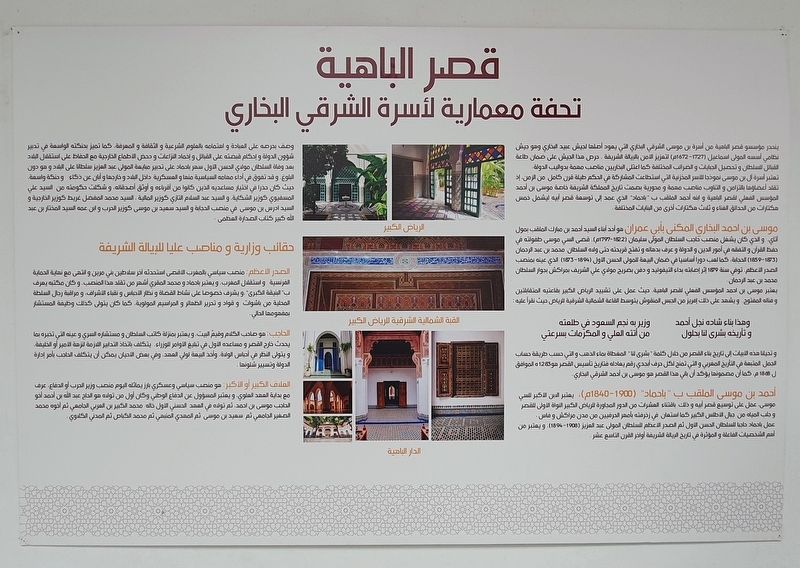
قصر الباهية Marker - Arabic version
Hajib: He is the direct intermediary between the sultan and his people, the government spokesman and the mediator in conflicts. He assists the sultan in his daily and ceremonial activities and ensures allegiance and sometimes even acts as Interim sultan during transitional periods.
Al'alaf alkabir: Political and military post which today is equivalent to the Minister of Defense, the first who occupied it was Haj Abdellah Ben Ahmed the brother of Hajib Moussa Ben Ahmed then his uncle Mohamed Elkbir Ben Laarbi Jamal and his brother Mohamed Essaghir then Si Said Ben Moussa, El Mehdi Mnebhi, Mohamed Gabas and El Madani El Glaoul.
Captions
Grand Riad
The northeast room of grand Riad
Dar Ibahia (Ba Hmad enlargements)
Topics. This historical marker is listed in this topic list: Notable Buildings. A significant historical year for this entry is 1820.
Location. 31° 37.286′ N, 7° 58.958′ W. Marker is in Marrakesh, Marrakesh-Safi. It is in Riad Zitoun Jdid.
Photographed by J. Makali Bruton, May 19, 2024
4. Bahia Palace Marker
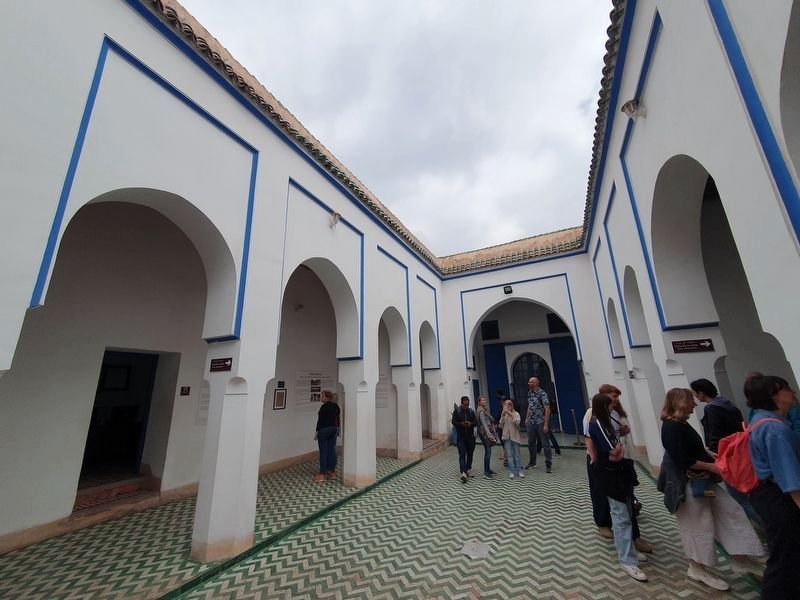
The marker is in the first courtyard after entering the Bahia Palace.

Regionally, it is in Africa, North Africa, The Maghreb, and in a coastal Mediterranean country. Historically, it finds itself in what was once Portuguese colonies, a Spanish colony, and specifically a French colony.
Other nearby markers. At least 8 other markers are within walking distance of this marker: A different marker also named Bahia Palace (a few steps from this marker); The Small Riad (a few steps from this marker); The Small Courtyard (within shouting distance of this marker); The Grand Riad (about 90 meters away, measured in a direct line); a different marker also named Bahia Palace (about 150 meters away); Place Qzadriya (approx. 0.2 kilometers away); Badia Palace (approx. 0.4 kilometers away); Room of Lalla Massaouda (approx. 0.7 kilometers away). Touch for a list and map of all markers in Marrakesh.
Credits. This page was last revised on August 17, 2024. It was originally submitted on May 31, 2024, by J. Makali Bruton of Washington, District of Columbia. This page has been viewed 376 times since then and 116 times this year. Photos: 1, 2, 3, 4. submitted on May 31, 2024, by J. Makali Bruton of Washington, District of Columbia.
