Swatara Township in Jonestown in Lebanon County, Pennsylvania — The American Northeast (Mid-Atlantic)
Inwood Iron Bridge
At Swatara Gap
| — | Historical Truss Information | — |
Photographed by William Pope, May 27, 2024
1. Innwood Iron Bridge Marker
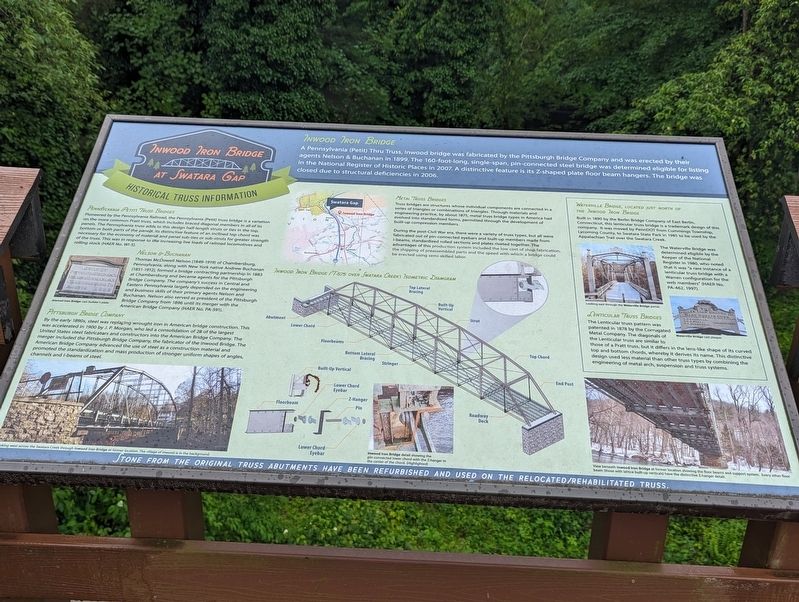
A Pennsylvania (Petit) Thru Truss, Inwood bridge was fabricated by the Pittsburgh Bridge Company and was erected by their agents Nelson & Buchanan in 1899. The 160-foot-long, single-span, pin connected steel bridge was determined eligible for listing in the National Register of Historic Places in 2007. A distinctive feature is its Z-shaped plate floor beam hangers. The bridge was closed due to structural deficiencies in 2006.
Pennsylvania (Petit) Truss Bridges
Pioneered by the Pennsylvania Railroad, the Pennsylvania (Petit) truss bridge is a variation on the more common Pratt truss, which includes braced diagonal members in all of its panels. The Pennsylvania truss adds to this design half-length struts or ties in the top, bottom or both parts of the panels. Its distinctive feature of an inclined top chord was necessary for the economy of material and panel sub-ties or sub-struts for greater strength of the truss. This was in response to the increasing live loads of railroad locomotives and rolling stock. (HAER No. WI-5).
Nelson & Buchanan
Thomas McDowell Nelson (1849-1919) of Chambersburg, Pennsylvania
this page online
Pittsburgh Bridge Company
By the early 1890s, steel was replacing wrought iron in American bridge construction. This was accelerated in 1900 by J.P. Morgan, who lead a consolidation of 28 of the largest United States steel fabricators and constructors into the American Bridge Company. The merger included the Pittsburgh Bridge Company, the fabricator of the Inwood Bridge. The American Bridge Company advanced the use of steel as a construction material and promoted the standardization and mass production of stronger uniform shapes of angles, channels and I-beams of steel.
Metal Truss Bridges
Truss bridges are structures whose individual components are connected
Photographed by William Pope, May 27, 2024
2. Inwood Iron Bridge Marker
During the post-Civil War era, there were a variety of truss types, but all were fabricated out of pin-connected eyebars and built-up members made from I-beams, standardized rolled sections and plates riveted together. The advantages of this production system included the low cost of shop fabrication, the shipping of preassembled parts and the speed with which a bridge could be erected using semi-skilled labor.
Waterville Bridge, located just north of the Inwood Iron Bridge
Built in 1890 by the Berlin Bridge Company of East Berlin, Connecticut, this lenticular truss bridge is a trademark design of this company. It was moved by PennDOT from Cummings Township, Lycoming County, to Swatara State Park in 1985 to be used by the Appalachian Trail over the Swatara Creek.
The Waterville Bridge was determined eligible by the Keeper of the National Register in 1980, who noted that it was "a

Photographed by William Pope, May 27, 2024
3. Inwood Iron Bridge Marker
Lenticular Truss Bridges
The Lenticular truss pattern was patented in 1878 by the Corrugated Metal Company. The diagonals of the Lenticular truss are similar to those of a Pratt truss, but it differs in the lens-like shape of its curved top and bottom chords, whereby it derives its name. This distinctive design used less material than other truss types by combining the engineering of metal arch, suspension and truss systems.
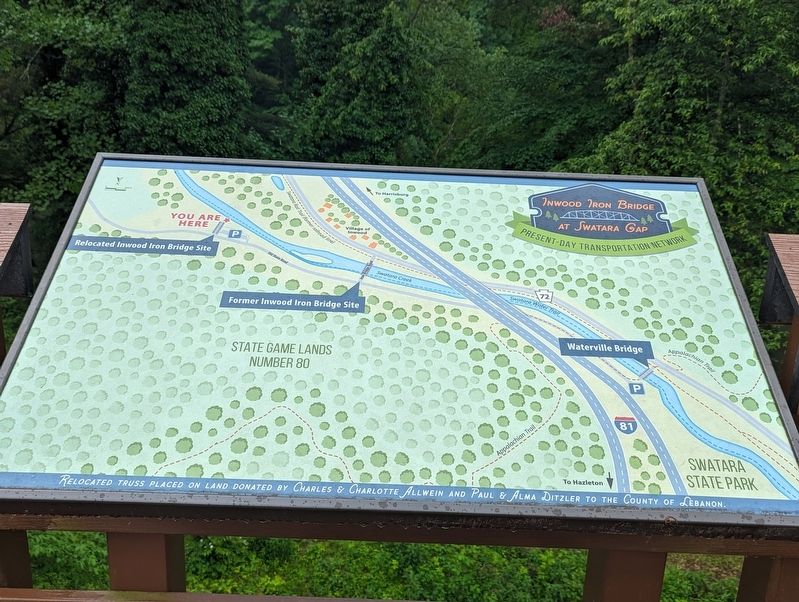
Stone from the original truss abutments have been refurbished and used on the relocated/rehabilitated truss.
Topics. This historical marker is listed in these topic lists: Bridges & Viaducts • Industry & Commerce. A significant historical year for this entry is 1899.
Location. 40° 28.54′ N, 76° 31.076′ W. Marker is in Jonestown, Pennsylvania, in Lebanon County. It is in Swatara Township. It is on Old State Road 0.3 miles east of Iron Bridge Road, on the right when traveling east. This marker is located at the Inwood Iron Bridge Park. Touch for map. Marker is at or near this postal address: 174

Photographed by William Pope, May 27, 2024
4. Inwood Iron Bridge Marker

Regionally, this marker is in South-Central Pennsylvania, specifically in Pennsylvania Dutch Country, and in Greater Harrisburg. It is also in the American Northeast, in the Mid-Atlantic, in Appalachia, and specifically in Northern Appalachia. Globally, it is in North America, the Western Hemisphere, the Western World, and the Anglosphere. Historically, it finds itself in what was once the Haudenosaunee (Iroquois) Confederacy and also one of the original Thirteen Colonies.
Other nearby markers. At least 8 other markers are within 2 miles of this marker, measured as the crow flies: Swatara Gap (approx. 0.2 miles away); Fort Swatara (approx. 0.8 miles away); Union Canal (approx. 0.8 miles away); Unlocking the Power of Water (approx. 0.8 miles away); Lickdale (approx. 1.2 miles away); Union Forge (approx. 1.7 miles away); Sattazahn Lutheran Church (approx. 1.9 miles away); a different marker also named Lickdale (approx. 1.9 miles away). Touch for a list and map of all markers in Jonestown.

Photographed by William Pope, May 27, 2024
5. Inwood Iron Bridge Marker

Photographed by William Pope, May 27, 2024
6. Built by Pittsburg Bridge Company Sign
Credits. This page was last revised on June 8, 2024. It was originally submitted on May 31, 2024, by William Pope of Marietta, Pennsylvania. This page has been viewed 652 times since then and 120 times this year. Photos: 1, 2, 3, 4, 5, 6. submitted on May 31, 2024, by William Pope of Marietta, Pennsylvania. • Bill Pfingsten was the editor who published this page.
