
Valkenburg in Valkenburg aan de Geul, Limburg, Netherlands — Northwestern Europe
Strijd om de bevrijding
⎯⎯⎯
Battle for Liberation
| — | 75 jaar Bevrijding fotoroute | — |
Photographed by Andrew Ruppenstein, May 28, 2024
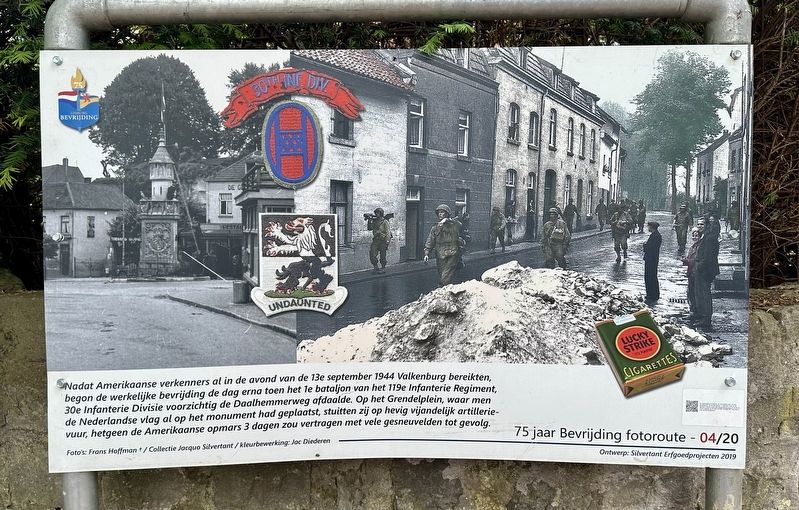
1. Strijd om de bevrijding / Battle for Liberation Marker

After American scouts reached Valkenburg in the evening of September 13, 1944, the actual liberation began the next day when the first battalion of the 119th Infantry Regiment, 30th Infantry Division carefully descended the Daalhemmerweg. At Grendelplein, where the Dutch flag had already been placed on the monument, they encountered heavy enemy artillery fire, which would delay the American advance for 3 days, resulting in many casualties. (Marker Number 04/20.)
Topics and series. This historical marker is listed in this topic list: War, World II. In addition, it is included in the Valkenburg Bevrijding/Liberation Route
this page online
Location. 50° 51.694′ N, 5° 49.793′ E. Marker is in Valkenburg, Limburg, in Valkenburg aan de Geul. It is at the intersection of Daalhemmerweg and Konijnsgracht, on the right when traveling south on Daalhemmerweg. Touch for map. Marker is at or near this postal address: Konijnsgracht 38f, Valkenburg, Limburg 6301 BM, Netherlands. Touch for directions.

Regionally, it is in Europe, the European Union, Atlantic Europe, the Benelux Low Countries, the Schengen Area, Western Europe, and the Western World. Historically, it finds itself in what was once the Roman Empire and specifically also the Holy Roman Empire.
Other nearby markers. At least 8 other markers are within walking distance of this marker: Karel Cahn (within shouting distance of this marker); Louis Cahn (within shouting distance of this marker); Kapsporen/ Cut Marks / Schlagspuren (about 120 meters away, measured in a direct line); Gemeentegrot als schuilplaats / Municipal Cave as Shelter (about 120 meters away); Construction of the Valkenburg Castle / Opbouw Kasteel Valkenburg (about 120 meters away);
Photographed by Andrew Ruppenstein, May 28, 2024
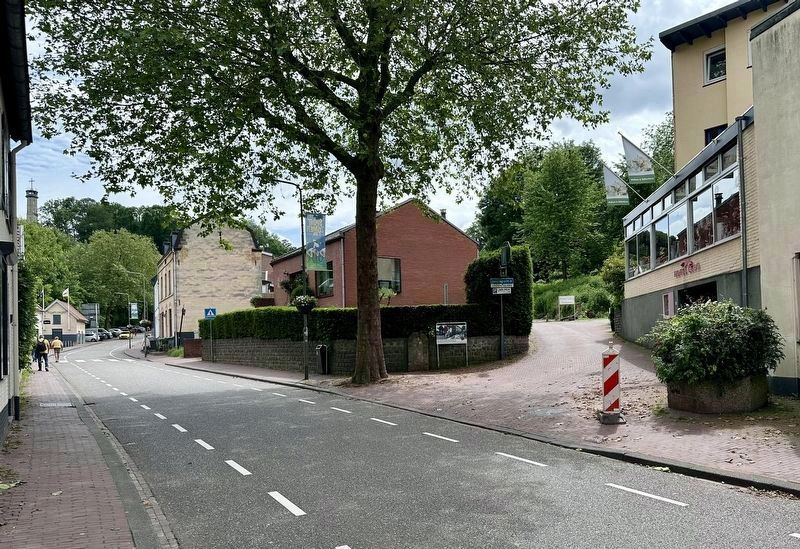
2. Strijd om de bevrijding / Battle for Liberation Marker - wide view
This is looking south on Daalhemmerweg, the road on which the Americans approached the town. The Grendelplein, the square where the Americans encountered heavy fire, is less than 100 meters to the north of the marker site, i.e., behind the photographer in this photo.
Also see . . . Valkenburg resistance (Wikipedia). The article is mainly on the resistance in Valkenburg, but the section on the actual liberation is concise enough to be presented here.
Liberation: When the allies approached Valkenburg in September 1944 there were several days of shooting, with the result that when the allies entered the town on 14 September it was deserted; everyone had fled into the caves. But two men stepped out onto the street, one of them Pierre Schunck, the other a youngster from The Hague who was in hiding with him. They had made contact the day before and now told the 19th US army corps where the Germans were to be found - in a hotel near the only remaining bridge over the river Geul, at the Wilhelminalaan, which the Germans kept intact as long as possible to let their troops retreat. A column of jeeps approached and Pierre was put on the hood of the first one. Later he found out that the soldier behind him had orders to shoot him if anything went wrong because they still didn't trust him. They were going to conquer the bridge, so Pierre sent off a few locals to tell people to stay indoors and not to start cheering. But the Germans were informed by a collaborating local and blew up the bridge just before the liberating soldiers had reached the bridge (creeping from tree to tree), by igniting the explosive charge that was already in place. So now Valkenburg became a front line and the troops were delayed for three days. The army division got orders to wait until Maastricht was conquered, which happened two days later. So on 17 September Valkenburg was finally on the right side of the front and fully liberated. The people could finally leave the caves, which was needed because during these few days food had run out and the hygienic conditions had become difficult due to the overcrowding of the caves. In those days in the caves three children had been born and an old man had died (of natural causes).(Submitted on June 1, 2024.)
Credits. This page was last revised on June 1, 2024. It was originally submitted on June 1, 2024, by Andrew Ruppenstein of Lamorinda, California. This page has been viewed 189 times since then and 26 times this year. Photos: 1, 2. submitted on June 1, 2024, by Andrew Ruppenstein of Lamorinda, California.
