Crieve Hall in Nashville in Davidson County, Tennessee — The American South (East South Central)
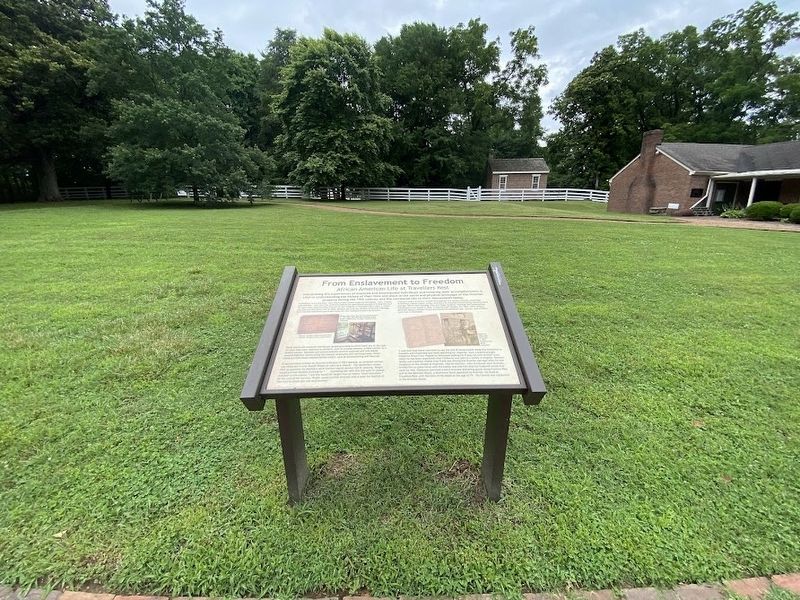
From Enslavement to Freedom
African American Life at Travellers Rest

Photographed by Darren Jefferson Clay, June 1, 2024
1. From Enslavement to Freedom Marker
In addition to owning land, John Overton also owned enslaved individuals - men, women, and children who were the workforce behind his agricultural pursuits of tilling the land for cash crops and providing food for all the residents of Travellers Rest. Mary, a widow who became Overton's wife in 1820, brought not only her children from that marriage, but enslaved individuals purchased from her first husband's estate by Overton.
Daily life of the enslaved individuals varied according to either their sex or the type of work they were required to perform, such as a house servant, a field worker, or a skilled laborer. Receipts and letters indicate several enslaved and free Blacks worked together constructing the historic structures still surviving today. Other enslaved individuals learned skilled trades, such as blacksmithing
this page online
A memorandum written by Overton indicates in 1821 Matilda, an enslaved woman, was hired out to one Joseph Wright to work as a weaver. The agreement stated that as payment for Matilda's work Overton would receive $22 in weaving. Wright would provide Matilda clothing by "... furnishing her with two full suits of clothes suitable to the season," and she would be taught how to weave "plain coverlets." At the end of her service, Wright would provide Overton with a loom for Matilda of the kind to which she was accustomed.
Overton's death inventory records his assets by first listing his books, household furnishings, horses, mules, cattle, and lastly 53 enslaved human beings listed by name and age. Within their bondage they also began families. Although the Emancipation Proclamation was issued in 1863, it was not until October 24, 1864, when military governor Andrew Johnson finally proclaimed all enslaved men, women, and children were free in Tennessee.
It was then that those who lived to see the end of enslavement made the transition to freedom and citizenship and went searching for relatives. Such a search brought Claiborne
Photographed by Darren Jefferson Clay, June 1, 2024
2. From Enslavement to Freedom Marker
Captions
Below: Barn Loom, four harness counterbalance, c. 1830-1862, elm and poplar hamess rig and frame. Ashland City, TN origin, Travellers Rest Collection
Source: Travellers Rest Collection and Archive, TN State Library and Archives
Claiborne Hines with dairy cart c. 1897 Travellers Rest Photo Collection
Topics. This historical marker is listed in this topic list: African Americans.
Location. 36° 4.573′ N, 86° 45.882′ W. Marker is in Nashville, Tennessee, in Davidson County. It is in Crieve Hall. It can be reached from Farrell Parkway west of Regent Drive. Touch for map. Marker is at or near this postal address: 636 Farrell Pkwy, Nashville TN 37220, United States of America. Touch for directions.

Regionally, this marker is in Middle Tennessee. It is also in the American South and specifically in the Upper South. Globally, it is in North America, the Western Hemisphere, the Western World, and the Anglosphere. Historically, it finds itself in what was once the territory of the Mississippian Culture, one of the Confederate States of America, and the Antebellum South.
Other nearby markers. At least 8 other markers are within walking distance of this marker: A different marker also named Travellers Rest (a few steps from this marker); Earliest Residents of Travellers Rest (a few steps from this marker); Battle of Nashville / Peach Orchard Hill (within shouting distance of this marker); Historic Travellers Rest Herb Garden (about 500 feet away, measured in a direct line); Herb Garden (about 500 feet away); Smokehouse (about 500 feet away); Arabian Horses (about 500 feet away); a different marker also named Travellers' Rest (approx. 0.2 miles away). Touch for a list and map of all markers in Nashville.
Another marker is no longer nearby. Travellers Rest (was a few steps from this marker but has been replaced with another marker now near it).
Credits. This page was last revised on June 4, 2024. It was originally submitted on June 2, 2024, by Darren Jefferson Clay of Duluth, Georgia. This page has been viewed 245 times since then and 52 times this year. Photos: 1, 2. submitted on June 2, 2024, by Darren Jefferson Clay of Duluth, Georgia. • James Hulse was the editor who published this page.
