Zeppelinheim in Neu-Isenburg in Offenbach, Hesse, Germany — Central Europe
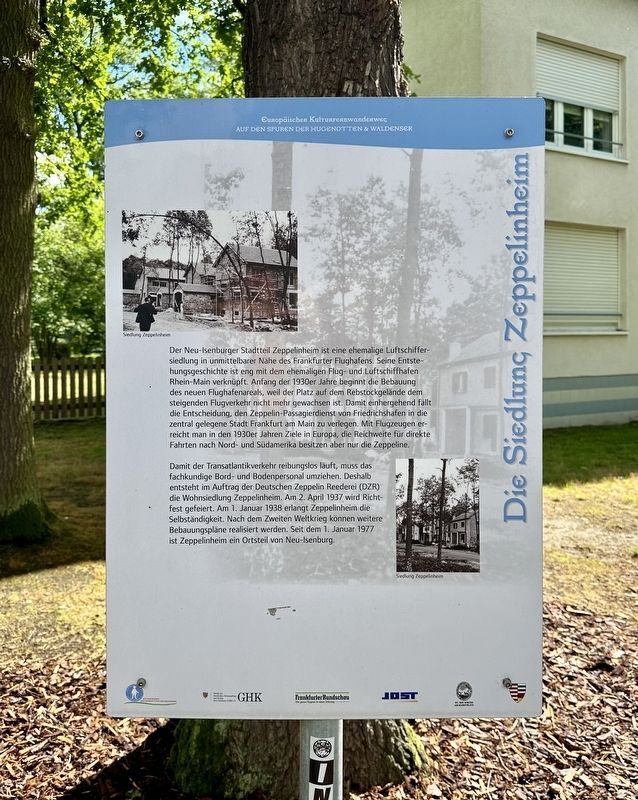
Die Siedlung Zeppelinheim
⎯⎯⎯
The Zeppelinheim Settlement
| — | Europäischer Kulturfernwanderweg | — |
Photographed by Andrew Ruppenstein, May 30, 2024
1. Die Siedlung Zeppelinheim / The Zeppelinheim Settlement Marker

Damit der Transatlantikverkehr reibungslos läuft, muss das fachkundige Bord- und Bodenpersonal umziehen. Deshalb entsteht im Auftrag der Deutschen Zeppelin Reederei (DZR) die Wohnsiedlung Zeppelinheim. Am 2. April 1937 wird Richtfest gefeiert. Am 1. Januar 1938 erlangt Zeppelinheim die Selbständigkeit. Nach dem Zweiten Weltkrieg können weitere Bebauungspläne realisiert werden. Seit dem 1. Januar 1977
this page online
The Neu-Isenburg district of Zeppelinheim is a former airship settlement in the immediate vicinity of Frankfurt Airport. Its history is closely linked to the former Rhein-Main airport and airship port. Construction of the new airport area began in the early 1930s because the space on the Rebstock site could no longer cope with the increasing air traffic. This led to the decision to move the Zeppelin passenger service from Friedrichshafen to the centrally located city of Frankfurt am Main. In the 1930s, airplanes were used to reach destinations in Europe, but only the Zeppelins had the range for direct flights to North and South America.
To ensure that transatlantic traffic would continue smoothly, the skilled on-board and ground staff had to relocate. The Zeppelinheim residential complex was therefore built on behalf of the Deutsche Zeppelin Reederei (DZR). The completion of the settlement was celebrated with a topping-out ceremony on April 2, 1937. Zeppelinheim became independent on January 1, 1938. After the Second World War, further development plans were
Photographed by Andrew Ruppenstein, May 30, 2024
2. Die Siedlung Zeppelinheim / The Zeppelinheim Settlement Marker - wide view
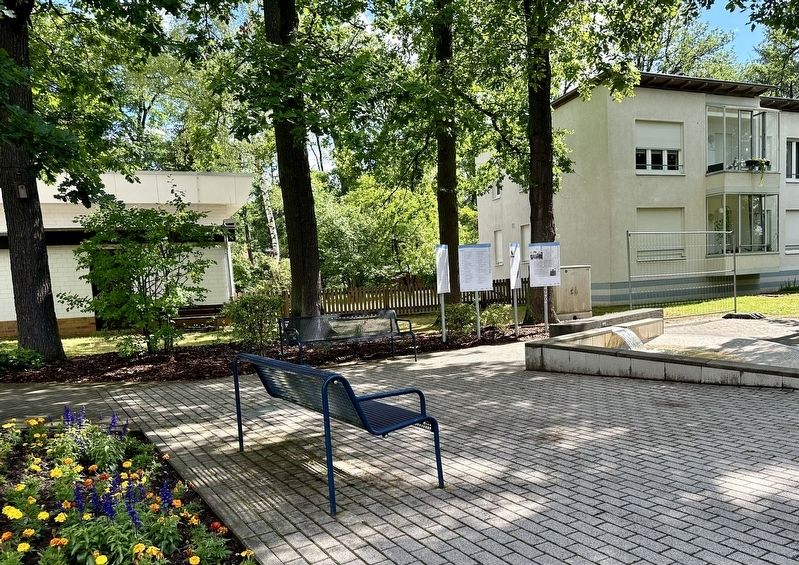
Of the four panels visible here, the Zeppelin Settlement marker is the rightmost.
Topics. This historical marker is listed in these topic lists: Air & Space • Settlements & Settlers. A significant historical date for this entry is April 2, 1937.
Location. 50° 2.115′ N, 8° 36.868′ E. Marker is in Neu-Isenburg, Hessen (Hesse), in Offenbach. It is in Zeppelinheim. It is on Kapitän-Lehman-Straße near Hirschsprung, on the right when traveling west. Touch for map. Marker is in this post office area: Neu-Isenburg HE 63263, Germany. Touch for directions.

Regionally, it is in Europe, the European Union, Atlantic Europe, Central Europe, the Schengen Area, Western Europe, and the Western World. Historically, it finds itself in what was once the Roman Empire, the Holy Roman Empire, and the former West Germany.
Other nearby markers. At least 8 other markers are within 10 kilometers of this marker, measured as the crow flies: Zeppelin-Museum Zeppelinheim (here, next to this marker); a different marker also named Zeppelin-Museum Zeppelinheim (within shouting distance of this marker); Mörfelden Synagoge (approx. 7.5 kilometers away); Die Industriegewerkschaft Chemie-Papier-Keramik / The Chemical-Paper-Ceramics Industrial Union (approx. 7.8 kilometers away); Prüfamt E-Werk / Power Station (approx. 8.2 kilometers away); Gutleutkaserne / Gutleut Barracks (approx. 8.2 kilometers away); Oskar Schindler (approx. 8.7 kilometers away); Hauptbahnhof - Main Station (approx. 8.8 kilometers away). Touch for a list and map of all markers in Neu-Isenburg.
Also see . . . Zeppelinheim (Wikipedia, in German).
Excerpt: From January 1934, around 600 hectares of forest were cleared west of the new Frankfurt-Darmstadt motorway. The northern part contained the runway with over 100 hectares of grass runway. The airship port was built in the southern part, which covers 318 hectares. At the same time, construction began on an independent settlement for the staff, the airship settlement, east of the motorway. The Reichsbahn set up a station between the Zeppelin home and the new airport as a connection to the city. The basis for the construction projects was a 1934 contract with Friedrichshafener Luftschiffbau Zeppelin GmbH for a central German home base for all airships, the Rhein-Main airport and airship port. It was rebuilt in 1935 and opened in 1936 with the first airship hangar. The new Rhein-Main airport and airship port was ceremoniously opened on July 8, 1936. 27 airlines flew to Rhein-Main. The LZ 129 Hindenburg and LZ 127 Graf Zeppelin set off from here on their always fully-booked transatlantic trips. In 1937, the first 78 houses in the settlement were occupied by 90 families and on January 1, 1938, Zeppelinheim was officially constituted as an independent municipality.…(Submitted on June 4, 2024.)
Credits. This page was last revised on June 4, 2024. It was originally submitted on June 4, 2024, by Andrew Ruppenstein of Lamorinda, California. This page has been viewed 290 times since then and 64 times this year. Photos: 1, 2. submitted on June 4, 2024, by Andrew Ruppenstein of Lamorinda, California.
