Hampton, Virginia — The American South (Mid-Atlantic)
F-86L Sabre/Mercury Test Capsule
| — | Air Power Park | — |
Photographed by Brandon D Cross
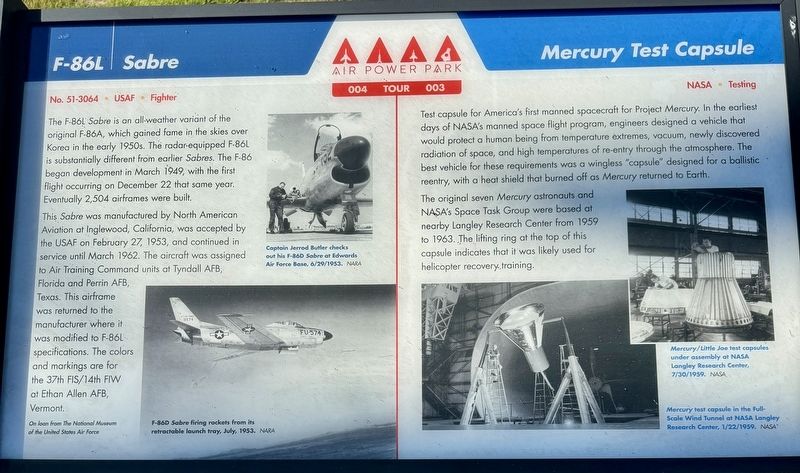
1. F-86L Sabre/Mercury Test Capsule Marker
F-86L Sabre
No. 51-3064 • USAF • Fighter
The F-86L Sabre is an all-weather variant of the original F-86A, which gained fame in the skies over Korea in the early 1950s. The radar-equipped F-86L is substantially different from earlier Sabres. The F-86 began development in March 1949, with the first flight occurring on December 22 that same year. Eventually 2,504 airframes were built.
This Sabre was manufactured by North American Aviation at Inglewood, California, was accepted by the USAF on February 27, 1953, and continued in service until March 1962. The aircraft was assigned to Air Training Command units at Tyndall AFB; Florida and Perrin AFB, Texas. This airframe was returned to the manufacturer where it was modified to F-86L-specifications. The colors and markings are for the 37th FIS/14th FIW at Ethan Allen AFB, Vermont.
On loan from the National Museum of the United States Air Force
(captions)
Captain Jerrod Butler checks out his F-86D Sabre at Edwards Air Force Base, 6/29/1953. NARA
F-86D Sabre firing rockets from its retractable launch tray, July, 1953. NARA
Mercury Test Capsule
NASA • Testing
Test
this page online
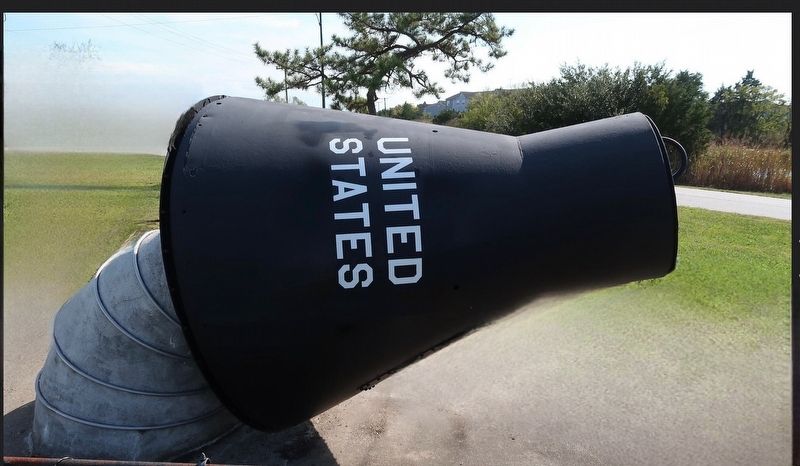
The original seven Mercury astronauts and NASA's Space Task Group were based at nearby Langley Research Center from 1959 to 1963. The lifting ring at the top of this capsule indicates that it was likely used for helicopter recovery training.
Mercury/Little Joe test capsules under assembly at NASA Langley Research Center, 7/30/1959. NASA.
Mercury test capsule in the Full-Scale Wind Tunnel at NASA Langley Research Center, 1/22/1959. NASA
Erected by Hampton Air Power Park and Museum. (Marker Number 04/03.)
Topics. This memorial is listed in these topic lists: Air & Space • War, Korean.
Location. 37° 2.615′ N,

Photographed by Brandon D Cross
2. F-86L Sabre/Mercury Test Capsule Marker

Regionally, this memorial is on Virginia’s Peninsula and in Coastal Virginia. It is also in the American South, specifically in the Upper South, in the Tidewater, and on the Eastern Seaboard. Globally, it is in the North Atlantic Region, North America, the Western Hemisphere, the Western World, and the Anglosphere. Historically, it finds itself in what was once the territory of the Mississippian Culture, one of the original Thirteen Colonies, one of the Confederate States of America, and the Antebellum South.
Other nearby markers. At least 8 other markers are within walking distance of this marker: Langley Field (here, next to this marker); NACA (here, next to this marker); NASA Space History (here, next to this marker); MIM-3 Nike-Ajax/XV-6A Kestrel
Photographed by Brandon D Cross
3. Mercury Test Capsule Marker
Other markers no longer nearby. A-7E Corsair II (was a few steps from this marker but has been permanently removed); Mercury Test Capsule (was within shouting distance of this marker but has been confirmed missing); T-33A T-Bird (was within shouting distance of this marker but has been permanently removed); M-2 Corporal (was within shouting distance of this marker but has been permanently removed).
Credits. This page was last revised on June 6, 2024. It was originally submitted on June 4, 2024, by Brandon D Cross of Flagler Beach, Florida. This page has been viewed 211 times since then and 21 times this year. Photos: 1, 2, 3. submitted on June 4, 2024, by Brandon D Cross of Flagler Beach, Florida. • Bernard Fisher was the editor who published this page.
