St Albans in Hertfordshire, England, United Kingdom — Northwestern Europe (the British Isles)
The Town Walls
Verulamium Park
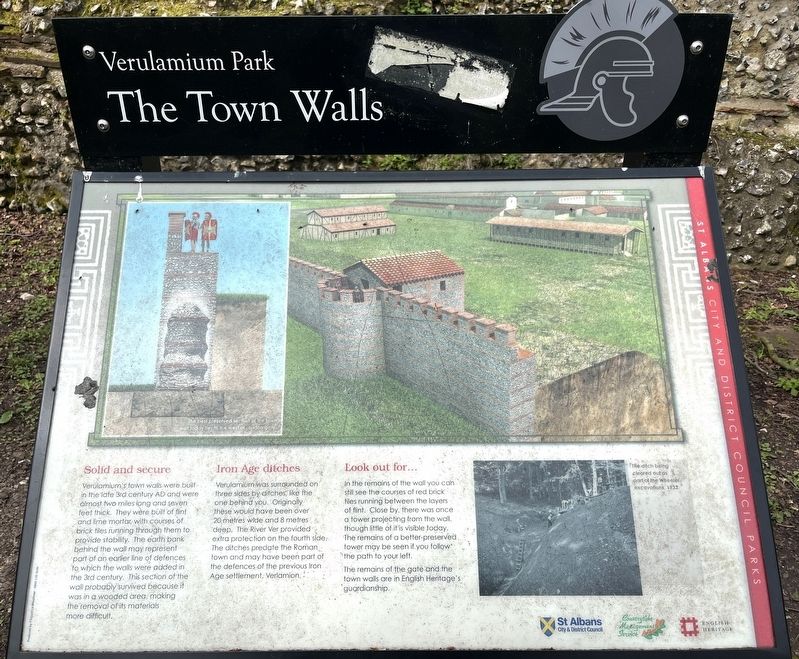
Photographed by Ray Gurganus, April 18, 2024
1. The Town Walls Marker
Solid and secure
Verulamium's town walls were built in the late 3rd century AD and were almost two miles long and seven feet thick. They were built of flint and lime mortar with courses of brick tiles running through them to provide stability. The earth bank behind the wall may represent part of an earlier line of defences to which the walls were added in the 3rd century. This section of the wall probably survived because it was in a wooded area making the removal of its materials more difficult.
Iron Age ditches
Verulamium was surrounded on three sides by ditches, like the one behind you. Originally these would have been over 20 metres wide and 8 metres deep. The River Ver provided extra protection on the fourth side The ditches predate the Roman town and may have been part of the defences of the previous Iron Age settlement, Verlamion.
Look out for...
In the remains of the wall you can still see the courses of red brick tiles running between the layers of flint. Close by, there was once a tower projecting from the wall though little of it is visible today. The remains of a better-preserved tower may be seen if
this page online
Topics. This historical marker is listed in this topic list: Forts and Castles.
Location. 51° 44.821′ N, 0° 21.201′ W. Marker is in St Albans, England, in Hertfordshire. It can be reached from The Ramparts. Touch for map. Marker is at or near this postal address: 3 The Ramparts, St Albans, England AL3 4AE, United Kingdom. Touch for directions.

Regionally, this marker is in the Greater South East. Globally, it is on the Atlantic Ocean, in the North Atlantic Region, in Europe, in Atlantic Europe, on one of the British Isles, in the Western World, and in the Anglosphere. Historically, it finds itself in what was once the Roman Empire.
Other nearby markers. At least 8 other markers are within walking distance of this marker: The London Gate (about 90 meters away, measured in a direct line); Tribal Britain (about 180 meters away); St Germain's Block (approx. 0.2 kilometers away); The Abbey Gatehouse and Romeland (approx. 0.8 kilometers away); An Ancient Story, An Ancient Building
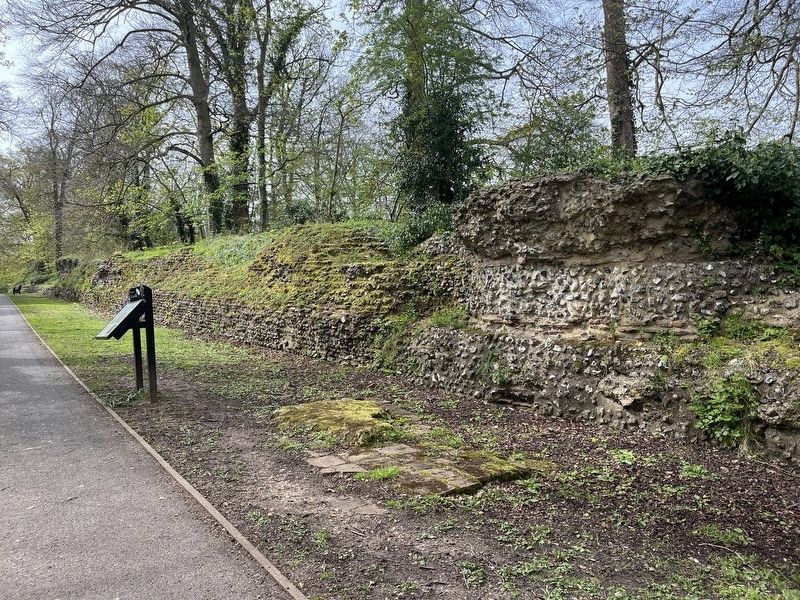
Photographed by Ray Gurganus, April 18, 2024
2. Remains of the Roman city walls
Credits. This page was last revised on June 6, 2024. It was originally submitted on June 6, 2024, by Ray Gurganus of Washington, District of Columbia. This page has been viewed 94 times since then and 13 times this year. Photos: 1, 2. submitted on June 6, 2024, by Ray Gurganus of Washington, District of Columbia. • Andrew Ruppenstein was the editor who published this page.
