Gordonsville in Albemarle County, Virginia — The American South (Mid-Atlantic)
Revolutionary War Campaign of 1781
Mechunk Creek
Photographed by Paul Crumlish, September 12, 2009
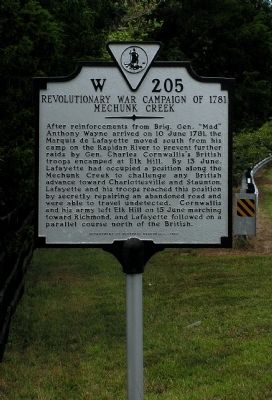
1. Revolutionary War Campaign of 1781 Marker
After reinforcements from Brig. Gen. "Mad" Anthony Wayne arrived on 10 June 1781, the Marquis de Lafayette moved south from his camp on the Rapidan River to prevent further raids by Gen. Charles Cornwallis's British troops encamped at Elk Hill. By 13 June, Lafayette had occupied a position along the Mechunk Creek to challenge any British advance toward Charlottesville and Staunton. Lafayette and his troops reached this position by secretly repairing an abandoned road and were able to travel undetected. Cornwallis and his army left Elk Hill on 15 June marching toward Richmond, and Lafayette followed on a parallel course north of the British.
Erected 2000 by Department of Historic Resources. (Marker Number W-205.)
Topics and series. This historical marker is listed in this topic list: War, US Revolutionary. In addition, it is included in the Virginia Department of Historic Resources (DHR) series list. A significant historical date for this entry is June 10, 1781.
Location. Marker is missing. It was located near 38° 3.722′ N, 78° 15.842′ W. Marker was in Gordonsville, Virginia, in Albemarle County. It was on Louisa Road (Virginia Route 22) ¼ mile east of Cobham Station Lane ( Route 640), on the right when traveling north. Touch for map. Marker was at or near this postal address: 531 Cobham Park, Gordonsville VA 22942, United States of America. Touch for directions.

Regionally, this marker was in the Piedmont and in Central Virginia. It was also in the American South and specifically in the Upper South. Globally, it was in North America, the Western Hemisphere, the Western World, and the Anglosphere. Historically, it found itself in what was once the territory of the Mississippian Culture, one of the original Thirteen Colonies, one of the Confederate States of America, and the Antebellum South.
this page online
Other nearby markers. At least 8 other markers are within 5 miles of this location, measured as the crow flies: Albemarle County / Louisa County (approx. half a mile away); St. John School — Rosenwald Funded (approx. 1.4 miles away); Castle Hill (approx. 1.9 miles away); Grace Episcopal Church (approx. 2.4 miles away); Walker's Church (approx. 2.4 miles away); Maury’s School (approx. 3 miles away); The Marquis Road (approx. 4.3 miles away); Civilian Conservation Corps Company 2347 (approx. 4.3 miles away).
Related markers. Click here for a list of markers that are related to this marker. This list shows various locations of Wayne's March in that started in York, Pennsylvania into Virginia to meet up with General Lafayette in the actions leading to the British surrender at the Battle of Yorktown.
Photographed by Paul Crumlish, September 12, 2009
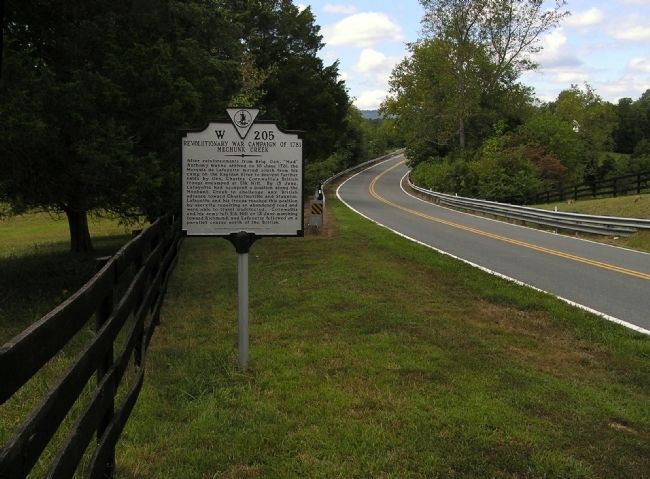
2. Wide view of the Revolutionary War Campaign of 1781 Marker
The highway rises in the distance to cross over the Mechunk Creek.
Credits. This page was last revised on June 21, 2026. It was originally submitted on September 21, 2009, by PaulwC3 of Northern, Virginia. This page has been viewed 2,728 times since then and 128 times this year. Last updated on June 19, 2026, by John Laycock of Sykesville, Maryland. Photos: 1, 2. submitted on September 21, 2009, by PaulwC3 of Northern, Virginia. • Bernard Fisher was the editor who published this page.
