
Valkenburg in Valkenburg aan de Geul, Limburg, Netherlands — Northwestern Europe
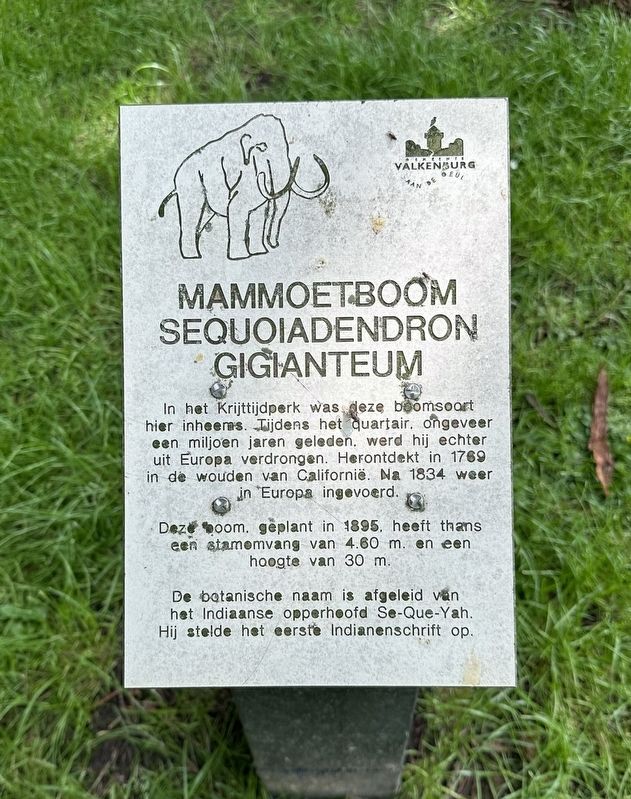
Mammoetboom Sequoiadendron Giganteum
Photographed by Andrew Ruppenstein, May 28, 2024
1. Mammoetboom Sequoiadendron Giganteum Marker

Deze boom, geplant in 1895, heeft thans een stamemvang van 4.60 m. en een hoogte van 30 m.
De botanische naam is afgeleid van het Indiaanse opperhoofd Se-Que-Yah. Hij stelde het eerste Indianenschrift op.
This tree species was native here in the Cretaceous period. However, during the Quaternary period, about a million years ago, it was pushed out of Europe. Rediscovered in 1769 in the forests of California. Reintroduced into Europe after 1834.
This tree, planted in 1895, currently has a trunk circumference of 4.60 m and a height of 30 m.
The botanical name is derived from the Indian chief Se-Que-Yah. He composed the first Indian script.
Erected by Gemeente Valkenburg aan de Geul.
Topics. This historical marker is listed in this topic list: Horticulture & Forestry. A significant historical year for this entry is 1769.
Location. 50° 52.065′ N, 5° 49.861′ E.
this page online

Regionally, it is in Europe, the European Union, Atlantic Europe, the Benelux Low Countries, the Schengen Area, Western Europe, and the Western World. Historically, it finds itself in what was once the Roman Empire and specifically also the Holy Roman Empire.
Other nearby markers. At least 8 other markers are within walking distance of this marker: Valkenburg US Army 30th Division - 119th Regiment Monument (within shouting distance of this marker); “Panzerabwehrkanone” (PAK-40) / “Anti-tank Gun” (PAK-40) (within shouting distance of this marker); Joodse deportations / Jewish Deportations (about 150 meters away, measured in a direct line); Station Valkenburg / Valkenburg Railway Station (about 180 meters away); Jan Hubert Vrancken and Frans Alexander Cobbenhagen memorial (approx. 0.2 kilometers away);
Photographed by Andrew Ruppenstein, May 28, 2024
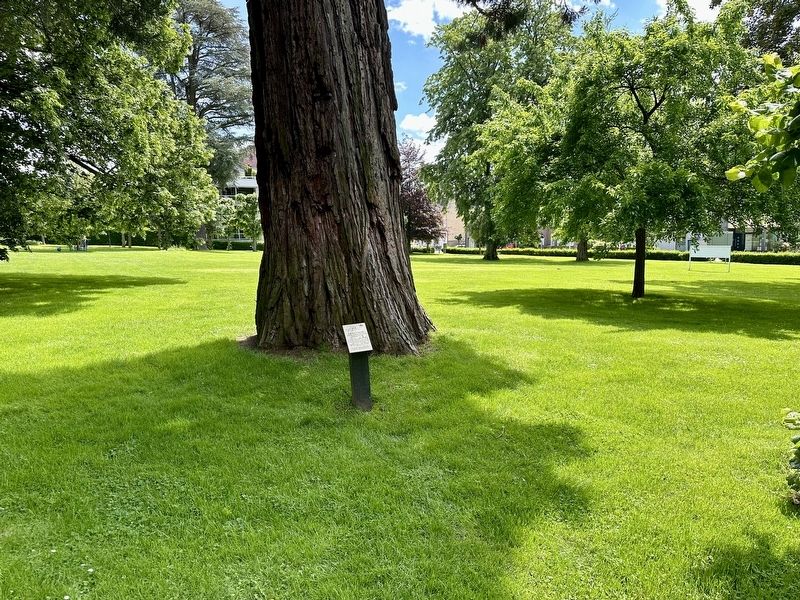
2. Mammoetboom Sequoiadendron Giganteum Marker - wide view
Also see . . . Sequoiadendron giganteum (Wikipedia).
Overview: Sequoiadendron giganteum, also known as the giant sequoia, giant redwood or Sierra redwood is a coniferous tree, classified in the family Cupressaceae in the subfamily Sequoioideae. Giant sequoia specimens are the most massive trees on Earth. They are native to the groves on the western slopes of the Sierra Nevada mountain range of California but are grown around the world.(Submitted on June 6, 2024.)
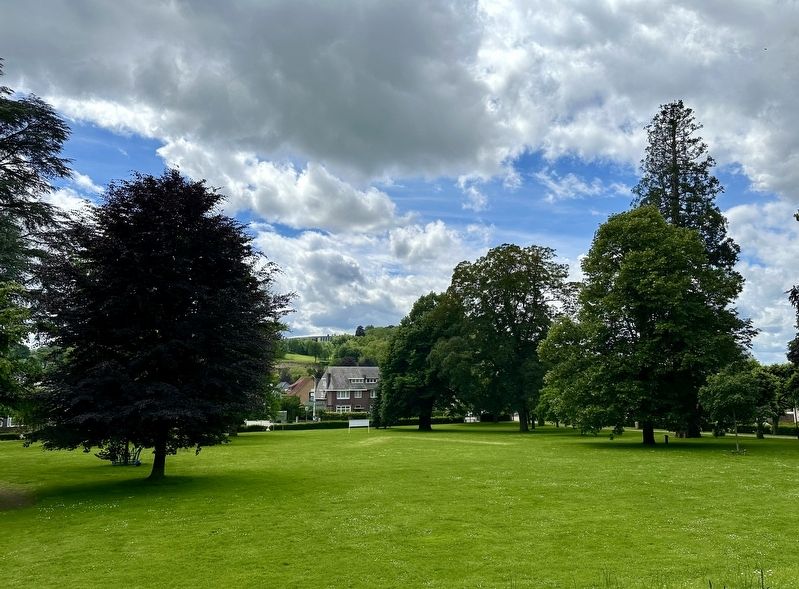
Etymology: The etymology of the genus name has been presumed—initially in The Yosemite Book by Josiah Whitney in 1868—to be in honor of Sequoyah (1767–1843), who was the inventor of the Cherokee syllabary. An etymological study published in 2012 concluded that Austrian Stephen L. Endlicher is responsible for the name. A linguist and botanist, Endlicher corresponded with experts in the Cherokee language including Sequoyah, whom he admired.He also realized that coincidentally the genus could be described in Latin as sequi (meaning to follow) because the number of seeds per cone in the newly classified genus aligned in mathematical sequence with the other four genera in the suborder. Endlicher thus coined the name "Sequoia" as both a description of the tree's genus and an honor to the indigenous man he admired.Photographed by Andrew Ruppenstein, May 28, 20243. Sequoiadendron Giganteum treeLooking out across the city hall park, the sequoia is visible here on the right, partially obscured by a shorter tree in front of it.
Credits. This page was last revised on June 6, 2024. It was originally submitted on June 6, 2024, by Andrew Ruppenstein of Lamorinda, California. This page has been viewed 115 times since then and 8 times this year. Photos: 1, 2, 3. submitted on June 6, 2024, by Andrew Ruppenstein of Lamorinda, California.
