
Arena District in Columbus in Franklin County, Ohio — The American Midwest (Great Lakes)
Columbus Union Station Arch
Photographed by Duane and Tracy Marsteller, May 26, 2024
1. Columbus Union Station Arch Marker
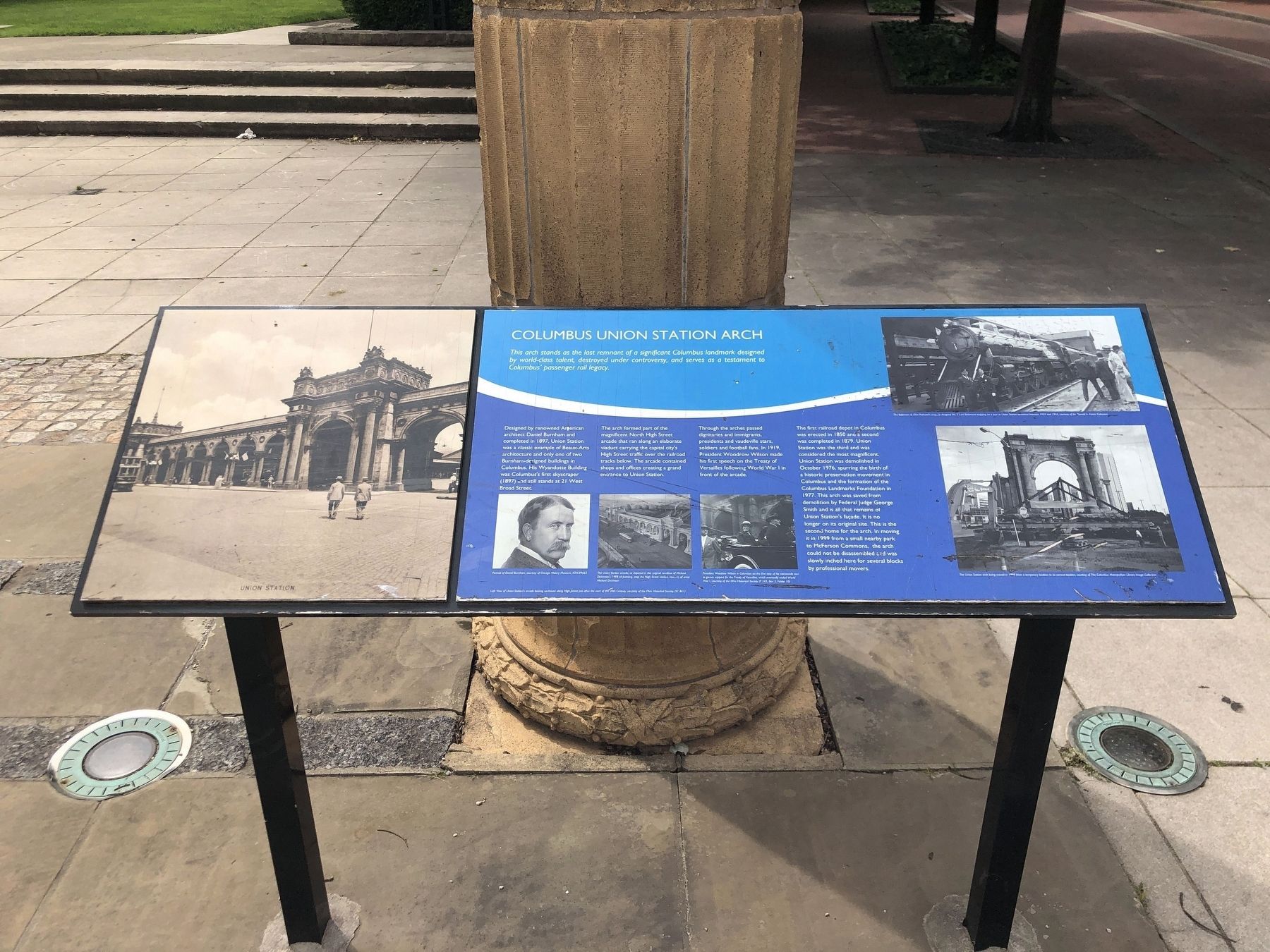
Designed by renowned American architect Daniel Burnham and completed in 1897, Union Station was a classic example of Beaux-Arts architecture and only one of two Burnham-designed buildings in Columbus. His Wyandotte Building was Columbus's first skyscraper (1897) – and still stands at 21 West Broad Street.
The arch formed part of the magnificent North High Street arcade that ran along an elaborate viaduct carrying the capital city's High Street traffic over the railroad tracks below. The arcade contained shops and offices creating a grand entrance to Union Station.
Through the arches passed dignitaries and immigrants, presidents and vaudeville stars, soldiers and football fans. In 1919, President Woodrow Wilson made his first speech on the Treaty of Versailles following World War I in front of the arcade.
The first railroad depot in Columbus was erected in 1850 and a second was completed in 1879. Union Station was the
this page online
[Captions]
Left: View of Union Station's arcade looking northeast along High Street just after the start of the 20th century. Courtesy of the Ohio Historical Society (SC 861)
Top right: The Baltimore & Ohio Railroad's uniquely designed No. 2 Lord Baltimore stopping on a track at Union Station sometime between 1935 and 1941. Courtesy of the Donald A. Foster Collection
Bottom row, left to right:
• Portrait of Daniel Burnham. Courtesy of Chicago History Museum, ICHi-09662
• The Union Station arcade, as depicted in this original rendition of Michael Dickinson's
Photographed by Duane and Tracy Marsteller, May 26, 2024
2. Columbus Union Station Arch Marker
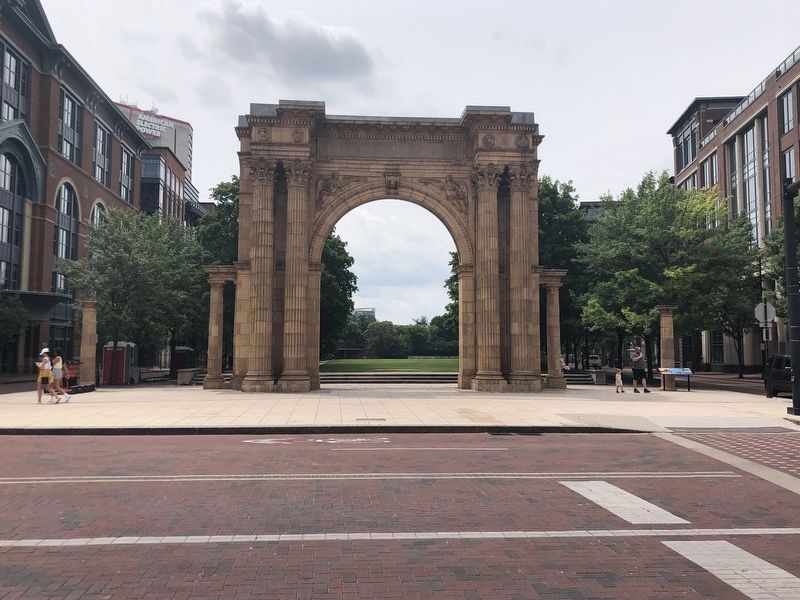
Marker is to the right of the arch.
• President Woodrow Wilson in Columbus on the first stop of his nationwide tour to garner support for the Treaty of Versailles, which eventually ended World War I. Courtesy of the Ohio Historical Society (P 245, Box J, Folder 10)
Topics. This historical marker is listed in these topic lists: Architecture • Railroads & Streetcars. A significant historical year for this entry is 1897.
Location. 39° 58.089′ N, 83° 0.453′ W. Marker is in Columbus, Ohio, in Franklin County. It is in the Arena District. It is at the intersection of John H McConnell Boulevard and West Nationwide Boulevard, on the left when traveling south on John H McConnell Boulevard. Touch for map. Marker is in this post office area: Columbus OH 43215, United States of America. Touch for directions.

Regionally, this marker is in Ohio’s Scioto Valley. It is also in the American Midwest and in the Corn Belt. Globally, it is in North America, the Western Hemisphere, the Western World, and the Anglosphere. Historically, it finds itself in what was once the Haudenosaunee (Iroquois) Confederacy, the territory of the Mississippian Culture, and the Northwest Territory.
Other nearby markers. At least 8 other markers are within walking distance of this marker: Columbus' First Professional Game (about 700 feet away, measured in a direct line); The Columbus Buckeyes (about 700 feet away); The Western League (about 700 feet away); The Negro Leagues in Columbus (about 700 feet away); The Columbus Senators (about 700 feet away); The Red Birds (about 700 feet away); The Jets (about 700 feet away); The Clippers (about 700 feet away). Touch for a list and map of all markers in Columbus.
Credits. This page was last revised on June 6, 2024. It was originally submitted on June 6, 2024, by Duane and Tracy Marsteller of Murfreesboro, Tennessee. This page has been viewed 803 times since then and 150 times this year. Photos: 1, 2. submitted on June 6, 2024, by Duane and Tracy Marsteller of Murfreesboro, Tennessee.
