Stamford in Lincolnshire, England, United Kingdom — Northwestern Europe (the British Isles)
The Hospital of Thomas Truesdale
Photographed by Stephen Palmer, June 1, 2024
1. The Hospital of Thomas Truesdale Marker
Truesdale's Hospital
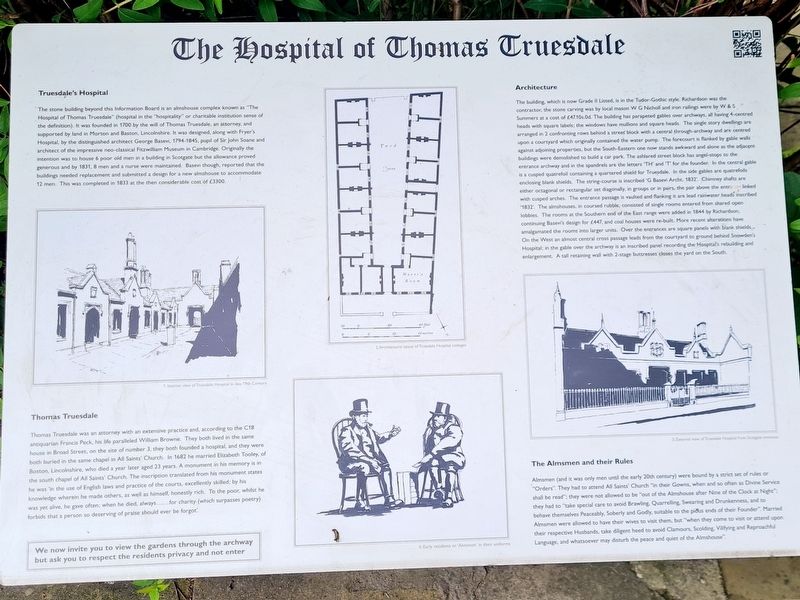
The stone building beyond this Information Board is an almshouse complex known as "The Hospital of Thomas Truesdale" (hospital in the "hospitality" or charitable institution sense of the definition). It was founded in 1700 by the will of Thomas Truesdale, an attorney, and supported by land in Morton and Baston, Lincolnshire. It was designed, along with Fryer's Hospital, by the distinguished architect George Basevi, 1794-1845, pupil of Sir John Soane and architect of the impressive neo-classical Fitzwilliam Museum in Cambridge. Originally the intention was to house 6 poor old men in a building in Scotgate but the allowance proved generous and by 1831, 8 men and a nurse were maintained. Basevi though, reported that the buildings needed replacement and submitted a design for a new almshouse to accommodate 12 men. This was completed in 1833 at the then considerable cost of £3300.
Thomas Truesdale
Thomas Truesdale was an attorney with an extensive practice and, according to the C18 antiquarian Francis Peck, his life paralleled William Browne. They both lived in the same house in Broad Street, on the
this page online
Architecture
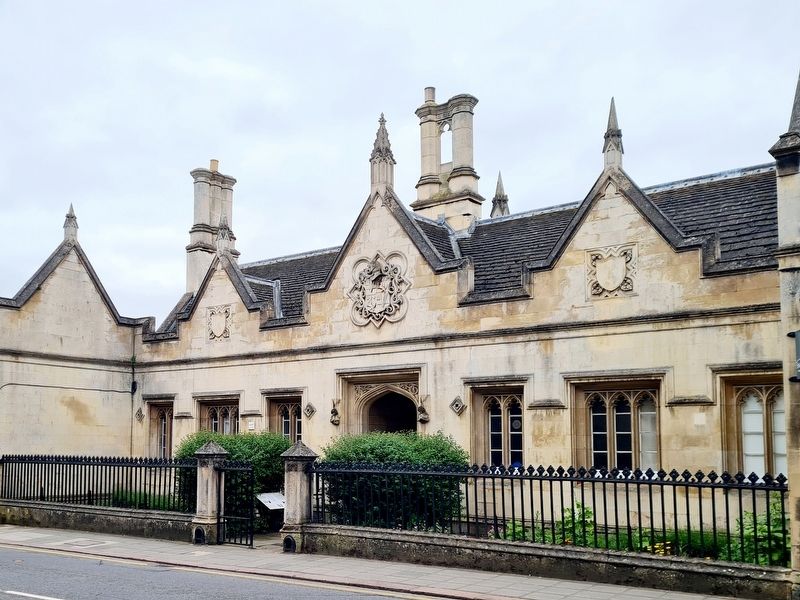
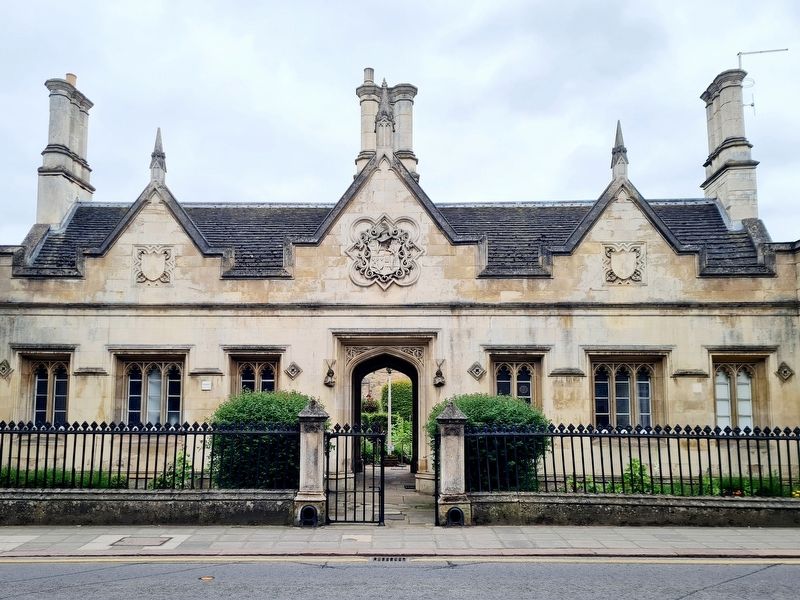
The building, which is now Grade II Listed, is in the Tudor-Gothic style: Richardson was the contractor, the stone carving was by local mason WG Nicholl and iron railings were by W & S Summers at a cost of £47.10s.0d. The building has parapeted gables over archways, all having 4-centred heads with square labels; the windows have mullions and square heads. The single story dwellings are arranged in 2 confronting rows behind a street block with a
Photographed by Stephen Palmer, June 1, 2024
2. The Hospital of Thomas Truesdale Marker
Photographed by Stephen Palmer, June 1, 2024
3. The Hospital of Thomas Truesdale
The Almsmen and their Rules
Almsmen (and it was only men until the early 20th century) were bound by a strict set of rules or "Orders". They had to attend All Saints' Church "in their Gowns, when and so often as Divine Service shall be read"; they were not allowed to be "out of the Almshouse after Nine of the Clock at Night": they had to "take special care to avoid Brawling, Quarrelling, Swearing and Drunkenness, and to behave themselves Peaceably, Soberly and Godly, suitable to the pious ends of their Founder". Married Almsmen were allowed to have their wives to visit them, but "when they come to visit or attend upon their respective Husbands, take diligent heed to avoid Clamours, Scolding, Vilifying and Reproachful Language, and whatsoever may disturb the peace and

Photographed by Stephen Palmer, June 1, 2024
4. The Hospital of Thomas Truesdale
We now invite you to view the gardens through the archway but ask you to respect the residents privacy and not enter.
Topics. This historical marker is listed in these topic lists: Architecture • Charity & Public Work. A significant historical year for this entry is 1700.
Location. 52° 39.151′ N, 0° 29.011′ W. Marker is in Stamford, England, in Lincolnshire. It is on Scotgate, on the right when traveling east. Marker is just inside the gate to the left. Touch for map. Marker is at or near this postal address: 65 Scotgate, Stamford, England PE9 2YB, United Kingdom. Touch for directions.

Regionally, this marker is in the Midlands. Globally, it is on the Atlantic Ocean, in the North Atlantic Region, in Europe, in Atlantic Europe, on one of the British Isles, in the Western World, and in the Anglosphere. Historically, it finds itself in what was once the Roman Empire.
Other nearby markers. At least 5 other markers are within 19 kilometers of this marker, measured as the crow flies: The Sundial at All Saints' Church (about 180 meters away, measured in a direct line); Stamford's Stone Heritage (approx. 0.3 kilometers away); St Michael's Churchyard and its surroundings (approx. 0.4 kilometers away); Stamford Theatre (approx. 0.4 kilometers away); Oundle Bridge (approx. 18.4 kilometers away).
Credits. This page was last revised on June 15, 2024. It was originally submitted on June 15, 2024, by Stephen Palmer of Ascot, England. This page has been viewed 233 times since then and 43 times this year. Photos: 1, 2, 3, 4. submitted on June 15, 2024, by Stephen Palmer of Ascot, England. • Andrew Ruppenstein was the editor who published this page.
