Downtown in Springfield in Sangamon County, Illinois — The American Midwest (Great Lakes)
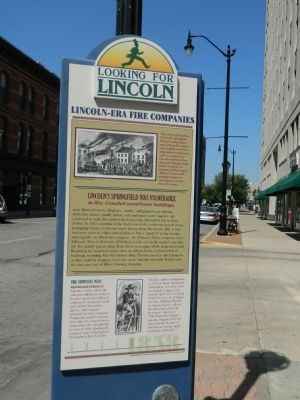
Lincoln-Era Fire Companies
Looking for Lincoln
Photographed by Beverly Pfingsten, June 9, 2012
1. Lincoln-Era Fire Companies Marker
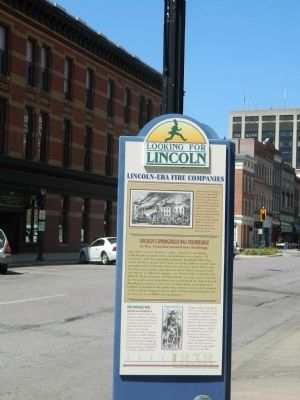
Lincoln's Springfield was vulnerable to fire, Crowded wood-frame buildings, open flames in stoves, fireplaces, candles, and primitive gas lighting ineffective alarms, muddy streets, and inadequate water supplies---all combined to make fires potentially devastating. Springfield had its share of fires. In 1855 a portion of the block west of the statehouse burned down, prompting citizens to become more serious about fire threats. Still, it took two more years to collect subscriptions to buy a "modern" pump carriage and organize an official fire company---the Pioneers. More companies soon followed. Then in February 1858 flames broke out on the square's east side; the fire quickly spread along Sixth street consuming all the shops in its path. Rounding the southwest corner here on Adams Street, it destroyed more buildings, including Florville's barber shop. Firemen saved as much property as they could by dragging it into the street. Lincoln reportedly helped carry the iron stove out of Diller's burning drugstore.
Fire companies were important social institutions in Lincoln's world. Much like volunteer militiamen, volunteer
this page online
[Caption:]
There were no fire hydrants in Lincoln's Springfield. Firemen hand-pumped water from public cisterns and trampled over fences and gardens to reach private wells. As a homeowner Lincoln would have been expected to keep two leather buckets handy for an emergency bucket brigade. (Below) Firemen used speaking trumpets to communicate over the din at fire scenes.
Erected by State of Illinois
Photographed by Beverly Pfingsten, June 9, 2012
2. Lincoln-Era Fire Companies Marker
Topics and series. This historical marker is listed in these topic lists: Charity & Public Work • Disasters. In addition, it is included in the Former U.S. Presidents: #16 Abraham Lincoln, and the Looking for Lincoln series lists. A significant historical month for this entry is February 1858.
Location. 39° 48.037′ N, 89° 38.824′ W. Marker is in Springfield, Illinois, in Sangamon County. It is in Downtown. It is on East Adams Street west of South 7th Street, on the right when traveling west. Between 6th & 7th Streets. Touch for map. Marker is at or near this postal address: 623 E Adams St, Springfield IL 62702, United States of America. Touch for directions.

Regionally, this marker is in Central Illinois. It is also in the American Midwest and in the Corn Belt. Globally, it is in North America, the Western Hemisphere, the Western World, and the Anglosphere. Historically, it finds itself in what was once the territory of the Mississippian Culture and also the Northwest Territory.
Other nearby markers. At least 8 other markers are within walking distance of this marker: The Lyceum (a few steps from this marker); Elijah Iles' American House Hotel (within shouting distance of this marker); The American House (within shouting distance of this marker); Streetscape 1859 (about 300 feet away, measured in a direct line); The Lincoln Boys in 1854 (about 300 feet away); Cook's Hall (about 300 feet away); Corneau & Diller Drug Store (about 300 feet away); In Their Springfield Prime (about 300 feet away). Touch for a list and map of all markers in Springfield.
More about this marker. Half a block southeast of the Old State Capitol building.
Credits. This page was last revised on December 14, 2024. It was originally submitted on July 5, 2012, by Bill Pfingsten of Bel Air, Maryland. This page has been viewed 867 times since then and 55 times this year. Last updated on June 16, 2024, by Brandi Bramlett of Springfield, Illinois. Photos: 1, 2. submitted on July 5, 2012, by Bill Pfingsten of Bel Air, Maryland. • Devry Becker Jones was the editor who published this page.
