Abbeville in Henry County, Alabama — The American South (East South Central)
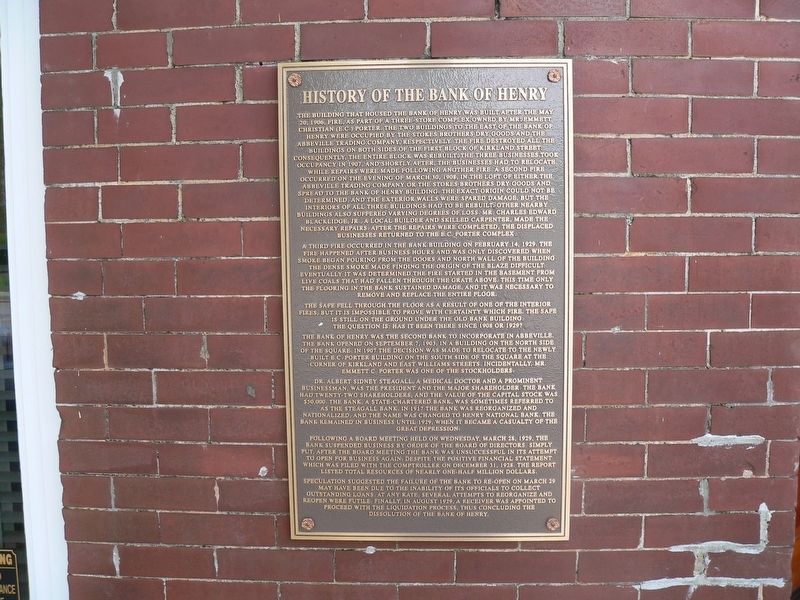
History of the Bank of Henry
Photographed by James L.Whitman, May 19, 2024
1. History of the Bank of Henry Marker
this page online
A third fire occurred in the bank building on February 14, 1929. The fire happened after business hours and was only discovered when smoke began pouring from the doors and north wall of the building. The dense smoke made finding the origin of the blaze difficult, eventually it was determined the fire started in the basement from live coals that had fallen through the grate above. This time only the flooring in the bank sustained damage, and it was necessary to remove and replace the entire floor.
The safe fell through the floor as a result of one of the interior fires, but it is impossible to prove with certainty which fire. The safe is still on the ground under the old bank building. The question is: has it been there since 1908 or 1929?
The Bank of Henry was the second bank to incorporate in Abbeville. The bank opened on September 7, 1903, in a building on the north side of the square. In 1907 the decision was made to relocate to the newly built E.C. Porter building on the south side of the square at the corner of Kirkland and East Williams Streets. Incidentally, Mr. Emmett C. Porter was
Photographed by James L.Whitman, May 19, 2024
2. History of the Bank of Henry Marker
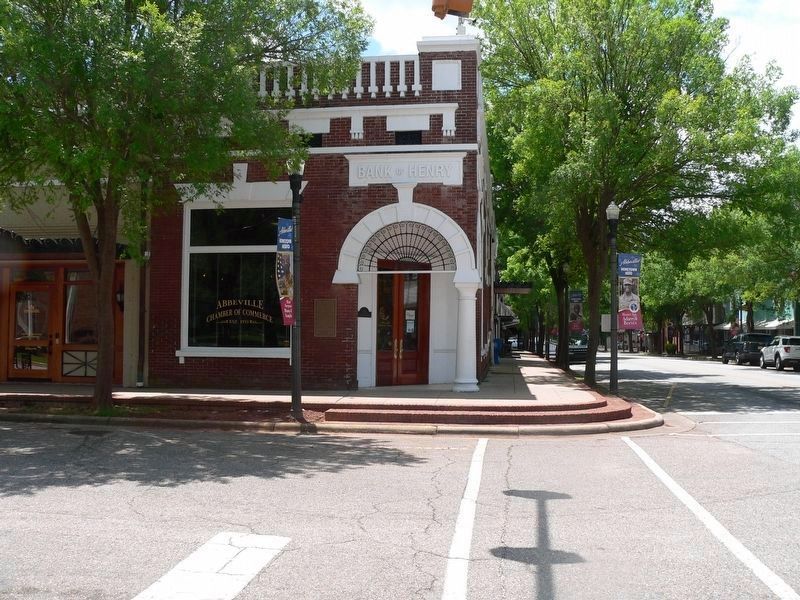
It is between the window and the door.
Dr. Albert Sidney Steagall, a medical doctor and a prominent businessman, was the president and the major shareholder. The bank had twenty-two shareholders, and the value of the capital stock was $50,000. The bank, a state-chartered bank, was sometimes referred to as the Steagall Bank. In 1917 the bank was reorganized and nationalized, and the name was changed to Henry National Bank. The bank remained in business until 1929, when it became a casualty of the Great Depression.
Following a board meeting held on Wednesday, March 28, 1929, the bank suspended business by order of the board of directors. Simply put, after the board meeting the bank was unsuccessful in its attempt to open for business again, despite the positive financial statement which was filed with the comptroller on December 31, 1928. The report listed total resources of nearly one-half million dollars.
Speculation suggested the failure of the bank to re-open on March 29 may have been due to the inability of its officials to collect outstanding loans. At any rate, several attempts to reorganize and reopen were futile, finally, in August
Photographed by James L.Whitman, May 19, 2024
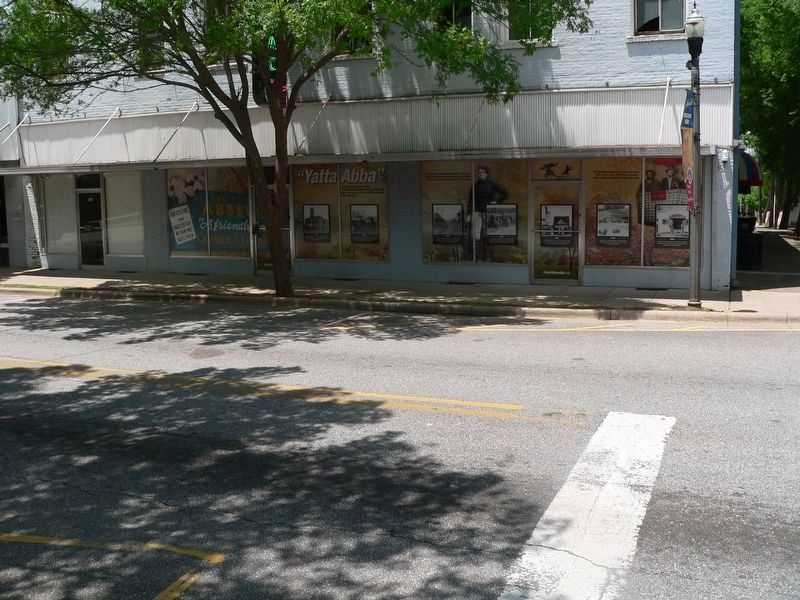
3. A view of the other side of the street
Topics. This historical marker is listed in this topic list: Notable Buildings. A significant historical date for this entry is September 7, 1903.
Location. 31° 34.246′ N, 85° 15.009′ W. Marker is in Abbeville, Alabama, in Henry County. It is at the intersection of East William Street and Kirkland Street, on the right when traveling east on East William Street. Touch for map. Marker is at or near this postal address: 113 E Williams St, Abbeville AL 36310, United States of America. Touch for directions.

Regionally, this marker is in the American South, specifically in the Deep South, and in the Wiregrass. Globally, it is in North America, a Gulf of Mexico state, the Western Hemisphere, the Western World, and the Anglosphere. Historically, it finds itself in what was once the territory of the Mississippian Culture, one of the Confederate States of America, and the Antebellum South.
Other nearby markers. At least 8 other markers are within walking distance of this marker: Henry, The Mother County (within shouting distance of this marker); Nordan's (within shouting distance of this marker); A County Older Than the State (within shouting distance of this marker); Archie Theatre (about 300 feet away, measured in a direct line); In Honor of William Calvin Oates (about 300 feet away); Abbeville / Seven Flags and an Arrow Over Abbeville (about 400 feet away); Methodist Episcopal Church, South (about 500 feet away); The First Baptist Church of Abbeville / Abbeville Pioneer Cemetery (approx. 0.2 miles away). Touch for a list and map of all markers in Abbeville.
Credits. This page was last revised on July 31, 2024. It was originally submitted on May 23, 2024, by James L.Whitman of Eufaula, Alabama. This page has been viewed 514 times since then and 78 times this year. Last updated on June 17, 2024, by James L.Whitman of Eufaula, Alabama. Photos: 1. submitted on May 23, 2024, by James L.Whitman of Eufaula, Alabama. 2, 3. submitted on June 17, 2024, by James L.Whitman of Eufaula, Alabama. • Bill Pfingsten was the editor who published this page.
