Wijlre in Gulpen-Wittem, Limburg, Netherlands — Northwestern Europe
Kazemat 11
⎯⎯⎯
Casemate 11

Photographed by Andrew Ruppenstein, May 29, 2024
1. Kazemat 11 / Casemate 11 Marker

De inzet van de Nederlandse soldaten in de bunkers van deze linie had tot doel de Duitse inval in mei 1940 te vertragen middels het opblazen van de Geulbruggen. Deze kazemat, type S-3, had drie schietopeningen met een Lewis M20 mitrailleur: in de volksmond vaak het stekelvarken of spinnenkop genoemd door de uitstekende haken.
In de nacht van 9 op 10 mei 1940 kwam het telefonisch bericht om de Geulbrug in Wijlre op te blazen. Hierna heeft Sergeant Cremers met zijn soldaten zich teruggetrokken naar het voorgeschreven punt in Scheulder. In allerij hadden zij de mitrailleur en de rijwielen achter moeten laten. Een paar uur later werden zij krijgsgevangen gemaakt door de Duitsers. Maanden na het vernielen van de Geulbrug is er een houten noodbrug gebouwd, zodat de bewoners van Beertsenhoven, Stokhem, Berghof en Keutenberg Wijlre weer konden bereiken. De Geulbrug is herbouwd in 1941,door aannemer Laeven uit Heerlen voor een bedrag van 29.900 gulden, waarna deze wederom opgeblazen werd
this page online
(Wijlre werd op donderdag 14 september 1944 door de Amerikanen bevrijd)
You are at Casemate 11 of type S-3, which was part of the delaying line of the Dutch Geul defensive line.
The aim of the deployment of Dutch soldiers in the bunkers of this line was to delay the German invasion in May 1940 by blowing up the Geul bridges. This casemate, type S-3, had three firing openings with a Lewis M20 machine gun: colloquially often called the porcupine or spider's head because of the protruding hooks.
On the night of May 9 to 10, 1940, the telephone message came to blow up the Geul Bridge in Wijlre. After this, Sergeant Cremers and his soldiers withdrew to the prescribed point in Scheulder. They had to leave the machine gun and bicycles behind in all haste. A few hours later they were taken prisoner by the Germans. Months after the destruction of the Geul Bridge, a wooden emergency bridge was built so that the residents of Beertsenhoven, Stokhem, Berghof and
Photographed by Andrew Ruppenstein, May 29, 2024
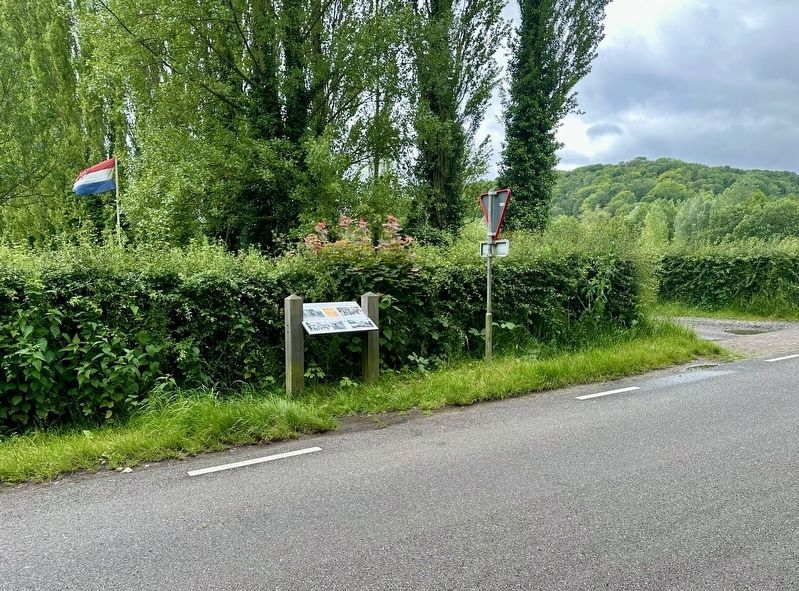
2. Kazemat 11 / Casemate 11 Marker - wide view
The casemate itself is not really visible from the road, but the Dutch flag indicates the location of the casemate.
(Wijlre was liberated by the Americans on Thursday, September 14, 1944)
Erected by Gemeente Gulpen-Wittem, Heemkunde Vereniging Wijlre.
Topics. This historical marker is listed in these topic lists: Bridges & Viaducts • Forts and Castles • War, World II. A significant historical date for this entry is May 10, 1940.
Location. 50° 49.783′ N, 5° 53.472′ E. Marker is in Wijlre, Limburg, in Gulpen-Wittem. It is at the intersection of Kasteel Wijlreweg and Gulpenerweg, on the left when traveling west on Kasteel Wijlreweg. Touch for map. Marker is at or near this postal address: Kasteel Wijlreweg 3, Wijlre, Limburg 6321 PP, Netherlands. Touch for directions.

Regionally, it is in Europe, the European Union, Atlantic Europe, the Benelux Low Countries, the Schengen Area, Western Europe, and the

Photographed by Andrew Ruppenstein, May 29, 2024
3. Kazemat 11 / Casemate 11
Other nearby markers. At least 8 other markers are within 3 kilometers of this marker, measured as the crow flies: Kasteel Wijlre (a few steps from this marker); Juliana en Bernhard boom / Juliana and Bernhard Tree (approx. 1.6 kilometers away); Gulpen bevrijd / Gulpen Liberated (approx. 1.6 kilometers away); Remise (approx. 1.9 kilometers away); Zuid-Limburgse Vakwerkhoeve / South Limburg Half-timbered Farmhouse (approx. 2.6 kilometers away); P51d Mustang jachtvliegtuig neergestort / P51d Mustang Fighter Plane Crash (approx. 2.6 kilometers away); Onze Lieve Vrouw van Fatima-kapel / Our Dear Lady of Fatima Chapel (approx. 2.6 kilometers away); Oude School / Old School (approx. 3.1 kilometers away).
More about this marker. The marker is located opposite the southern gate of Kasteel Wijlre on Kasteel Wijlreweg. There is no parking nearby and the roads have no shoulder here. Note that just a few steps west of the marker there is a narrow unpaved service road running perpendicular to Kasteel Wijlreweg that one might chance a brief stop on, depending on how adventurous or indiscreet one is feeling. There does not seem to be any public access to the casemate, although one might also note that there is a gap in the hedgerow between that same service road and the casemate itself.
Regarding Kazemat 11 / Casemate 11. The Geul Bridge, mentioned on the marker, is roughly 60 meters due east of the marker site.
Credits. This page was last revised on June 17, 2024. It was originally submitted on June 17, 2024, by Andrew Ruppenstein of Lamorinda, California. This page has been viewed 244 times since then and 46 times this year. Photos: 1, 2, 3. submitted on June 17, 2024, by Andrew Ruppenstein of Lamorinda, California.
