Peterborough, England, United Kingdom — Northwestern Europe (the British Isles)
St Thomas Becket
Photographed by Stephen Palmer, May 31, 2024
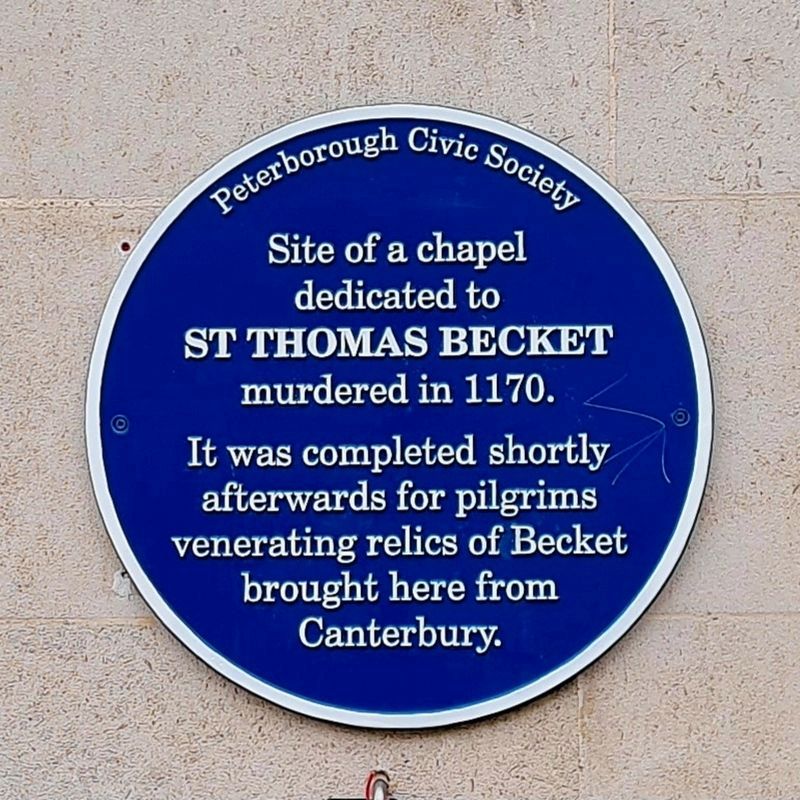
1. St Thomas Becket Marker
Site of a chapel dedicated to St Thomas Becket murdered in 1170.
It was completed shortly afterwards for pilgrims venerating relics of Becket brought here from Canterbury.
Erected by Peterborough Civic Society.
Topics. This historical marker is listed in this topic list: Religion & Religious Structures. A significant historical date for this entry is December 29, 1170.
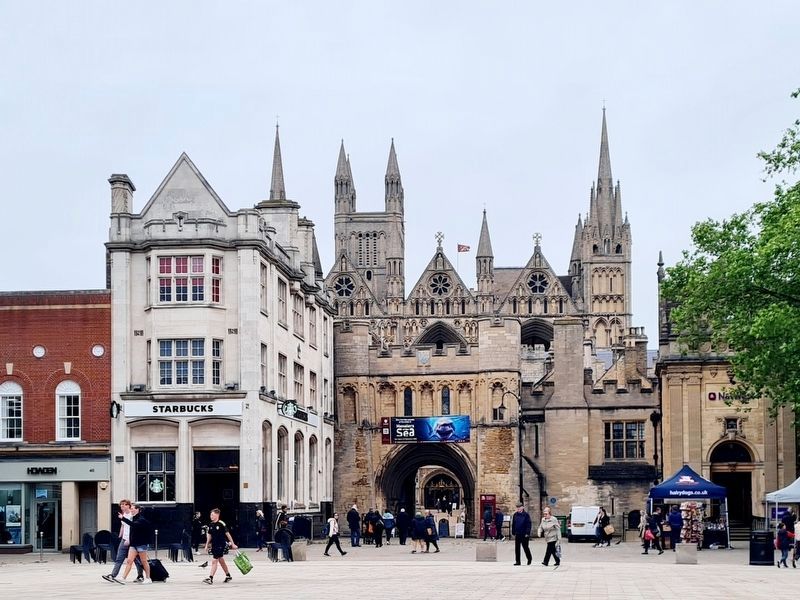
Location. 52° 34.353′ N, 0° 14.527′ W. Marker is in Peterborough, England. It can be reached from Cathedral Square. Marker is on the side of Starbucks by the Cathedral Gatehouse. Touch for map. Marker is at or near this postal address: Starbucks Cathedral Square, Peterborough, England PE1 1YD, United Kingdom. Touch for directions.

Regionally, this marker is in East Anglia. Globally, it is on the Atlantic Ocean, in the North Atlantic Region, in Europe, in Atlantic Europe, on one of the British Isles, in the Western World, and in the Anglosphere. Historically, it finds itself in what was once the Roman Empire.
Other nearby markers. At least 8 other markers are within walking distance of this marker: Markets and Monarchs (within shouting distance
this page online
Also see . . . Thomas Becket (Wikipedia).
Overview: Thomas Becket, also known as Saint Thomas of Canterbury, Thomas of London and later Thomas à Becket (21 December 1119 or 1120 – 29 December 1170), served as Lord Chancellor from 1155 to 1162, and then notably as Archbishop of Canterbury from 1162 until his death in 1170. He engaged in conflict with Henry II, King of England, over the rights and privileges of the Church and was murdered by followers of the King in Canterbury Cathedral. Soon after his death, he was canonised by Pope Alexander III. He is venerated as a saint and martyr by the Catholic Church and the Anglican Communion.

Photographed by Stephen Palmer, May 31, 2024
2. St Thomas Becket Marker
Photographed by Stephen Palmer, May 31, 2024
3. Starbucks next to the Cathedral Gatehouse
Credits. This page was last revised on June 18, 2024. It was originally submitted on June 18, 2024, by Stephen Palmer of Ascot, England. This page has been viewed 226 times since then and 23 times this year. Photos: 1, 2, 3. submitted on June 18, 2024, by Stephen Palmer of Ascot, England. • Andrew Ruppenstein was the editor who published this page.
