Cricqueville-en-Bessin in Calvados, Normandy, France — Western Europe
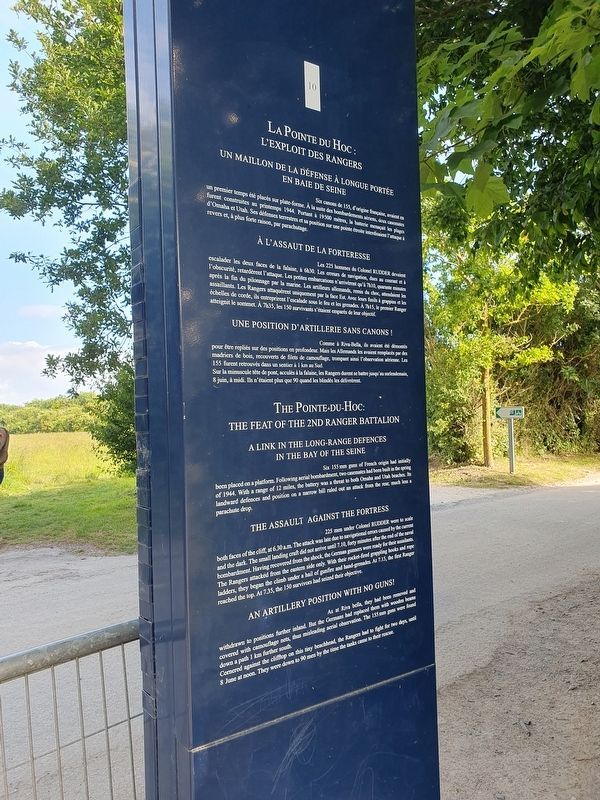
The Pointe-du-Hoc: the Feat of the 2nd Ranger Battalion
Photographed by J. Makali Bruton, June 5, 2024
1. The Pointe-du-Hoc: the Feat of the 2nd Ranger Battalion Marker

La Pointe du Hoc: L'exploit des Rangers
Un maillon de la défense a longue portée en Baie de Seine
Six canons 155, origine française, avaient en un premier temps été placés sur plate-forme. À la suite des bombardements aériens, deux casemates furent construites au printemps 1944. Portant à 19500 miles, le batterie menaçait les plages d’Omaha et Utah. Ses défenses terrestres et sa position sur une pointe étroites interdisaient l’attaque à revers et, à plus forte raison, par parachutage.
À l'assaut de la Forteresse
Les 225 hommes du Colonel Rudder devaient escalader les deux faces de la falaise, à 6h30. Les erreurs de navigation, dues au courant et à l'obscurité, retardèrent l'attaque. Les petites embarcations n’arriverent qu'à 7h10, quarante minutes après la fin du pilonnage par la marine. Les artilleurs allemands, venis, remis du choc, attendaient les assaillants. Les Rangers attaquèrent uniquement par la face Est. Avec leurs fusils à grappins et les échelles de corde, ils entreprirent l'escalade sous le feu et les grenades. À 7h15, le premier Ranger atteignite le sommet. À 7h35, les 150 survivants s'étaient
this page online
Une position d'artillerie sans canons!
Comme à Riva-Bella, ils avaient démontés pour être repliés sur des positions en profondeur. Mais les Allemands les avaient remplacés par des madriers de bois, recouverts de filets de camouflags, trompant ainsi l’observation aérienne. Les 155 furent retrouvés dans un sentier à 1 km au Sud. Sur la minuscule tête de pont, acculés à la falaise, les Rangers durant se battre jusqu'au surlendemain, 8 juin, à midi. Ils n'étaient plus que 90 quand les blindés les délivrent.
The Pointe-du-Hoc: the Feat of the 2nd Ranger Battalion
A link in the long-range defences in the Bay of the Seine
Six 155 mm guns of French origin had initially been placed on a platform. Following aerial bombardment, two casemates had been built in the spring of 1944. With a range of 12 miles, the battery was a threat to both Omaha and Utah beaches. Its landward defences and position on a narrow bill ruled out an attack from the rear, much less a parachute drop.
The assault against the fortress
225 men under Colonel Rudder were to scale both faces of the cliff, at 6.30 a.m. The attack was late
Photographed by J. Makali Bruton, June 5, 2024
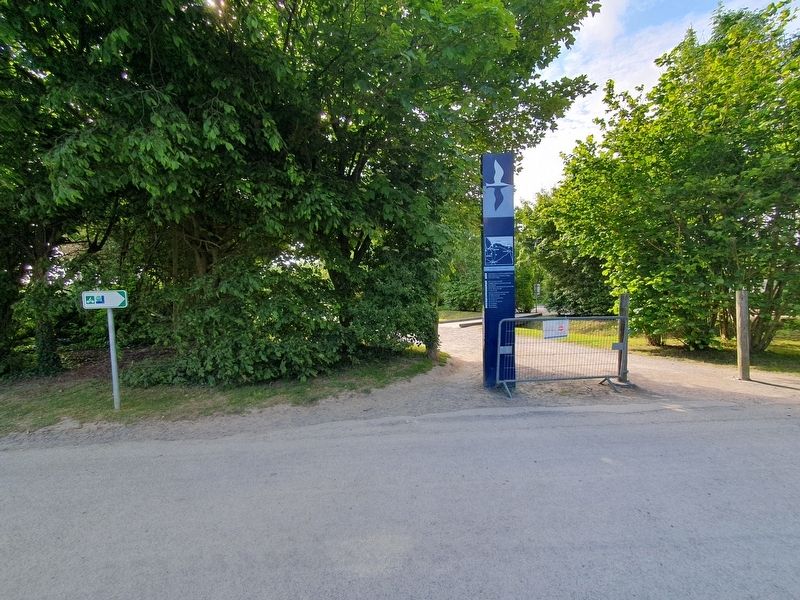
2. The Pointe-du-Hoc: the Feat of the 2nd Ranger Battalion Marker
This wide view of the marker shows its reverse. It is near the parking area for the Pointe-du-Hoc visitors center.
An artillery position with no guns!
As at Riva bella, they had been removed and withdrawn to positions further inland. But the Germans had replaced them with wooden beams covered with camouflage nets, thus misleading aerial observation. The 155 mm guns were found down a path 1 km farther south. Cornered against the clifftop on this tiny beachhead, the Rangers had to fight for two days, until 8 June at noon. They were down to 90 men by the time the tanks came to their rescue. (Marker Number 10.)
Topics. This memorial is listed in this topic list: War, World II. A significant historical year for this entry is 1944.
Location. 49° 23.604′ N, 0° 59.389′ W.
Photographed by J. Makali Bruton, June 5, 2024
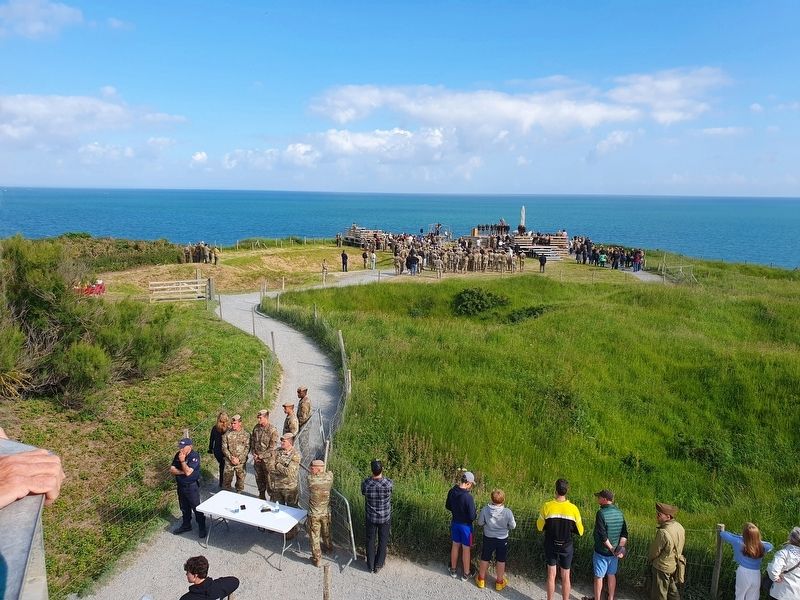
3. A view towards Pointe-du-Hoc during the 80th anniversary celebration

Regionally, it is in the North Atlantic Region, Europe, the European Union, Atlantic Europe, the Schengen Area, Western Europe, a coastal Mediterranean country, and the Western World. Historically, it finds itself in what was once a French colony and also the Roman Empire.
Other nearby markers. At least 8 other markers are within 3 kilometers of this marker, measured as the crow flies: Ranger Casualties (about 120 meters away, measured in a direct line); Pointe du Hoc (about 210 meters away); Preparing to Invade (approx. 0.2 kilometers away); Bravery Under Fire (approx. 0.2 kilometers away); a different marker also named Pointe du Hoc (approx. 0.4 kilometers away); Les belles demeures / The beautiful houses (approx. 2 kilometers away); Le village / The village (approx. 2 kilometers away); Le patrimoine bâti / The built heritage (approx. 2.6 kilometers away). Touch for a list and map of all markers in Cricqueville-en-Bessin.
Also see . . . Pointe du Hoc at Wikipedia. (Submitted on June 20, 2024, by J. Makali Bruton of Washington, District of Columbia.)
Credits. This page was last revised on June 20, 2024. It was originally submitted on June 20, 2024, by J. Makali Bruton of Washington, District of Columbia. This page has been viewed 200 times since then and 23 times this year. Photos: 1, 2, 3. submitted on June 20, 2024, by J. Makali Bruton of Washington, District of Columbia.
