Colorado City in Mohave County, Arizona — The American Mountains (Southwest)
The Early History

Photographed by Jeremy Snow, April 20, 2024
1. The Early History Marker
this page online
Erected by CCUSD Senior Class of 1990.
Topics. This historical marker is listed in these topic lists: Religion & Religious Structures • Settlements & Settlers. A significant historical year for this entry is 1862.
Location. 36° 59.426′ N, 112° 57.893′ W. Marker is in Colorado City, Arizona, in Mohave
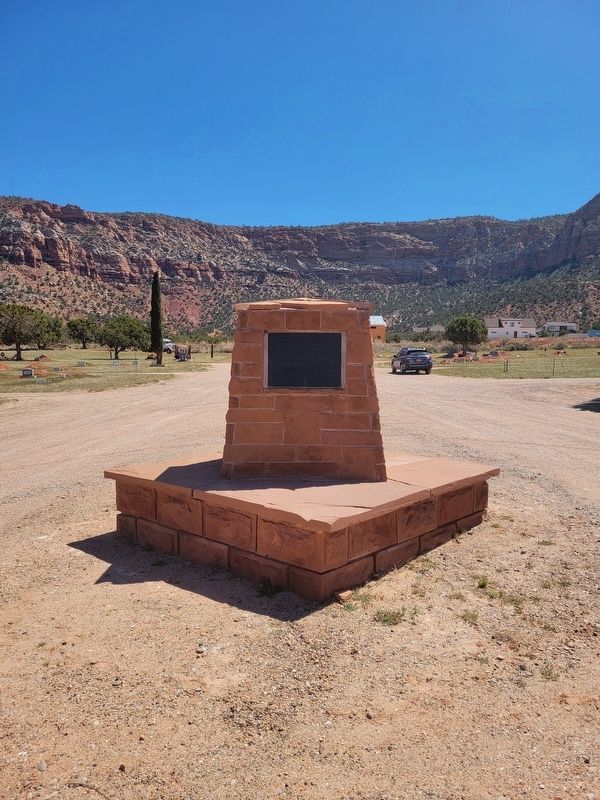
Photographed by Jeremy Snow, April 20, 2024
2. The Early History Marker

Regionally, this marker is in the American Southwest and on the Colorado Plateau. Globally, it is in North America, the Western Hemisphere, the Western World, and the Anglosphere. Historically, it finds itself in what was once New Spain and also Mexico’s Alta California.
Other nearby markers. At least 7 other markers are within 14 miles of this marker, measured as the crow flies: The Historic Dixie-Long Valley, Utah Pioneer Trail (approx. 3.1 miles away); Rockville Bridge (approx. 12.3 miles away in Utah); a different marker also named Rockville Bridge (approx. 12.3 miles away in Utah); Grafton Cemetery (approx. 13½ miles away in Utah); Grafton, Utah (approx. 13.8 miles away in Utah); Discovery of Zion Canyon (approx. 13.9 miles away in Utah); Historic Irrigation Ditch (approx. 14.1 miles away in Utah).
Photographed by Jeremy Snow, April 20, 2024
3. The Modern Era
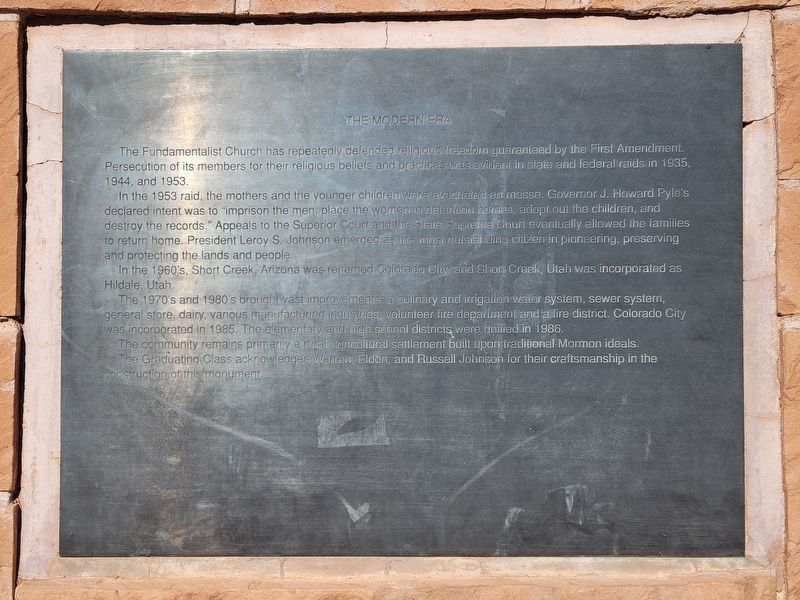
THE MODERN ERA The Fundamentalist Church has repeatedly defended religious freedom guaranteed by the First Amendment. Persecution of its members for their religious beliefs and practices was evident in state and federal raids in 1935, 1944, and 1953. In the 1953 raid, the mothers and the younger children ware evacuated en masse. Governor J. Howard Pyle's declared intent was to "imprison the men, place the women in detention homes, adopt out the children, and destroy the records.” Appeals to the Superior Court and the State Supreme Court eventually allowed the families to return home. President Leroy S. Johnson emerged as the most outstanding citizen in pioneering, preserving, and protecting the lands and people. In the 1960's, Short Creek, Arizona was renamed Colorado City, and Short Creek, Utah was incorporated as Hildale, Utah. The 1970's and 1980's brought vast improvements: a culinary and irrigation water system, sewer system, general store, dairy, various manufacturing industries, volunteer fire department and a fire district. Colorado City was incorporated in 1985. The elementary and high school districts were unified in 1986. The community remains primarily a rural agricultural settlement built upon traditional Mormon ideals. The Graduating Class acknowledges Warren, Eldon, and Russell Johnson for their craftsmanship in the construction of this monument.
Photographed by Jeremy Snow, April 20, 2024
4. The Valley and the Mountains
he Valley and the Mountains
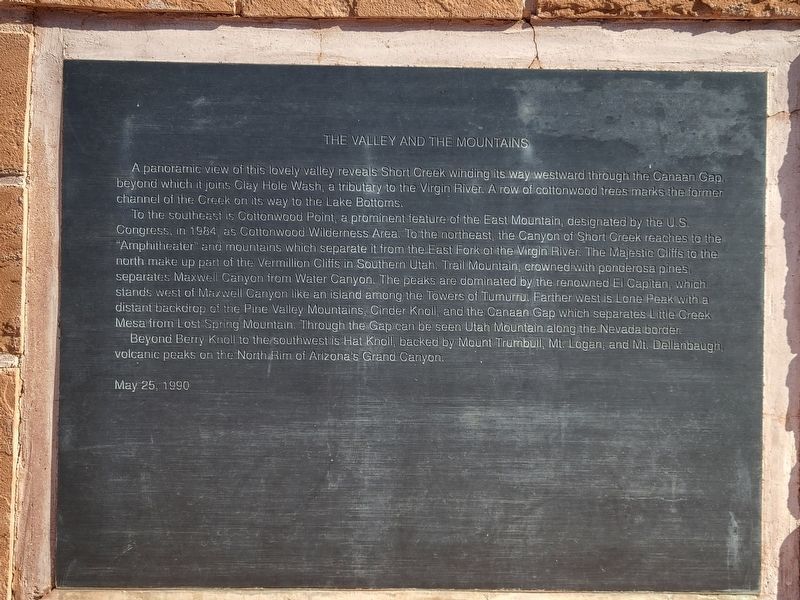
A panoramic view of this lovely valley reveals Short Creek winding its way westward through the Canaan Gap, beyond which it joins Clay Hole Wash, a tributary to the Virgin River. A row of cottonwood trees marks the former channel of the Creek on its way to the Lake Bottoms. To the southeast is Cottonwood Ppoint, a prominent feature of the East Mountain, designated by the U.S. Congress, in 1984, as Cottonwood Winderness Area. To the northeast, the Canyon of Short Creek reaches to the "Amphitheater" and mountains which separate it from the East Fork of the Virgin River. The Majestic Cliffs to the north make up part of the Vermillion Cliffs in Southern Utah. Trail Mountain, crowned by the removned El Capitan, which stands west of Maxwell Canyon like an island amoung the Towers of Tumurru. Father west in Lone Peak with a distant backdrop of the Pine Valley Mountains, Cinder Knoll, and the Canaan Gap which separates Little Creek Mesa from Lost Spring Mountain. Through the Gap can be seen Utah Mountain along the Nevada border. Beyond Berry Knowll to the southwest is Hat Knoll, back by Mount Trumbull, Mt. Logan, and Mt. Dellenbaugh, volcanic peaks on the North Rim of Arizona's Grand Canyon.
Credits. This page was last revised on June 28, 2025. It was originally submitted on June 21, 2024, by Jeremy Snow of Cedar City, Utah. This page has been viewed 503 times since then and 107 times this year. Photos: 1, 2, 3, 4. submitted on June 21, 2024, by Jeremy Snow of Cedar City, Utah. • Bill Pfingsten was the editor who published this page.
