Marker Logo
THE HISTORICAL
MARKER DATABASE
“Bite-Size Bits of Local, National, and Global History”
Saratoga Springs in Utah County, Utah — The American Mountains (Southwest)
 

Camp W.G. Williams Hostess House/Officers Club

— National Register —


Camp W.G. Williams Hostess House/Officers Club Marker image. Click for full size.
Photographed by Jeremy Snow, June 23, 2024
1. Camp W.G. Williams Hostess House/Officers Club Marker
Inscription. Constructed 1935-38, the Camp W.G. Williams Officers Club, originally the Hostess House, is significant for its association with the public works programs of the New Deal era. The building was constructed as a joint Federal Emergency Relief Administration (FERA) and Works Progress Administration (WPA) project at a cost of $32,735. Federal relief programs were extensive in Utah because of the impact the Great Depression had on the state. During the period 1932-1940, Utah had a very high unemployment rate, among the highest in the nation, and was one of the highest recipients of federal funds for construction. Building projects such as the Officers Club were important during the era since virtually every public building constructed in Utah was completed under federal programs by one of several agencies. In its original function as a hostess house, the Officers Club was intended as a place where wives and families of officers and men at Camp Williams could socialize and also hold camp functions. Designed in the English Tudor style by the local architect Edward O. Anderson, the building features decorative split-stone rubble,
Paid Advertisement
Click or scan to see
this page online
facing both the interior and exterior; decorative false half-timbering in the gables; and a large split-stone fireplace with opposite halves of stone placed symmetrically at the centerline. All stone, sand, and gravel used in the construction was quarried from the Camp Williams Military Reservation. The English Tudor style was popular in Utah in the 1920s and 1930s in both residential and public architecture. This is one of the larger buildings in the state to feature the style.
 
Erected 2004 by Utah Division of State History.
 
Topics and series. This historical marker is listed in these topic lists: ArchitectureMilitary. In addition, it is included in the Works Progress Administration (WPA) projects series list. A significant historical year for this entry is 1935.
 
Location. 40° 26.076′ N, 111° 55.332′ W. Marker is in Saratoga Springs, Utah, in Utah County. It is on Camp Williams, on the right when traveling east. Touch for map. Marker is at or near this postal address: 6300 Camp Williams, Saratoga Springs UT 84045, United States of America. Touch for directions.

Regionally, this marker is in the Wasatch Front and in Greater
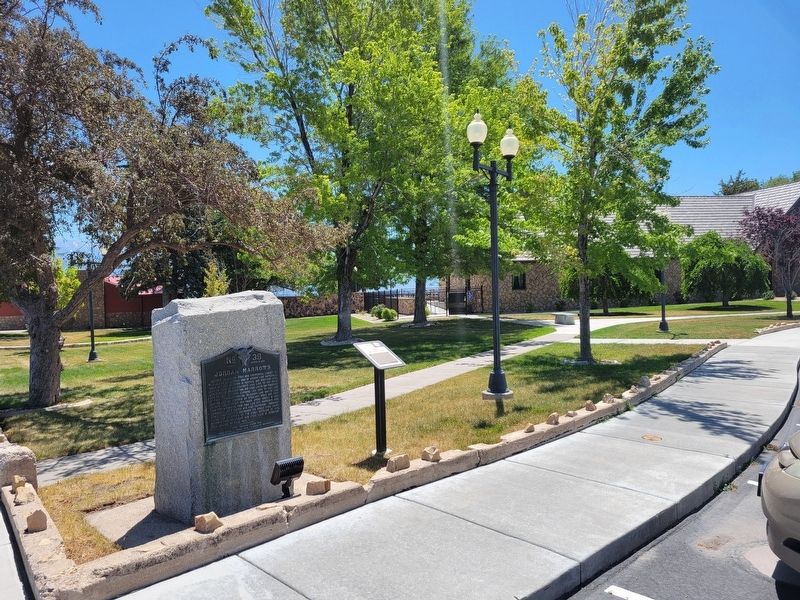
Camp W.G. Williams Hostess House/Officers Club Marker image. Click for full size.
Photographed by Jeremy Snow, June 23, 2024
2. Camp W.G. Williams Hostess House/Officers Club Marker
Provo. It is also in the American Mountain West and on the Colorado Plateau. Globally, it is in North America, the Rocky Mountains, the Western Hemisphere, the Western World, and the Anglosphere. Historically, it finds itself in what was once New Spain and also Mexico’s Alta California.

Other nearby markers. At least 8 other markers are within 5 miles of this marker, measured as the crow flies: Jordan Narrows (here, next to this marker); Indian Ford Ferry (Rocky Ford Ferry) (approx. half a mile away); Harder Memorial (approx. 0.7 miles away); Rockwell's Original Station (approx. 3.6 miles away); Rockwell Station (approx. 3.6 miles away); a different marker also named Rockwell Station (approx. 3.7 miles away); a different marker also named Rockwell Station (approx. 3.7 miles away); War Memorial (approx. 4.1 miles away).
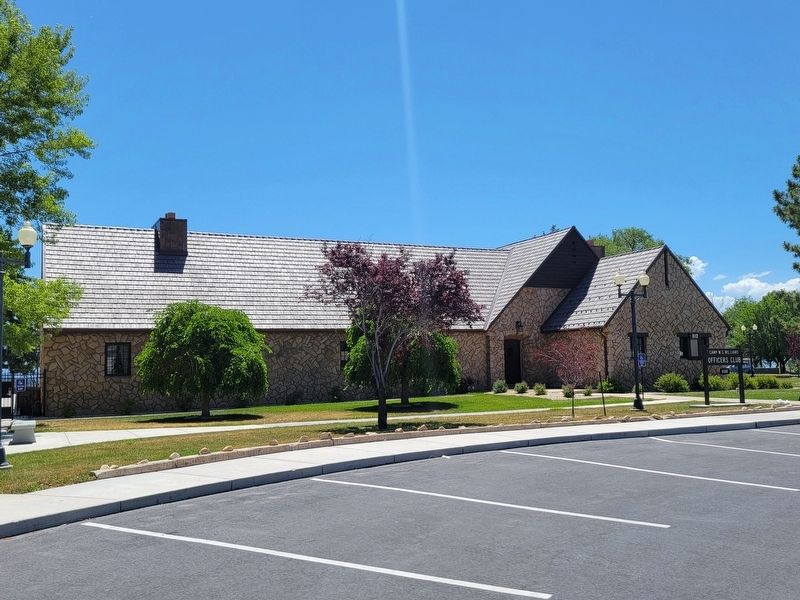
 
Camp W.G. Williams Hostess House/Officers Club Building image. Click for full size.
Photographed by Jeremy Snow, June 23, 2024
3. Camp W.G. Williams Hostess House/Officers Club Building
 
 
Credits. This page was last revised on June 25, 2024. It was originally submitted on June 24, 2024, by Jeremy Snow of Cedar City, Utah. This page has been viewed 342 times since then and 69 times this year. Photos:   1, 2, 3. submitted on June 24, 2024, by Jeremy Snow of Cedar City, Utah. • Andrew Ruppenstein was the editor who published this page.

m=249483

CeraNet Cloud Computing sponsors the Historical Marker Database.
This website earns income from purchases you make after using our links to Amazon.com. We appreciate your support.
Paid Advertisement
Sep. 10, 2026