Cricqueville-en-Bessin in Calvados, Normandy, France — Western Europe
Bravery Under Fire
Courage
Photographed by J. Makali Bruton, June 5, 2024
1. Bravery Under Fire Marker

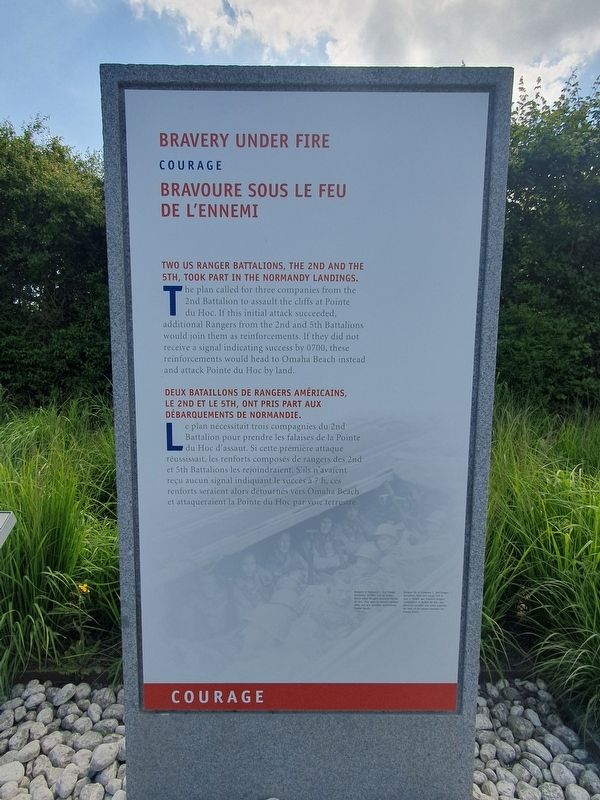
Bravery Under Fire
Two US Ranger battalions, the 2nd and the 5th, took part in the Normandy landings.
The plan called for three companies from the 2nd Battalion to assault the cliffs at Pointe du Hoc. If this initial attack succeeded, additional Rangers from the 2nd and 5th Battalions would join them as reinforcements. If they did not receive a signal indicating success by 0700, these reinforcements would head to Omaha Beach instead and attack Pointe du Hoc by land.
Rangers of Company C, 2nd Ranger Battalion, in their LCA on D-Day. While other Rangers attacked Pointe du Hoc, they were to assault another radar and gun position overlooking Omaha Beach.
Capt John Raaen | HQ Company, 5th Ranger Battalion
When no word came of the Ranger’s success at Pointe du Hoc, Captain Raaen and his company diverted to Omaha Beach with the rest of the 5th Ranger Battalion.
The 5th Ranger Battalion played a key role in breaching the German beach defenses. Like most of the Rangers from Omaha, Raaen broke through to Pointe de Hoc on the morning of June 8. Accompanied by elements of the 116th Infantry Regiment, 29th Infantry Division,
this page online
Captain John Raaen served throughout the Normandy campaign and was awarded the Silver Star for his actions on D-Day. Seriously wounded in December 1944, he recovered and later retired from the Army as a major general.
Both Ranger battalions fought further battles after Pointe du Hoc. Their next major engagement was the arduous siege of Brest. Left, American Infantrymen enter the outskirts of Brest under German machine gun fire on September 9, 1944.
Rangers at Pointe du Hoc firing on German forces from one of the many shell holes and bomb craters that covered the battlefield.
Holding the Line
The Germans launched fierce counterattacks to recapture Pointe du Hoc.
During the night of June 6, the outnumbered Rangers repelled two major attacks south of the coast road before pulling back to Pointe du Hoc. The American force fought for the next two days, supported by naval gunfire and a trickle of reinforcements and supplies. On June 8 a relief force from Omaha Beach broke through to relieve the embattled defenders. Although more than
Photographed by J. Makali Bruton
2. Bravery Under Fire Marker
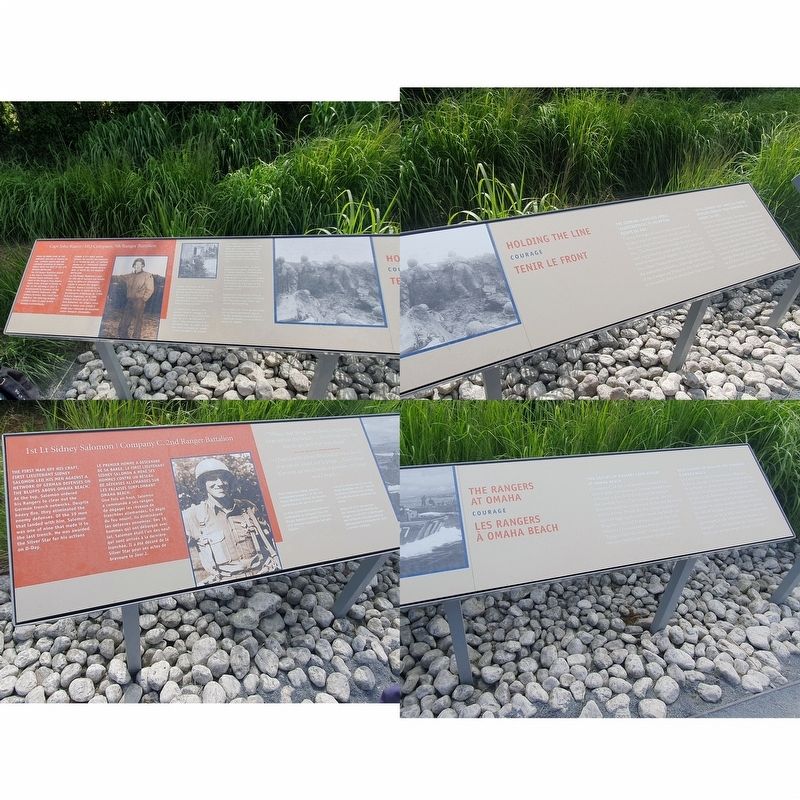
This collage includes portions of the marker's first two panels.
1st Lt Sidney Salomon | Company C, 2nd Ranger Battalion
The first man off his craft, First Lieutenant Sidney Salomon led his men against a network of German defenses on the bluffs above Omaha Beach.
At the top, Salomon ordered his Rangers to clear out the German trench networks. Despite heavy fire, they eliminated the enemy defenses. Of the 39 men that landed with him, Salomon was one of nine that made it to the last trench. He was awarded the Silver Star for his actions on D-Day.
"When that thing went down, you had to clear out on the beach.... So we had only one way to go, and that was ahead?
Tech Corps Fred Millet, 5th Ranger Battalion
First Lieutenant Sidney Salomon commanded Company C of the 2nd Ranger Battalion during the invasion and finished the war as a captain.
LCA 1377 carrying men of the 5th Ranger Battalion. LCA 1377 was hit by German artillery after landing at Omaha Beach but withstood the attack.
The Rangers at Omaha Beach
Two groups of Rangers came ashore at Omaha Beach.
Company C of the 2nd Battalion landed first,
Photographed by J. Makali Bruton
3. Bravery Under Fire Marker
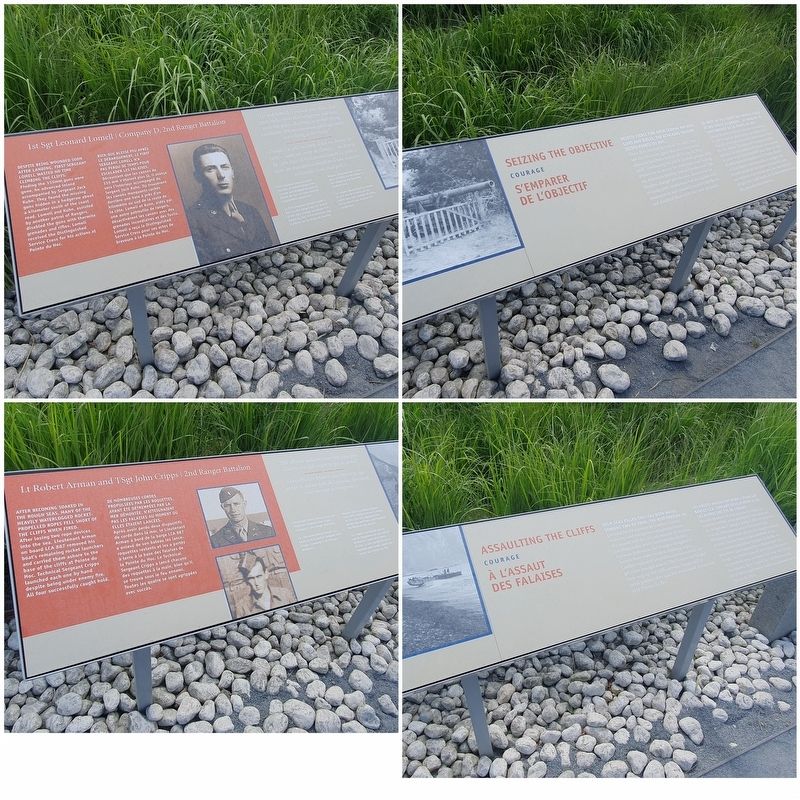
This collage includes portions of the marker's last two panels.
1st Sgt Leonard Lomell | Company D, 2nd Ranger Battalion
Despite being wounded soon after landing, First Sergeant Lomell wasted no time climbing the cliffs.
Finding the 155mm guns were gone, he advanced inland accompanied by Sergeant Jack Kuhn. They found the missing guns hidden in a hedgerow about a kilometer south of the coast road. Lomell and Kuhn, assisted by another patrol of Rangers, disabled the guns with thermite grenades and rifles. Lomell received the Distinguished Service Cross for his actions at Pointe du Hoc.
"Lo and behold, I peeked over this-just pure luck-over this hedgerow and there were the guns, all sitting in proper firing condition, the ammunition piled up neatly, everything
Photographed by J. Makali Bruton, June 5, 2024
4. Bravery Under Fire Marker
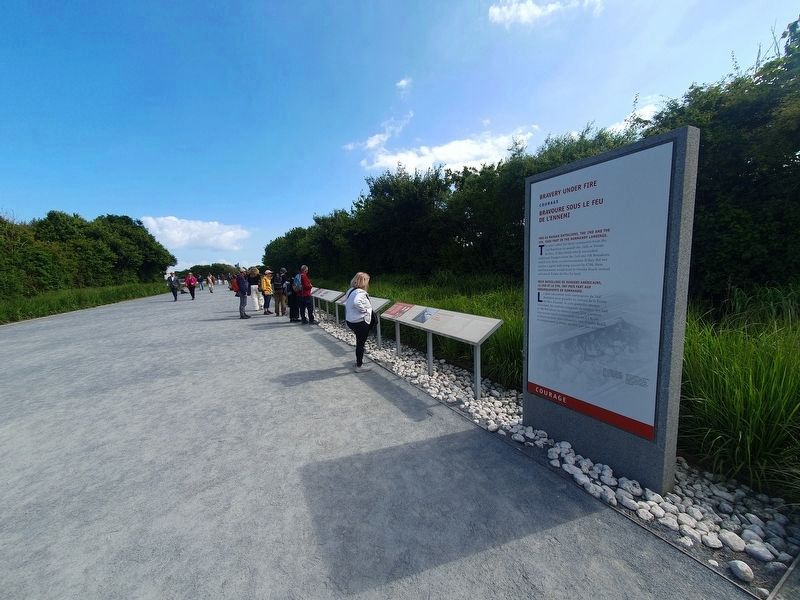
View of multiple panels that make up the marker, looking north towards the beach.
1st Sgt Leonard Lomell 2nd Ranger Battalion
First Sergeant Leonard Lomell was one of several Rangers who located and disabled the guns at Pointe du Hoc. He later received a battlefield commission.
Rangers discovered the 155mm guns of Pointe du Hoc hidden in this hedgerow and promptly disabled them.
Seizing the Objective
Despite fierce fire from German machine guns and rifles, the attacking rangers seized Pointe du Hoc.
When they reached the top of the cliffs, they saw that the heavy guns that were their main objective had been moved off Pointe du Hoc itself. Continuing the attack in small groups, they pressed on to secure the vital coast road linking the American landing sites at Omaha and Utah Beaches. Ranger patrols soon discovered the missing guns, unmanned but stockpiled with ammunition and pointed toward Utah Beach, and disabled them with thermite grenades.
Lt Robert Arman and TSgt John Cripps | 2nd Ranger Battalion
After becoming soaked in the rough seas, many of the heavily waterlogged rocket- propelled ropes fell short of the cliffs when fired.
After losing two rope devices into the sea, Lieutenant Arman on board LCA 887 removed his boat's remaining rocket launchers and carried them ashore to the base of the cliffs at Pointe du Hoc. Technical Sergeant Cripps launched each one by hand despite being under enemy fire. All four successfully caught hold.
"The officers said everyone that even gets close to the cliff ought to get an award."
Pvt Salva Maimone, 2nd Ranger Battalion
Lieutenant Robert Arman (top) and Technical Sergeant John Cripps, Company F, 2nd Ranger Battalion.
Rangers train in southern England near cliffs similar to these at Pointe du Hoc. This LCA, equiped with rocket rope launchers, participated in the Pointe du Hoc assault.
Assaulting the Cliffs
High seas filled the LCAs with water, sinking two of them. The rest pressed on.
Delayed for 40 minutes by weather, limited visibility, and navigation equipment failure, the assault lost the critical element of surprise. Landing under heavy fire from the alerted German defenders, the Rangers struggled to launch their water-soaked climbing ropes Ladder-equipped amphibious trucks could not get close enough ashore. The Americans fought their way up the cliffs anyway. Supported by naval gunfire, they quickly established themselves atop Pointe du Hoc.
****************************************************
Bravoure sous le fue de l’ennemi
Deux bataillons de Rangers américains, le 2nd et le 5th, ont pris part aux débarquements de Normandie.
Le plan nécessitait trois compagnies du 2nd Battalion pour prendre les falaises de la Pointe réussissait, les renforts composés de rangers des 2nd et 5th Battalions les rejoindraient. S'ils n'avaient reçu aucun signal indiquant le succès 17 h, ces renforts seraient alors détournés vers Omaha Beich et attaqueraient la Pointe du Hoc par voie terrestre.
Rangers de la Compagnie C, 2e bataillon de Rangers, dans leur barge LCA le jour J. Tandis que d’autres Rangers attaquaient la Pointe du Hoc, eux devaient attaque une autre position de radar et de canons surplombant Omaha Beach.
Capt John Raaen | HQ Company, 5th Ranger Battalion
Comme il n'y avait aucun signal du succès des Rangers à la Pointe du Hoc, le captain Raaen et sa compagnie furent detournes vers Omaha Beach avec le reste du 5th Ranger battalion.
Le 5th Ranger Battalion a joué un rôle clé en ouvrant une brèche dans les défenses allemandes. Comme la plupart des rangers d'Omaha, Raaen a avancé sur la Pointe du Hoc le matin du 8 juin. Accompagnés d'éléments du 116th Infantry Regiment, de la 29th Infantry Division, et du 743rd Tank Battalion, les rangers venus assurer la relève sont arrivés à temps pour repousser de nouvelles contre-attaques allemandes.
Le Captain John Raaen a servi pendant toute la campagne de Normandie et a reçu la Silver Star pour ses actes de bravoure le Jour J. Sérieusement blessé en décembre 1944, il a guéri et pris, plus tard, sa retraite de l'armée en tant que général de division.
Après la Pointe du Hoc, les deux bataillons de rangers ont pris part à d'autres batailles. L'intervention majeure suivante fut le pénible siège de Brest. Cl-dessus, les soldats d'infanterie américains entrent dans la périphérie de Brest sous le feu des mitrailleuses allemandes le 9 septembre 1944.
Des rangers à la Pointe du Hoc tirant sur les forces allemandes depuis l'un des nombreux trous d'obus et cratères de bombe qui couvraient le champ de bataille.
Tenir la front
Les allemands ont lance des contre attaques feroces pour reprendre la Pointe du Hoc.
Pendant la nuit du 6 juin, les rangers, dépassés en nombre, ont repoussé deux attaques importantes au sud de la route côtière avant de se replier à la Pointe du Hoc. Les forces américaines ont lutte les deux jours suivants, avec l'appui de l'artillerie navale et un filet de renforts et de matériel. Le 8 juin un renfort venu d'Omaha Beach a traversé les lignes pour soulager les défenseurs assiégés. Bien que plus de la moitié des rangers de la Pointe du Hoc aient été tués ou blessés, ils avaient accompli leur mission.
1st Lt Sidney Salomon | Company C, 2nd Ranger Battalion
Le premier homme à descendre de sa barge, le first lieutenant Sidney Salomon a mené ses hommes contre un réseau de défenses allemandes sur les falaises surplombant Omaha Beach.
Une fois en haut, Salomon a commandé à ses rangers de dégager les réseaux de tranchées allemandes. En dépit du feu nourri, ils éliminèrent les défenses ennemies. Des 39 hommes qui ont débarqué avec lui, Salomon était l'un des neuf qui sont arrivés à la dernière tranchée. Il a été décoré de la Silver Star pour ses actes de bravoure le Jour J.
« Quand cette chose descendait, vous deviez évacuer en allant sur la plage...Alors nous n'avions qu'un chemin à prendre, et c'était vers l'avant. »
Le First Lieutenant Sydney Salomon commandait la Company C du 2nd Ranger Battalion pendant l'invasion et il termina la guerre en tant que Captain.
Barge LCA 1377 transportant des hommes du Se bataillon de rangers. La LCA 1377 a été frappée par l'artillerie allemande après le débarquement à Omaha Beach, mais a résisté à l'attaque.
Les Rangers a Omaha Beach
Deux groupes de Rangers ont débarques a Omaha Beach.
La Company C du 2nd Battalion a débarqué d'abord, chargée d'éliminer à la Pointe et au Raz de la Percée un point fort allemand qui menaçait les forces du débarquement. Le deuxième groupe, le 5th Battalion et deux compagnies du 2nd Battalion détourné de la Pointe du Hoc, rejoignait les unités assiégées luttant pour aller au-delà de la plage. Quand le brigadier général Norman Cota de la 29th Infantry Division rallia ses troupes, il cria « Montrez le chemin, les Rangers! ». L'exclamation de Cota continue à être la devise des rangers jusqu'à ce jour.
1st Sgt Leonard Lomell | Company D, 2nd Ranger Battalion
Bien que blessé peu après le débarquement, le first sergeant lomell n'a pas perdu de temps pour escalader les falaises.
Découvrant que les canons de 155 mm n'étaient plus là, il avança vers l'intérieur accompagné du Sergent Jack Kuhn. Ils trouvèrent les canons manquants cachés derrière une haie à près d'un kilomètre au sud de la route de la côte. Lomell et Kuhn, aidés par une autre patrouille de rangers, désactivèrent les canons avec des grenades incendiaires et des fusils. Lomell a reçu la Distinguished Service Cross pour ses actes de bravoure à la Pointe du Hoc.
« Voilà, j'ai jeté un coup d'oeil au-dessus de cette-juste un coup de chance-au-dessus de cette haie et les canons étaient là, prêts à tirer, les munitions empilées d'une manière ordonnée, tout était prêt. »
1st Sgt Leonard Lomell 2nd Ranger Battalion
Le First Sergeant Leonard Lomell a été l'un des rangers qui ont trouvé et mis hors d'usage les canons à la Pointe du Hoc. Il fut promu au rang d'officier sur le champ de bataille.
Les rangers découvrirent les canons de 155 mm de la Pointe du Hoc cachés dans cette bordure de hales. Ils les mirent hors d'action très rapidement.
S'emparer de l'objectif
En depit du feu feroce des mitrailleuses et des fusils allemands, les rangers se sont empares de la Pointe du Hoc.
Quand ils sont arrivés au sommet des falaises, ils ont vu que les gros canons qui étaient leur objectif principal avaient été retirés de la Pointe du Hoc même. Poursuivant l'attaque en petits groupes, ils ont continué d'avancer pour assurer la route de la côte essentielle pour relier les sites de débarquement américains d'Omaha Beach et Utah Beach. Les patrouilles de rangers ont bientôt découvert les canons manquants, sans surveillance mais stockés avec des munitions et dirigés vers Utah Beach. Ils les désactiverent avec des grenades incendiaires.
Lt Robert Arman and TSgt John Cripps | 2nd Ranger Battalion
De nombreuses cordes propulsées par les roquettes, ayant été détrempées par la mer démontée, n'atteignaient pas les falaises au moment où elles étaient lancées.
Après avoir perdu deux dispositifs de corde dans la mer, le Lieutenant Arman à bord de la barge LCA 887 a enlevé de son bateau les lance-roquettes restants et les a portés à terre à la base des falaises de La Pointe du Hoc. Le Technical Sergeant Cripps a lancé chacune des roquettes à la main, bien qu'il se trouva sous le feu ennemi. Toutes les quatre se sont agrippées avec succès.
« Les officiers disaient que tous ceux qui arrivent, même près de la falaise, devraient recevoir une récompense. »
Pvt Salva Maimone, 2nd Ranger Battalion
Le Lieutenant Robert Arman (en haut) et le Technical Sergeant John Cripps, Company F, 2nd Ranger Battalion.
Les rangers s'extranet dans le sud de Angleterre sur des falaises similaire à celles de la Pointe du Hoc. Ce LCA, equipe de lance-roquettes pour cordes a participe à l’assaut de la Pointe du Hoc.
A l'Assaut des Falaises
Les hautes vagues ont rempli d'eau les barges lca, coulant deux d'entre elles. Les autres ont été de l'avant.
Retardé pendant 40 minutes par le temps, la visibilité limitée, et les pannes de l'équipement de navigation, l'assaut a perdu l'effet de surprise crucial. Débarquant sous le feu nourri des défenseurs allemands alertes, les rangers avaient du mal à lancer leurs cordes imbibées d'eau. Les camions amphibies équipés d'échelles ne pouvaient pas s'approcher suffisamment da rivage. Les Americains se sont battus de toutes les manières pour se fraver une voie vers le haut des falaises. Avec l'appui de l'artillerie navale, ils se sont rapidement établis au sommet de la Pointe du Hoc.
Topics. This memorial is listed in this topic list: War, World II. A significant historical date for this entry is June 6, 1944.
Location. 49° 23.615′ N, 0° 59.184′ W. Memorial is in Cricqueville-en-Bessin, Normandie (Normandy), in Calvados. It is on Chemin des Rangers, on the left when traveling east. Located just north of the visitors center at Pointe du Hoc. Touch for map. Memorial is in this post office area: Cricqueville-en-Bessin, Normandie 14450, France. Touch for directions.

Regionally, it is in the North Atlantic Region, Europe, the European Union, Atlantic Europe, the Schengen Area, Western Europe, a coastal Mediterranean country, and the Western World. Historically, it finds itself in what was once a French colony and also the Roman Empire.
Other nearby markers. At least 8 other markers are within 3 kilometers of this marker, measured as the crow flies: Preparing to Invade (a few steps from this marker); Pointe du Hoc (within shouting distance of this marker); Ranger Casualties (about 240 meters away, measured in a direct line); The Pointe-du-Hoc: the Feat of the 2nd Ranger Battalion (approx. 0.2 kilometers away); a different marker also named Pointe du Hoc (approx. half a kilometer away); Les belles demeures / The beautiful houses (approx. 2.1 kilometers away); Le village / The village (approx. 2.1 kilometers away); Le patrimoine bâti / The built heritage (approx. 2.4 kilometers away). Touch for a list and map of all markers in Cricqueville-en-Bessin.
Also see . . . Rudder’s Rangers and the Boys of Pointe du Hoc: The U.S. Army Rangers’ Mission in the Early Morning. (Submitted on June 4, 2026, by Mike McKeown of Baltimore, Maryland.)
Credits. This page was last revised on June 6, 2026. It was originally submitted on June 25, 2024, by J. Makali Bruton of Washington, District of Columbia. This page has been viewed 311 times since then and 101 times this year. It was the Marker of the Week May 31, 2026. Photos: 1, 2, 3, 4. submitted on June 25, 2024, by J. Makali Bruton of Washington, District of Columbia.
