
Givenchy-en-Gohelle in Pas-de-Calais, Upper France, France — Western Europe
Vimy Ridge and Canadians During the First World War
Photographed by J. Makali Bruton, June 11, 2024
1. Vimy Ridge and Canadians During the First World War Marker

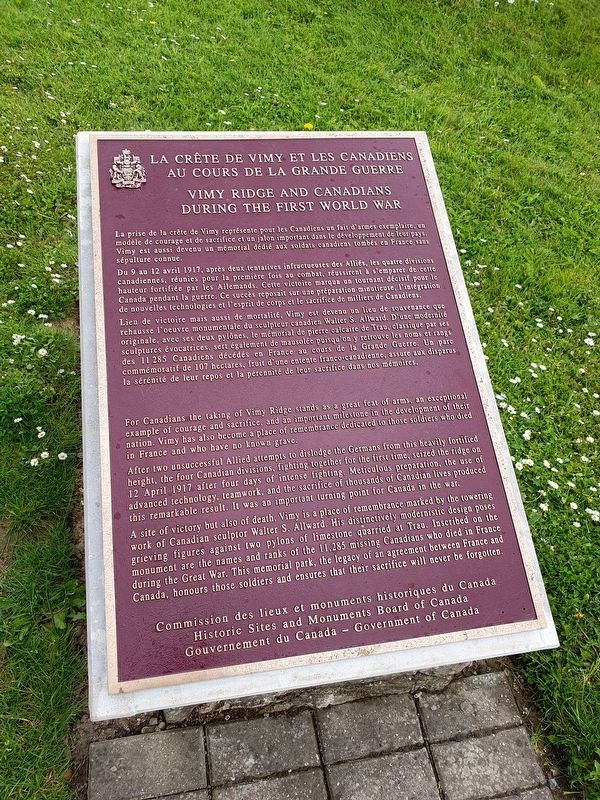
La Crête de Vimy et les Canadiens au cours de la Grande Guerre
La prise de la crête de Vimy représente pour les Canadiens un fait d'armes exemplaire, un modèle de courage et de sacrifice et un jalon important dans le développement de leur pays. Vimy est aussi devenu un mémorial dédié aux soldats canadiens tombés en France sans sépulture connue.
Du 9 au 12 avril 1917, après deux tentatives infructueuses des Alliés, les quatre divisions canadiennes, réunies pour la première fois au combat, réussirent à s'emparer de cette hauteur fortifiée par les Allemands. Cette victoire marqua un tournant décisif pour le Canada pendant la guerre. Ce succès reposait sur une préparation minutieuse, l'intégration de nouvelles technologies et l'esprit de corps et le sacrifice de milliers de Canadiens.
Lieu de victoire mais aussi de mortalité, Vimy est devenu un lieu de souvenance que rehausse l'oeuvre monumentale du sculpteur canadien Walter S. Allward. D'une modernité originale, avec ses deux pylônes, le mémorial de pierre calcaire de Trau, classique par ses sculptures évocatrices, sert également de mausolée puisqu'on
this page online
Commission des lieux et monuments historiques du Canada
Gouvernement du Canada
Vimy Ridge and Canadians during the First World War
For Canadians the taking of Vimy Ridge stands as a great feat of arms, an exceptional example of courage and sacrifice, and an important milestone in the development of their nation. Vimy has also become a place of remembrance dedicated to those soldiers who died in France and who have no known grave.
After two unsuccessful Allied attempts to dislodge the Germans from this heavily fortified height, the four Canadian divisions, fighting together for the first time, seized the ridge on 12 April 1917 after four days of intense fighting. Meticulous preparation, the use of advanced technology, teamwork, and the sacrifice of thousands of Canadian lives produced this remarkable result. It was an important turning point for
Photographed by J. Makali Bruton, June 11, 2024
2. Vimy Ridge and Canadians During the First World War Marker
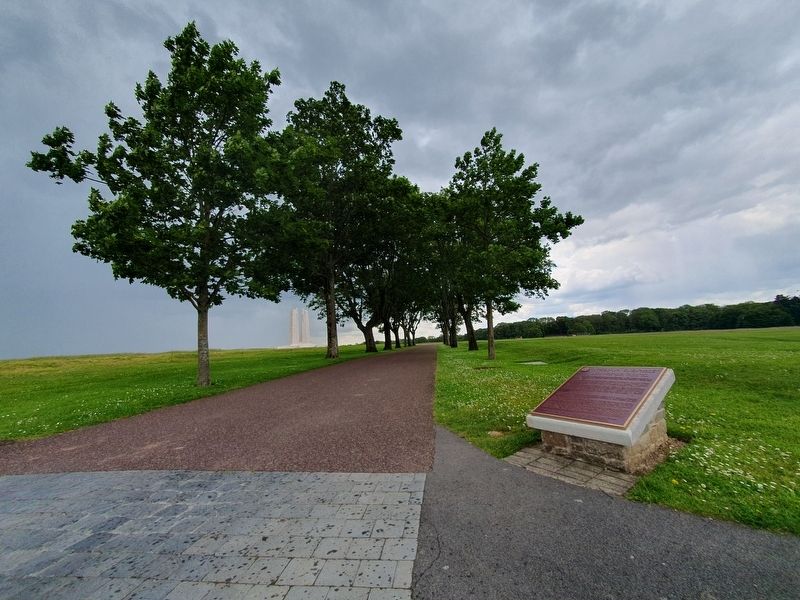
The Canadian National Vimy Memorial can be seen to the north in this view.
A site of victory but also of death, Vimy is a place of remembrance marked by the towering work of Canadian sculptor Walter S. Allward. His distinctively modernistic design poses grieving figures against two pylons of limestone quarried at Trau. Inscribed on the monument are the names and ranks of the 11,285 missing Canadians who died in France during the Great War. This memorial park, the legacy of an agreement between France and Canada, honours those soldiers and ensures that their sacrifice will never be forgotten.
Historic Sites and Monuments Board of Canada
Government of Canada
Erected by Historic Sites and Monuments Board of Canada.
Topics and series. This historical marker is listed in this topic list: War, World I. In addition, it is included in the Canada, Historic Sites and Monuments Board series list. A significant historical date for this entry is April 12, 1917.
Location. 50° 22.747′ N, 2° 46.236′ E. Marker is in Givenchy-en-Gohelle, Hauts-de-France (Upper France), in Pas-de-Calais. It is on Chemin des Canadiens (Route D55) west of Route des Canadiens, on the right when traveling west. Touch for map. Marker is at or near this postal address: 5 Chem des Canadiens, Givenchy-en-Gohelle, Hauts-de-France 62580, France. Touch for directions.

Regionally, it is in the North Atlantic Region, Europe, the European Union, Atlantic Europe, the Schengen Area, Western Europe, a coastal Mediterranean country, and the Western World. Historically, it finds itself in what was once a French colony and also the Roman Empire.
Other nearby markers. At least 8 other markers are within 5 kilometers of this marker, measured as the crow flies: Moroccan Division Memorial (within shouting distance of this marker); Canadian National Vimy Memorial (approx. 0.3 kilometers away); Jardin de la Paix Canadien (approx. 0.8 kilometers away); The Canadians at Vimy Ridge (approx. 0.8 kilometers away); Staying Healthy (approx. 0.9 kilometers away); German Observation Post (approx. 0.9 kilometers away); Be Prepared (approx. 0.9 kilometers away); General Maistre et du 21e Corps d’Armee (approx. 4.1 kilometers away). Touch for a list and map of all markers in Givenchy-en-Gohelle.
Also see . . . Battle of Vimy Ridge at Wikipedia. Historians attribute the success of the Canadian Corps to technical and tactical innovation, meticulous planning, powerful artillery support and extensive training, as well as the inability of the 6th Army to properly apply the new German defensive doctrine. The battle was the first occasion when the four divisions of the Canadian Expeditionary Force fought together and it was made a symbol of Canadian national achievement and sacrifice. A 100 ha (250-acre) portion of the former battleground serves as a memorial park and site of the Canadian National Vimy Memorial. (Submitted on June 27, 2024.)
Credits. This page was last revised on June 27, 2024. It was originally submitted on June 27, 2024, by J. Makali Bruton of Washington, District of Columbia. This page has been viewed 201 times since then and 31 times this year. Photos: 1, 2. submitted on June 27, 2024, by J. Makali Bruton of Washington, District of Columbia.
