West Loop in Chicago in Cook County, Illinois — The American Midwest (Great Lakes)
Holden Block
Stephen Vaughn Shipman, architect; 1872
| — | Chicago Landmark | — |

Photographed by Sean Flynn, June 28, 2024
1. Holden Block Marker
Designated on May 4, 2011
Richard M. Daley, Mayor
Erected 2011 by Commission on Chicago Landmarks; City of Chicago.
Topics and series. This historical marker is listed in these topic lists: Architecture • Disasters • Industry & Commerce. In addition, it is included in the Illinois, Chicago Landmarks Commission, and the The Great Chicago Fire of 1871 series lists. A significant historical year for this entry is 1872.
Location. 41° 52.902′ N, 87° 39.196′ W. Marker is in Chicago, Illinois, in Cook County. It is in West Loop. It can be reached from the intersection of West Madison Street and North Carpenter Street, on the
this page online

Regionally, this marker is on Chicago’s West Side. It is also in the American Midwest. Globally, it is in North America, on the Great Lakes, in the Western Hemisphere, in the Western World, and in the Anglosphere. Historically, it finds itself in what was once the Viceroyalty of New France, the territory of the Mississippian Culture, and the Northwest Territory.
Other nearby markers. At least 8 other markers are within walking distance of this marker: Mary Bartelme, Illinois’ First Female Judge (approx. 0.2 miles away); The Schoenbrun and Co. Building (approx. ¼ mile away); Walgreens 3000th Drugstore (approx. 0.3 miles away); Charles R. Walgreen Sr. (approx. 0.3 miles away); Healing Garden (approx. 0.4 miles away); Herb Garden (approx. 0.4 miles away); Native Species (approx. 0.4 miles away); Takeaway (approx. half a mile away). Touch for a list and map of
Photographed by Sean Flynn, June 28, 2024
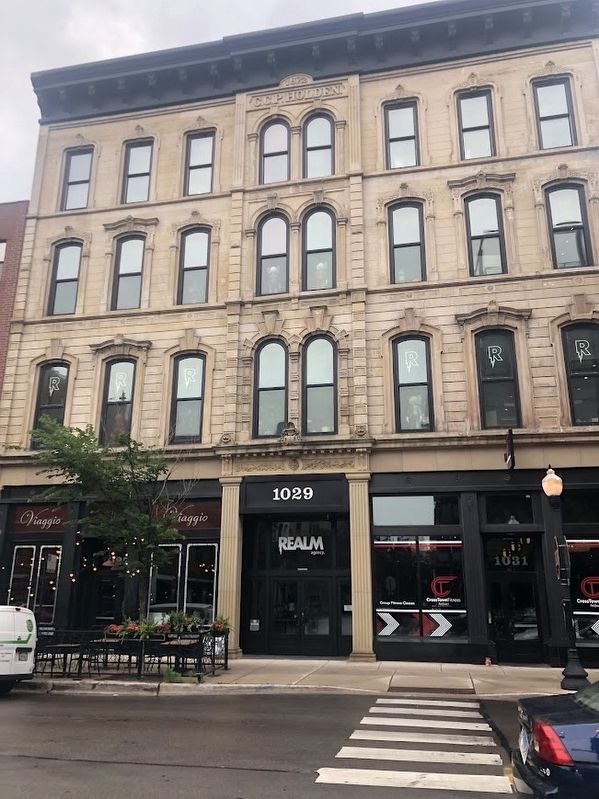
2. Holden Block
Note "1872" and "CCP Holden" engraved at the top of the building.
Regarding Holden Block. Charles P. Holden, the building's namesake, was born in New Hampshire and arrived with his family in Illinois as a child in 1836, eventually settling in Will County, about 30 miles south of the city. After a stint in the army during the Mexican War and then four years in California as a Gold Rush prospector, Holden returned to Chicago in the mid-1850s and soon became one of the city's top political figures. He was president of the city council at the time of the Great Chicago Fire of 1871. He died in Matteson, Illinois, south of Chicago, and is buried at Oakwood Cemetery in Joliet.
The date of the building's designation as a Chicago Landmark (May 4, 2011) is exactly 12 days before the end of Richard M. Daley's 22-year stint as Chicago's mayor.
Also see . . .
1. Charles C.P. Holden. An 1895 biography of Charles Holden (Submitted on June 28, 2024, by Sean P. Flynn of Oak Park, Illinois.)
2. Quarrying History and Use of the Buena Vista Freestone, South-Central Ohio.
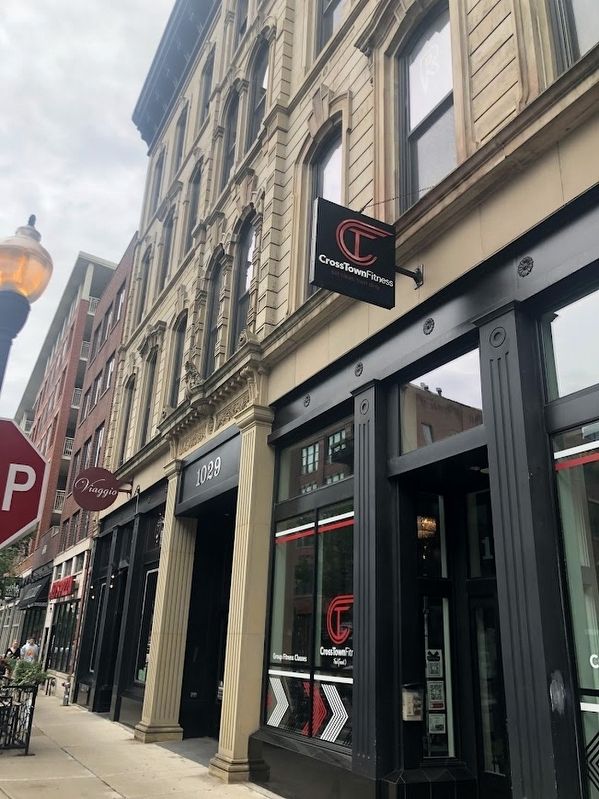
Excerpt: “Historically, it has been used for a variety of items, including entire buildings,(Submitted on October 18, 2025, by Sean P. Flynn of Oak Park, Illinois.)canal structures, fence posts, and laundry tubs. Some 19th-century structures built with this stone remain in cities where it was once commonly used.”Photographed by Sean Flynn, June 28, 20243. Holden Block
C. D. Mosher, photographer; courtesy of Chicago History Museum (ICHi-024446)
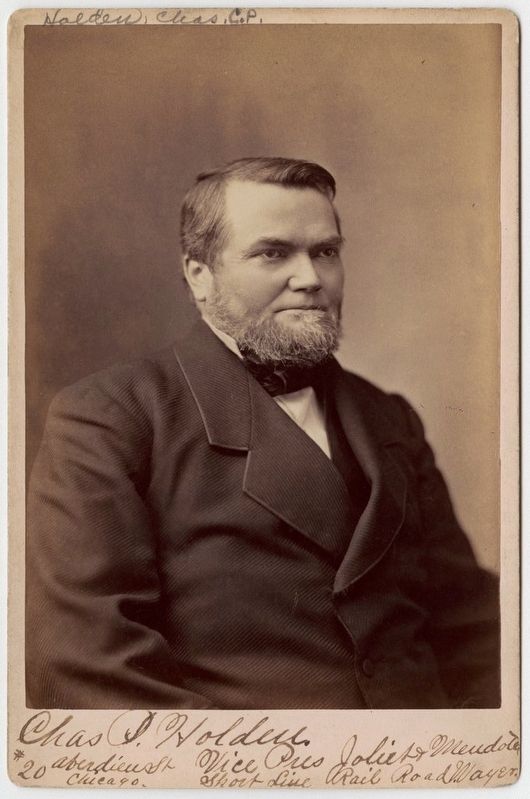
4. Charles C.P. Holden (1827-1905)
The handwritten caption at the bottom of this undated photo says, "Vice Pres Joliet + Mendota Short Line Rail Road"
Credits. This page was last revised on July 23, 2026. It was originally submitted on June 28, 2024, by Sean P. Flynn of Oak Park, Illinois. This page has been viewed 302 times since then and 63 times this year. Photos: 1, 2, 3, 4. submitted on June 28, 2024, by Sean P. Flynn of Oak Park, Illinois.
