Arset El Bilk in Marrakesh, Marrakesh-Safi, Morocco — Africa (Northern Africa)
The Koutoubia Mosques
Photographed by J. Makali Bruton, May 19, 2024
1. The Koutoubia Mosques Marker

English
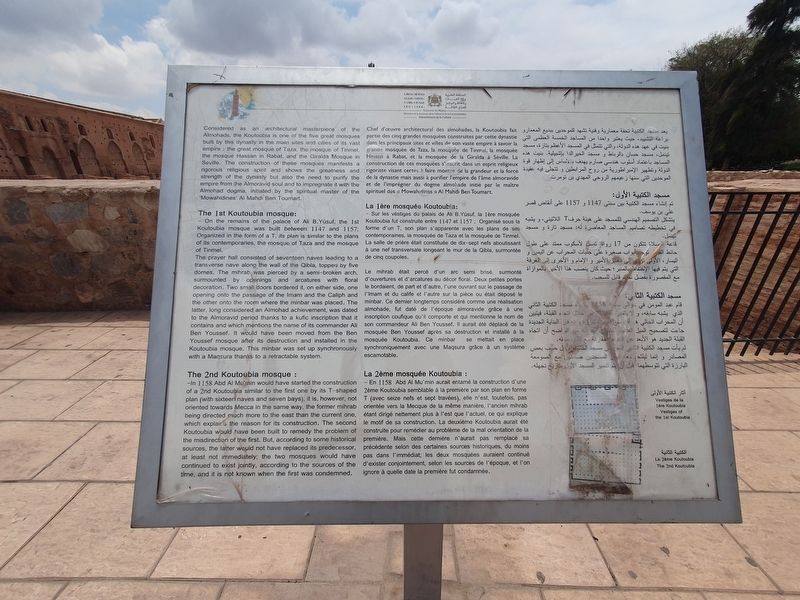
Considered as an architectural masterpiece of the Almohads, the Koutoubia is one of the five great mosques built by this dynasty in the main sites and cities of its vast empire: the great mosque of Taza, the mosque of Tinmel, the mosque Hassan in Rabat, and the Giralda Mosque in Seville. The construction of these mosques manifests a rigorous religious spirit and shows the greatness and strength of the dynasty but also the need to purify the empire from the Almoravid soul and to impregnate it with the Almohad dogma, initiated by the spiritual master of the "Mowahidines' Al Mahdi Ben Toumart.
The 1st Koutoubia mosque:
On the remains of the palace of Ali B.Yusuf, the 1st Koutoubia mosque was built between 1147 and 1157; Organized in the form of a T, its plan is similar to the plans of its contemporaries, the mosque of Taza and the mosque of Tinmel.
The prayer hall consisted of seventeen naves leading to a transverse nave along the wall of the Qibla, topped by five domes. The mihrab was pierced by a semi-broken arch, surmounted by openings and arcatures with floral decoration. Two small doors
this page online
The 2nd Koutoubia mosque :
-In 1158 Abd Al Mu'min would have started the construction of a 2nd Koutoubia similar to the first one by its T-shaped plan (with sixteen naves and seven bays), it is, however, not oriented towards Mecca in the same way, the former mihrab being directed much more to the east than the current one, which explains the reason for its construction. The second Koutoubia would have been built to remedy the problem of the misdirection of the first. But, according to some historical sources, the latter would not have replaced its predecessor, at least not immediately;

Photographed by J. Makali Bruton, May 19, 2024
2. The Koutoubia Mosques Marker
The remnants of the first Koutoubia Mosque are to the right of the marker.
Chef d'œuvre architectural des almohades, la Koutoubia fait an partie des cinq grandes mosquées construites par cette dynastie dans les principaux sites et villes de son vaste empire à savoir la grande mosquée de Taza, la mosquée de Tinmel, la mosquée Hassan à Rabat, et la mosquée de la Giralda à Séville. La construction de ces mosquées s'inscrit dans un esprit religieux rigoriste visant certes à faire montre de la grandeur et la force jác de la dynastie mais aussi à purifier l'empire de l'âme almoravide et de l'imprégner du dogme almohade initié par le maître spirituel des « Mowahidinos » Al Mahdi Ben Toumart.
La lère mosquée Koutoubia:
- Sur les véstiges du palais de Ali B.Yusuf, la 1ère mosquée Koutoubia fut construite entre 1147 et 1157; Organisé sous la forme d'un T, son plan s'apparente avec les plans de ses contemporaines, la mosquée de Taza et la mosquée de Tinmel. La salle de prière était constituée de dix-sept nefs aboutissant à une nef transversale longeant le mur de la Qibla, surmontée de cinq coupoles.
Le mihrab était percé d'un arc semi brisé, surmonté d'ouvertures et d'arcatures au décor floral. Deux petites portes le bordaient, de part et d'autre, l'une ouvrant sur le passage de I'Imam et du calife et l'autre sur la pièce ou était déposé le minbar. Ce dernier longtemps considéré comme une réalisation almohade, fut daté de l'époque almoravide grâce à une inscription coufique qu'il comporte et qui mentionne le nom de son commandeur Ali Ben Youssef. Il aurait été déplacé de la mosquée Ben Youssef après sa destruction et installé à la mosquée Koutoubia. Ce minbar se mettait en place synchroniquement avec une Maqsura grâce à un système escamotable.
La 2ème mosquée Koutoubia:
- En 1158 Abd Al Mu'min aurait entamé la construction d'une 2ème Koutoubia semblable à la première par son plan en forme T (avec seize nefs et sept travées), elle n'est, toutefois, pas orientée vers la Mecque de la même manière, l'ancien mihrab étant dirigé nettement plus à l'est que l'actuel, ce qui explique le motif de sa construction. La deuxième Koutoubia aurait été construite pour remédier au problème de la mal orientation de la première. Mais cette dernière n'aurait pas remplacé sa précédente selon des certaines sources historiques, du moins pas dans l'immédiat; les deux mosquées auraient continué d'exister conjointement, selon les sources de l'époque, et l'on ignore à quelle date la première fut condamnée.
Arabic text not transcribed
Topics. This historical marker is listed in these topic lists: Architecture • Religion & Religious Structures.
Location. 31° 37.47′ N, 7° 59.609′ W. Marker is in Marrakesh, Marrakesh-Safi. It is in Arset El Bilk. It is at the intersection of Avenue Mohammed V and Rue Fatima Zahra, on the right when traveling east on Avenue Mohammed V. Touch for map. Marker is at or near this postal address: Av Mohammed V 320, Marrakesh, Marrakesh-Safi 40000, Morocco. Touch for directions.

Regionally, it is in Africa, North Africa, The Maghreb, and in a coastal Mediterranean country. Historically, it finds itself in what was once Portuguese colonies, a Spanish colony, and specifically a French colony.
Other nearby markers. At least 8 other markers are within walking distance of this marker: The Stone Fortress and the Gate of Ali (a few steps from this marker); The Minaret of Koutoubia (within shouting distance of this marker); Sidi Mimoun Square (approx. 0.3 kilometers away); The Mausoleum of Sidi Abu Mohamed Abdellah El Ghazouani Moul El Ksour (approx. 0.4 kilometers away); Youssef Ibn Tachfine Mausoleum (approx. 0.4 kilometers away); Zawiya Tijaniya (Al-Kenssoussiya) (approx. half a kilometer away); Al-Mouassine Mosque or Al-Chorafa Mosque (approx. 0.6 kilometers away); Mouassine Square (approx. 0.7 kilometers away). Touch for a list and map of all markers in Marrakesh.
Credits. This page was last revised on June 30, 2024. It was originally submitted on June 28, 2024, by J. Makali Bruton of Washington, District of Columbia. This page has been viewed 263 times since then and 66 times this year. Photos: 1, 2. submitted on June 28, 2024, by J. Makali Bruton of Washington, District of Columbia.
