Kingstree in Williamsburg County, South Carolina — The American South (South Atlantic)
Battle of Kingstree
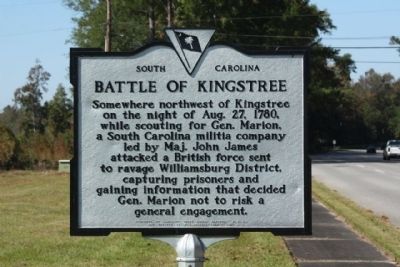
Photographed by Mike Stroud, November 3, 2009
1. Battle of Kingstree Marker
Erected 1958 by South Carolina Department of Archives and History; sponsored by Margaret Gregg Gordon Chapter, D.A.R., Williamsburg County. (Marker Number 45-3.)
Topics and series. This historical marker is listed in this topic list: War, US Revolutionary. In addition, it is included in the Daughters of the American Revolution (DAR) series list. A significant historical date for this entry is August 27, 1812.
Location. 33° 40.359′ N, 79° 50.406′ W. Marker is in Kingstree, South Carolina, in Williamsburg County. It is on West Academy Street (State Highway 527) near Frierson Lane, on the right when traveling south. Touch for map. Marker is in this post office area: Kingstree SC 29556, United States of America. Touch for directions.

Regionally, this marker is in the Pee Dee. It is also in the American South and specifically
this page online
Other nearby markers. At least 10 other markers are within walking distance of this marker: Kingstree: Gathering Vital Intelligence (approx. half a mile away); Williamsburg Church (approx. half a mile away); St. Alban’s Episcopal Church (approx. 0.7 miles away); Williamsburgh Historical Museum (approx. 0.8 miles away); Old Muster Ground and Courthouse (approx. 0.8 miles away); Williamsburg County Veterans Memorial (approx. 0.8 miles away); Dr. Martin Luther King, Jr. (approx. 0.8 miles away); Willamsburg County Veterans Monument (approx. 0.8 miles away); Williamsburg Courthouse and Historic District (approx. 0.8 miles away); Williamsburg County Vietnam Memorial (approx. 0.8 miles away). Touch for a list and map of all markers in Kingstree.
Also see . . . Francis Marion. Francis Marion (c. 1732 –
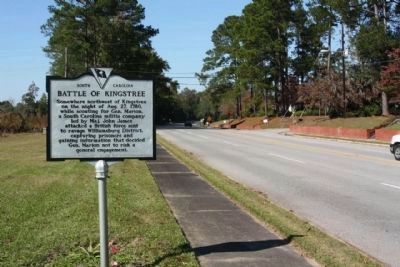
Photographed by Mike Stroud, November 3, 2009
2. Battle of Kingstree Marker, looking north along West Academy Street (State Road 527)
Additional commentary.
1. Battle of Kingstree
Kingstree, South Carolina
27 August 1780, Skirmish
Major James Wemyss was a British officer, who would soon have a reputation for cruelty, which was only surpassed by Tarleton. Most of Tarleton's image was incorrect and used as propaganda, but Wemyss's cruelty was well founded. Marion's partisans came to the attention of the British after his successful prisoner rescue, in what was supposed to have been a subdued area. Wemyss was sent into the Williamsburg Township to organize the Loyalist militia, and put down the partisans.
Wemyss brought with him 200 regulars of the 63rd Regiment, and 100 men of Harrison's South Carolina Rangers, the Royal North Carolina Regiment and Colonel Samuel Bryan's North Carolina Volunteers. Wemyss had been ordered by Cornwallis to punish the concealment of arms and ammunition with a total destruction of the plantations. This attempt at seizing the arms of the farmers would drive more
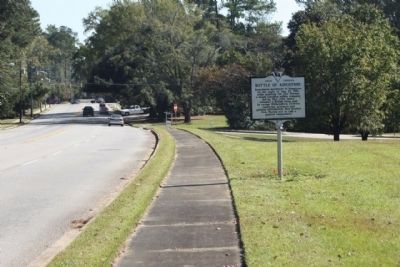
Photographed by Mike Stroud, November 3, 2009
3. Battle of Kingstree Marker, looking south along West Academy Street
Marion sent James and a small party of men to determine the strength of Wemyss's force. James hid his men in a thicket and counted the British as they marched past. When the rear guard started past their position, the partisans rushed out and killed or captured thirty of the British. They then quickly made their escape. James suffered almost as much as the British in the ambush, losing five killed, fifteen wounded and ten captured.
After the attack, four hundred Regulars and Loyalists, out of Kings Tree and Georgetown, reinforced Wemyss. Marion decided that the force was too strong for his small partisan force, and withdrew to North Carolina with sixty of his men and the two fieldpieces he had captured. The artillery slowed him down, so after crossing the Little Pee Dee River he wheeled them into a swamp and continued on.
After marching day and night Marion ended up at Amy's Mill, on Drowning Creek, where he stayed for several days.579 Marion dispatched James with a small party of volunteers back to South Carolina to gain intelligence, and raise the militia. (Source: Nothing but blood and Slaughter: The Revolutionary War in the Carolinas, Volume II: 1780
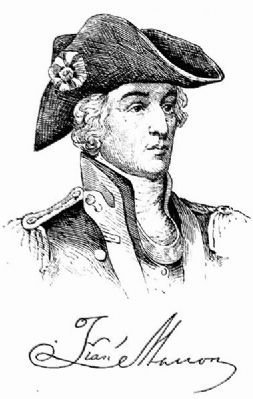
Photographed by Wikipedia
4. Francis Marion
(c. 1732–1795)
(c. 1732–1795)
— Submitted February 2, 2010, by Brian Scott of Anderson, South Carolina.
Credits. This page was last revised on May 25, 2026. It was originally submitted on November 30, 2009, by Mike Stroud of Bluffton, South Carolina. This page has been viewed 2,648 times since then and 92 times this year. Photos: 1, 2, 3. submitted on November 30, 2009, by Mike Stroud of Bluffton, South Carolina. 4. submitted on February 2, 2010, by Brian Scott of Anderson, South Carolina. • Craig Swain was the editor who published this page.
