Toquerville in Washington County, Utah — The American Mountains (Southwest)
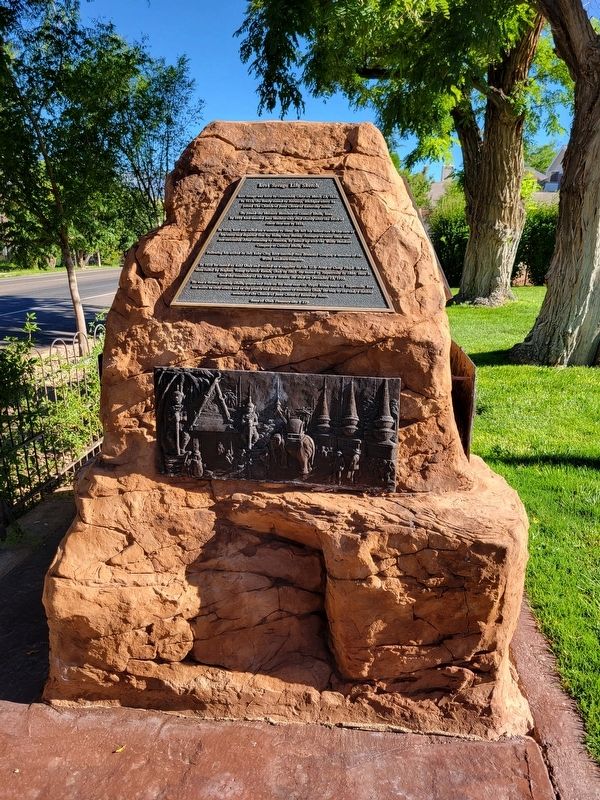
Levi Savage
Photographed by Jeremy Snow, June 28, 2024
1. Levi Savage Marker
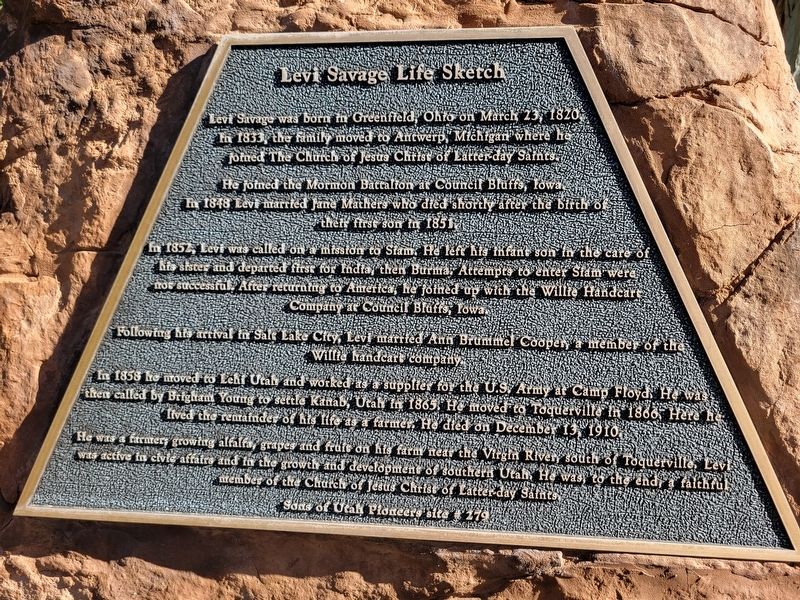
Levi Savage Life Sketch
Levi Savage was born in Greenfield, Ohio on March 23, 1820, In 1833, the family moved to Antwerp, Michigan where he joined The Church of Jesus Christ of Latter-day Saints. He joined the Mormon Battalion at Council Bluffs, Iowa. In 1848 Levi married Jane Mathers who died shortly after the birth of their first son in 1851. In 1852, Levi was called on a mission to Siam. He left his infant son in the care of his sister and departed first for India, then Burma. Attempts to enter Siam were not successful. After returning to America, he joined up with the Willie Handcart Company at Council Bluffs, Iowa. Following his arrival in Sale Lake City, Levi married Ann Brunimel Cooper a member of the Willie handcart company.
In 1858 he moved to Lehi, Utah and worked as a supplier for the U.S. Army at Camp Floyd. He was then called by Brigham Young to settle Kanab, Utah. In 1865, He moved to Toquerville In 1866. Here he lived the remainder of his life as a farmer. He died on December 13, 1910. He was a farmer growing alfalfa grapes and fruit on his farm near the Virgin Rivery south of Toquerville. Levi was
this page online
Sons of Utah Pioneers Site #179
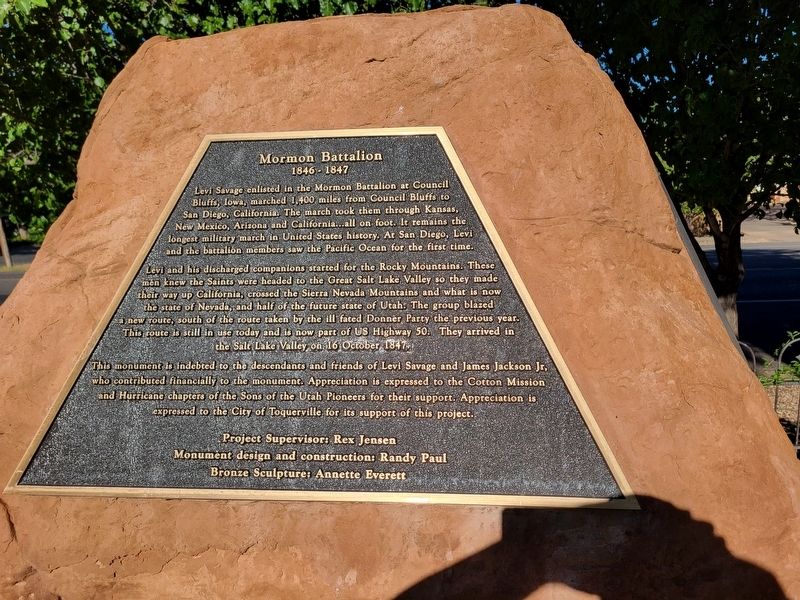
Mormon Battalion
1846- 1847
Levi Savage enlisted in the Mormon Battalion at Council Bluffs, Iowa, marched 1,400 miles from Council Bluffs to San Diego, California. The march took them through Kansas, New Mexico, Arizona and California...all on foot. It remains the longest military march in United States history. At San Diego, Levi and the battalion members saw the Pacific Ocean for the first time.
Levi and his discharged companions started for the Rocky Mountains. These men knew the Saints were headed to the Great Salt Lake Valley so they made their way up California, crossed the Sierra Nevada Mountains and what is now the state of Nevada, and half of the future state of Utah. The group blazed a new route, south of the route taken by the ill fated Donner Party the previous year. This route is still in use today and is now part of US Highway 50. They arrived in the Sale Lake Valley, on 16 October 1847.
This monument is indebted
Photographed by Jeremy Snow, June 28, 2024
2. Mormon Battalion 1846-1847
Project Supervisor: Rex Jensen
Monument design and construction: Randy Paul
Bronze Sculpture: Annette Everett
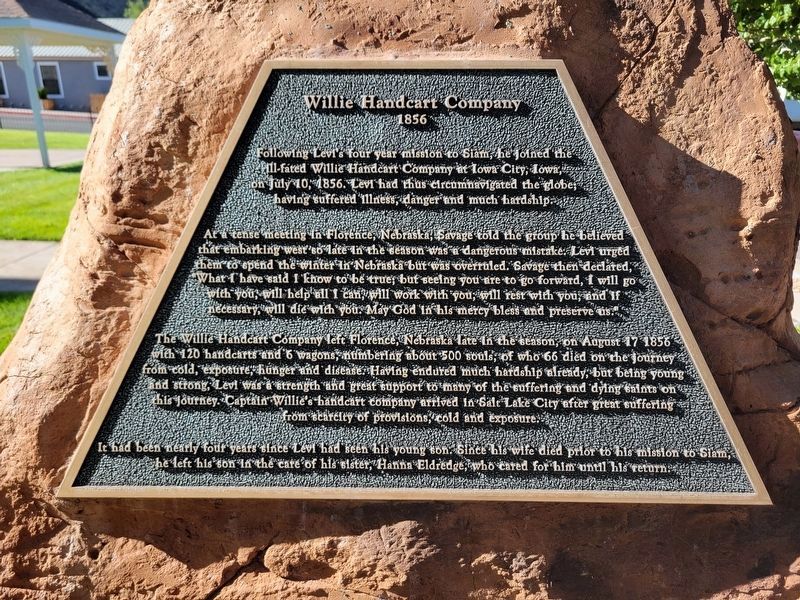
Willie Handcart Company
1856
Following Levi's four year mission to Siam, he joined the ill-fated Willie Handcart Company at Iowa City, Iowa, on July 10, 1856. Levi had thus circumnavigated the globe; having suffered illness, danger and much hardship.
A tense meeting in Florence, Nebraska, Savage told the group he believed that embarking west so late in the season was a dangerous mistake. Levi urged them to spend the winter in Nebraska, but was overruled. Savage then declared, "What I have said I know to be true; but seeing you are to go forward, I will go with you, will help all I can, will work with you, will rest with you, and if necessary, will die with you. May God in his mercy bless and preserve
Photographed by Jeremy Snow, June 28, 2024
3. Willie Handcart Company 1856
The Willie Handcart Company left Florence, Nebraska late in the season, on August 17, 1856 with 120 handcarts and 6 wagons, numbering about 500 souls, of who 66 died on the journey from cold, exposure, hunger and disease. Having endured much hardship already, but being youg and strong, Levi was a strength and great support to many of the suffering and dying saints on this journey. Captain Willie's handcart company arrived in Salt Lake City after great suffering from scarcity of provisions, cold and exposure.
It had been nearly four years since Levi had seen his young son. Since his wife died prior to his mission to Siam, he left his son in the care of his sister, Hanna Eldredge, who cared for him until his return.
Erected by Sons of Utah Pioneers. (Marker Number 179.)
Topics. This historical marker is listed in these topic lists: Religion & Religious Structures • Settlements & Settlers.
Location. 37° 15.285′ N, 113° 17.102′ W. Marker is in Toquerville, Utah, in Washington County. It is on Toquerville Boulevard, on the right when traveling north. Touch for map.
Photographed by Jeremy Snow, June 28, 2024
4. Levi Savage Marker

Regionally, this marker is in Color Country. It is also in the American Southwest, in the Mountain West, and on the Colorado Plateau. Globally, it is in North America, the Rocky Mountains, the Western Hemisphere, the Western World, and the Anglosphere. Historically, it finds itself in what was once New Spain and also Mexico’s Alta California.
Other nearby markers. At least 8 other markers are within 4 miles of this marker, measured as the crow flies: Toquer (here, next to this marker); Toquerville (here, next to this marker); Toquerville Veterans Memorial (here, next to this marker); In Honor of Chief Toquer (a few steps from this marker); John Steele House (about 400 feet away, measured in a direct line); The Naegle Big House (approx. 0.4 miles away); La Verkin Canal (approx. 3.1 miles away); Southern Exploring Company – 1849 (approx. 3.7 miles away). Touch for a list and map of all markers in Toquerville.
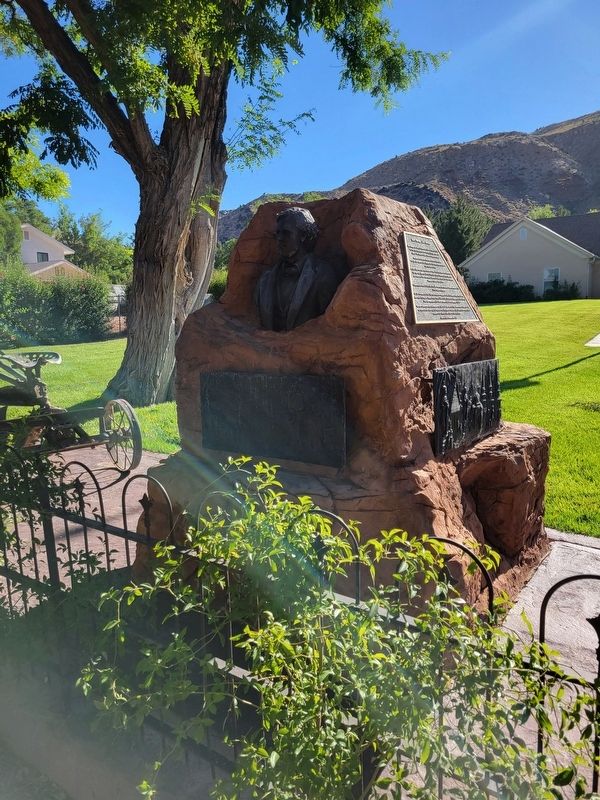
Photographed by Jeremy Snow, June 28, 2024
5. Levi Savage Marker
Credits. This page was last revised on July 8, 2024. It was originally submitted on July 2, 2024, by Jeremy Snow of Cedar City, Utah. This page has been viewed 672 times since then and 98 times this year. Photos: 1, 2, 3, 4, 5. submitted on July 2, 2024, by Jeremy Snow of Cedar City, Utah. • J. Makali Bruton was the editor who published this page.
