Columbia in Boone County, Missouri — The American Midwest (Upper Plains)
Maplewood Barn and Theatre
Historic Nifong Park
Photographed by Jason Voigt, June 25, 2024
1. Maplewood Barn and Theatre Marker
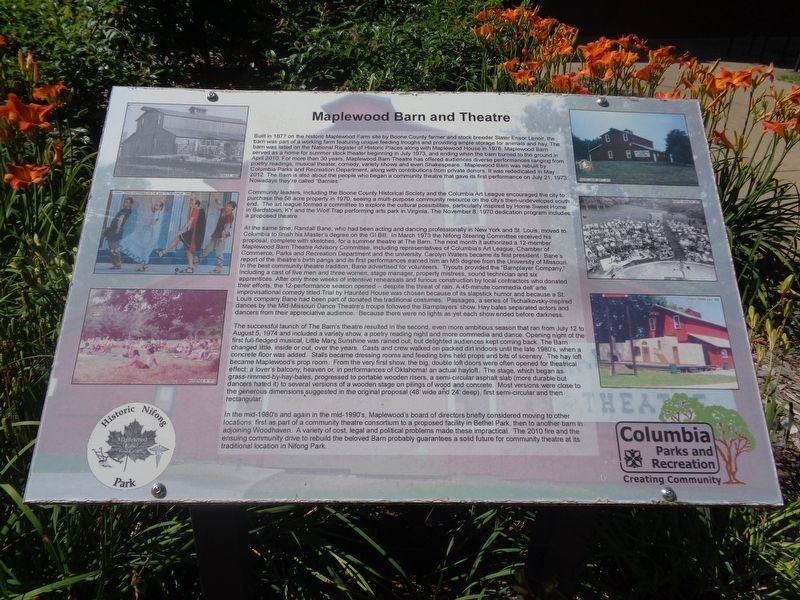
Community leaders, including the Boone County Historical Society and the Columbia Art League encouraged the city to purchase the 58 acre property in 1970, seeing a multi-purpose community
this page online
At the same time, Randall Bane, who had been acting and dancing professionally in New York an St. Louis, moved to Columbia to finish his Master's degree on the G.I. Bill. In March 1973 the Nifong Steering Committee received his proposal, complete with sketches, for a summer theatre at The Barn. The next month it authorized a 12-member Maplewood Barn Theatre Advisory Committee, including representatives of Columbia's Art League, Chamber of Commerce, Parks and Recreation Department and the university. Carolyn Waters became its first president. Bane's report of the theatre's birth pangs and its first performances earned him an MS degree from the University of Missouri. In the best community theatre tradition, Bane advertised for volunteers. Tryouts provided the "Barnplayer Company," including a cast of five men and three women, stage
Photographed by Jason Voigt, June 25, 2024
2. Maplewood Barn and Theatre Marker
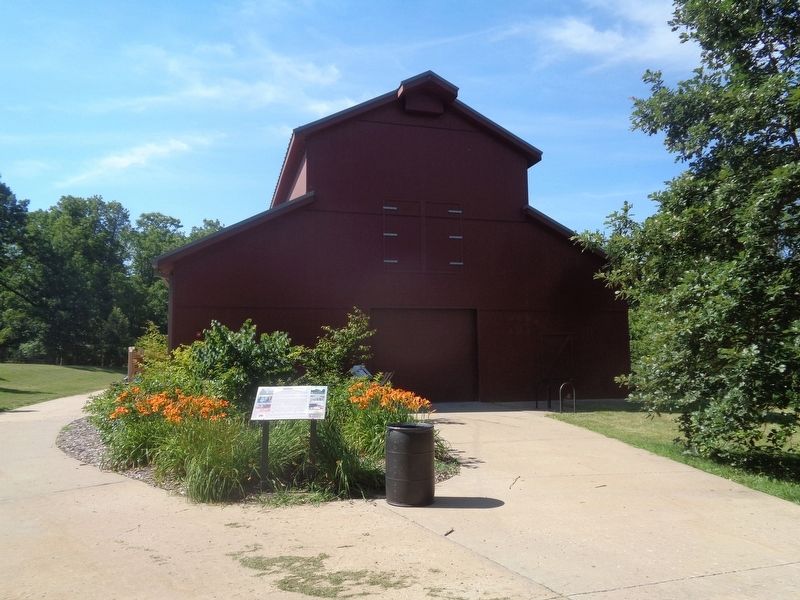
The successful launch of The Barn's theatre resulted in the second, even more ambitious season that ran from July 12 to August 5, 1974 and included a variety show, a poetry reading night and more commedia and dance. Opening night of the final full-fledged musical, Little Mary Sunshine, was rained out, but delighted audiences kept coming back. The Barn changed little, inside or out, over the years. Casts and crew
Photographed by Jason Voigt, June 25, 2024
3. Maplewood Barn and Theatre Marker
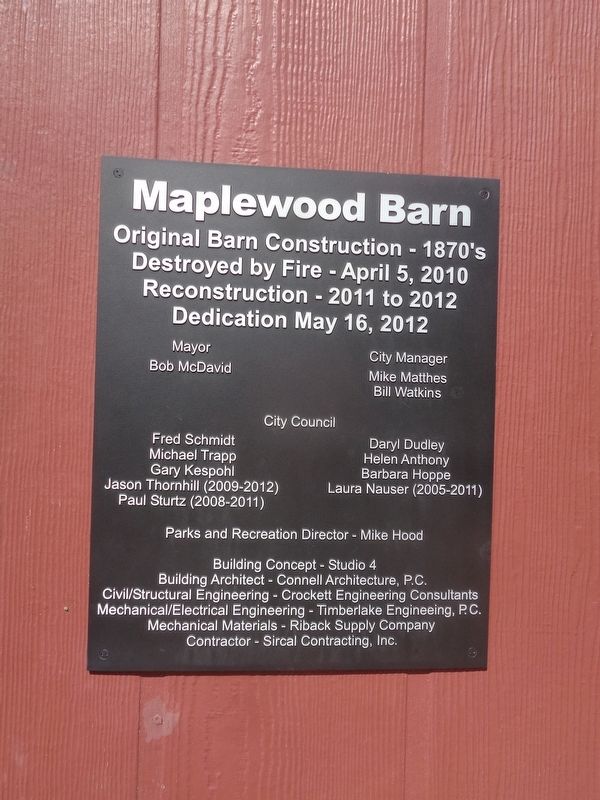
additional sign
In the mid-1980's and again the mid-1990's, Maplewood's board of directors briefly considered moving to other locations: first as part of a community theatre consortium to a proposed facility in Bethel Park, then to another barn in adjoining Woodhaven. A variety of cost, legal and political problems made these impractical. The 2010 fire and the ensuing community drive to rebuild the beloved Barn probably guarantees a solid future for community theatre at its traditional location in Nifong Park.
Erected by Columbia Parks and Recreation.
Topics. This historical marker is listed in these topic lists: Arts, Letters, Music • Entertainment. A significant historical month for this entry is March 1973.
Location. 38° 54.462′ N, 92° 17.793′ W. Marker is in Columbia, Missouri, in Boone County. It can be reached from East Nifong Boulevard west of Ponderosa Street. Marker is located at Frank L. Nifong Memorial Park. Touch for map. Marker is at or near this postal address: 2900 E Nifong Blvd, Columbia MO 65201, United States of America. Touch for directions.

Regionally, this marker is in Little Dixie and in the Missouri River Corridor. It is also in the American Midwest, in the Lewis & Clark Corridor, and in the Corn Belt. Globally, it is in North America, the Western Hemisphere, the Western World, and the Anglosphere. Historically, it finds itself in what was once the territory of the Mississippian Culture, the Louisiana Purchase, and the Antebellum South.
Other nearby markers. At least 8 other markers are within 3 miles of this marker, measured as the crow flies: Rock Bridge Mills Millstone (about 700 feet away, measured in a direct line); The Gordon-Collins Log Cabin (about 700 feet away); The Easley Country Store (about 700 feet away); The Ryland Farm House (about 700 feet away); Columbia (approx. 2.1 miles away); War Memorial (approx. 2.1 miles away); Jewell Cemetery State Historic Site (approx. 2.3 miles away); The F.L. Duley - M.E. Miller Erosion Plots (approx. 2.6 miles away). Touch for a list and map of all markers in Columbia.
Another marker is no longer nearby. Jewell Cemetery (was approx. 2.3 miles away but has been replaced with another marker now near it).
Credits. This page was last revised on July 2, 2024. It was originally submitted on July 2, 2024, by Jason Voigt of Glen Carbon, Illinois. This page has been viewed 242 times since then and 43 times this year. Photos: 1, 2, 3. submitted on July 2, 2024, by Jason Voigt of Glen Carbon, Illinois.
