Cricqueville-en-Bessin in Calvados, Normandy, France — Western Europe
Preparing to Invade
Competence
Photographed by J. Makali Bruton, June 5, 2024
1. Preparing to Invade Marker

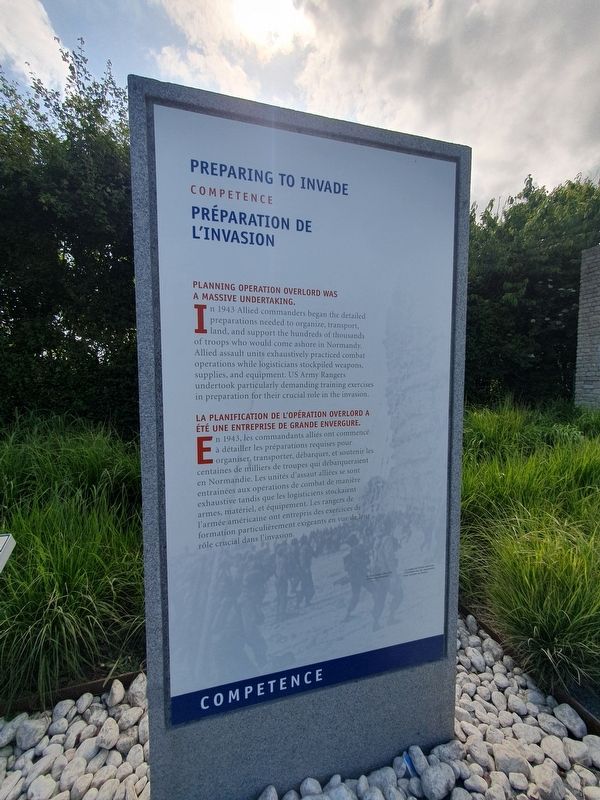
Preparing to Invade
Planning Operation Overlord was a massive undertaking.
In 1943 Allied commanders began the detailed preparations needed to organize, transport, land, and support the hundreds of thousands of troops who would come ashore in Normandy. Allied assault units exhaustively practiced combat operations while logisticians stockpiled weapons, supplies, and equipment. US Army Rangers undertook particularly demanding training exercises in preparation for their crucial role in the invasion.
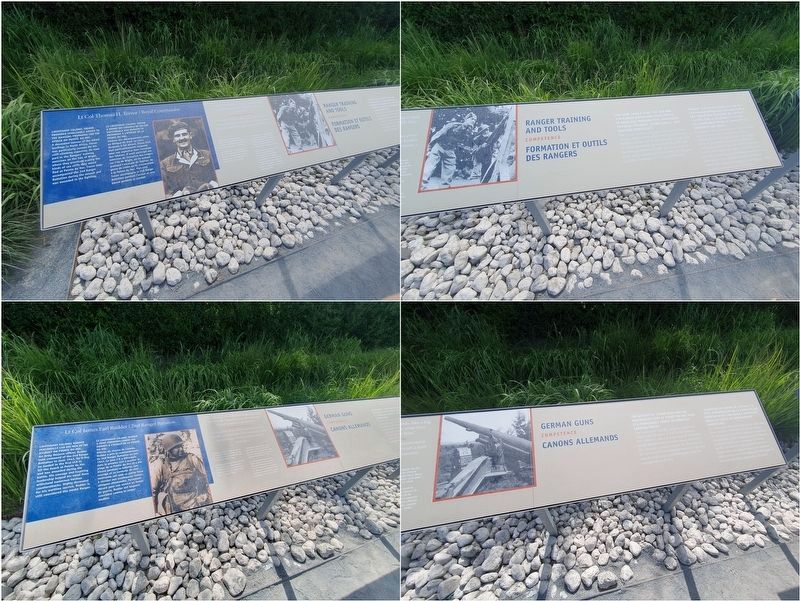
Lt Col Thomas H. Trevor | Royal Commandos
Lieutenant Colonel Trevor provided invaluable advice to the Rangers preparing for the attack on Point du Hoc.
A decorated veteran of the Allied landings in North Africa, Trevor was particularly renown for his cliff-climbing expertise. He took part in the Rangers' training exercises on the Isle of Wight, where they practiced scaling the kinds of sea cliffs they would find at Pointe du Hoc. Trevor later accompanied the 2nd Ranger Battalion during the assault and was wounded in the fighting.
"I think they had scouts out trying to find the highest and most difficult
this page online
Lt George Kerchner, 2nd Ranger Battalion
The Rangers that trained with Lieutenant Colonel Thomas Trevor developed an enormous respect for his skills, experience, and bravery.
A British Royal Commando leads a US Ranger in bayonet drill. The Rangers trained in concert with the Commandos after arriving in the British Isles, and the two forces forged a lasting wartime partnership.
Ranger Training and Tools
For more than a year, the 2nd and 5th ranger battalions participated in grueling training that emphasized physical strength, combat skills, and weapons proficiency. The Ranger training program stressed problem solving, independent action, and improvisation. Rangers also learned to use specialized tools such as rocket-propelled ropes to scale the cliffs and thermite grenades to disable the German guns. These skills would prove vital when the Rangers faced the challenges of D-Day and beyond.
Lt Col James Earl Rudder | 2nd Ranger Battalion
Lieutenant Colonel Rudder personally led his men in the assault on Pointe du Hoc.
An Army Reserve officer, Rudder took command of the 2nd Ranger Battalion in June
Photographed by J. Makali Bruton
2. Preparing to Invade Marker
This collage shows portions of the first two panels that make up the marker.
"He talked to you softly but firmly, like a big brother. He inspired you to do your best. You just wanted to die for him."
1st Sgt Leonard Lomell, 2nd Banger Battalion
Lieutenant Colonel James Rudder at his command post on Pointe du Hoc. He insisted on landing with the men of the initial assault force.
The Germans armed Pointe du Hoc with French-built K418 155mm guns like the one shown here. Many German coastal defenses used guns captured from France in 1940.
German Guns
The battery of 155mm guns and the observation post at Pointe du Hoc made it a formidable threat to American landing forces.
The heavy guns had the range to reach Utah and Omaha Beaches, as well as the invasion fleet offshore. Allied planners feared the battery would devastate the invasion forces. Pointe du Hoc became a primary target for pre-invasion air and
Photographed by J. Makali Bruton
3. Preparing to Invade Marker
This collage shows portions of the last two panels that make up the marker.
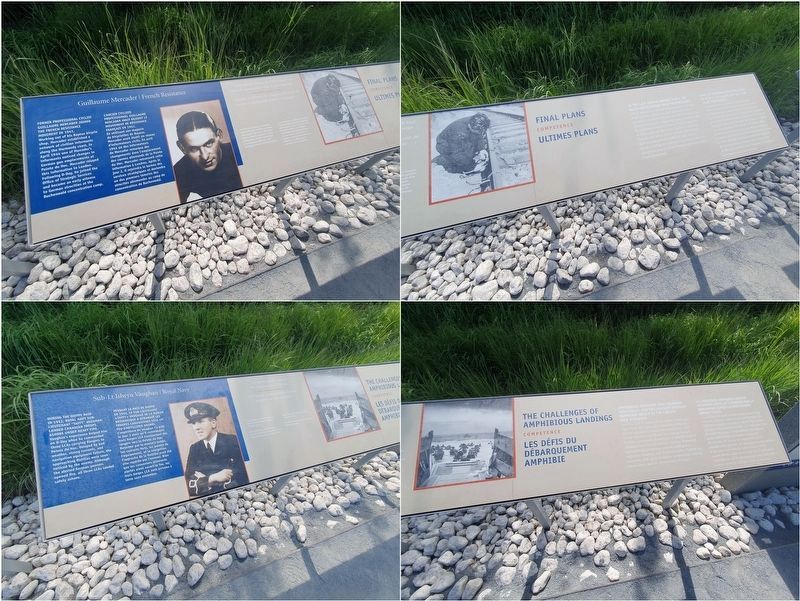
Guillaume Mercader | French Resistance
Former professional cyclist Guillaume Mercader joined the French resistance movement in 1941.
Working out of his Bayeux bicycle shop, Mercader established a network of civilian informants along the Normandy coast. In April 1944 one of Mercader's informants noticed changes in German gun emplacements at Pointe du Hoc. Mercader relayed this information to London. Following D-Day, he joined the Office of Strategic Services and became an early witness to German atrocities at the Buchenwald concentration camp.
"Throughout France, the Free French had been of inestimable value in the campaign..."
General Dwight D. Eisenhower, US Army
The French Resistance movement grew during the German occupation and played a key role in the Allied victory. Members gathered critical intelligence on troop movements, scouted enemy defenses, and sabotaged German communications.
Final Plans
In the last months before D-Day, the Allies accelerated their preparations.
Allied planners gathered information on
Photographed by J. Makali Bruton, June 5, 2024
4. Preparing to Invade Marker
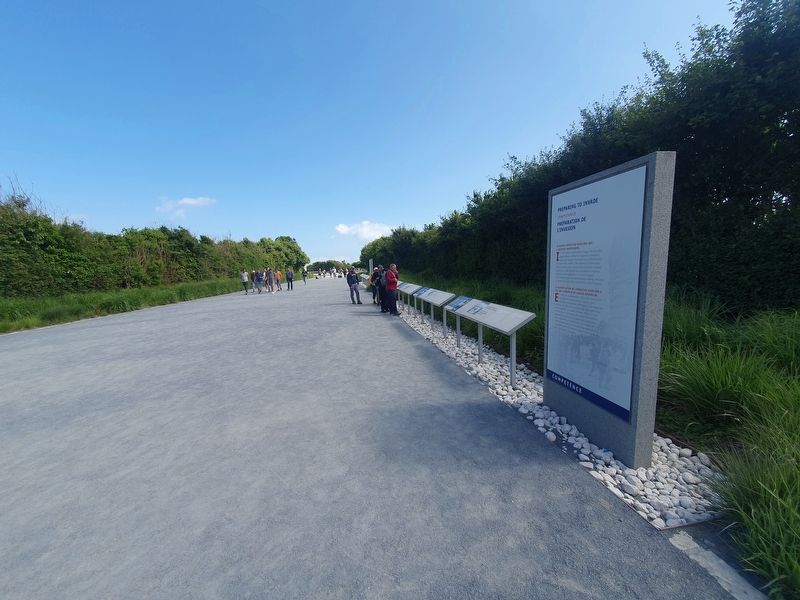
This view of the multi-paneled marker is towards the north and the beach of Pointe du Hoc.
Sub-Lt Islwyn Vaughan | Royal Navy
During the Dieppe raid in 1942, Royal Navy Sub-lieutenant "Taffy" Vaughan landed Canadian troops ashore under heavy fire.
Vaughan's experience helped him on D-Day when he commanded three LCAs carrying Rangers to Pointe du Hoc. Delayed by bad weather, strong currents, and navigation equipment failure, the approaching flotillas were soon noticed by the enemy. Although the alerted German gunners opened fire, all three LCAs landed safely ashore.
"Let no one underestimate the magnitude of this task.”
Admiral Sir Bertram Ramsay, Royal Navy
Sub-Lieutenant Islwyn Vaughan, Royal Navy Volunteer Reserve, in April 1942.
American soldiers invade German-occupied Europe.
The Challenges of Amphibious Landings
Amphibious invasions pose enormous challenges, and the invasion through normandy would be the largest ever attempted.
Soldiers had to come ashore under enemy fire, fight their way through formidable defenses, defeat expected German counterattacks, and create a secure beachhead in order to launch further operations. Paratroopers would jump in darkness to seize key terrain. Success depended upon precise planning, sound intelligence, superior training, and absolute secrecy before the invasion, and upon seamless cooperation among naval, land, and air forces once it began.
Préparation de l'invasion
La planification de l'Opération Overlord a été une entreprise de grande envergure.
En 1943, les commandants alliés ont commencé à détailler les préparations requises pour à organiser, transporter, débarquer, et soutenir les centaines de milliers de troupes qui débarqueraient en Normandie. Les unités d'assaut alliées se sont entrainées aux opérations de combat de manière exhaustive tandis que les logisticiens stockaient armes, matériel, et équipement. Les rangers de l'armée américaine ont entrepris des exercices de formation particulièrement exigeants en vue de leur rôle crucial dans l'invasion.
Lt Col Thomas H. Trevor | Royal Commandos
Le Lieutenant Colonel Trevor a donné des conseils de valeur inestimable aux Rangers se préparant à l'attaque de la Pointe du Hoc.
Vétéran des débarquements alliés en Afrique du Nord, au cours desquels il fut décoré, Trevor était tout particulièrement renommé pour son expertise dans l'escalade des falaises. Il avait participé aux exercices de formation des rangers sur l'île de Wight, où ils avaient pratiqué l'escalade de falaises du genre de celles qu'ils trouveraient à la Pointe du Hoc. Plus tard, Trevor accompagna le 2nd Ranger Battalion pendant l'assaut et sera blessé pendant le combat.
«Je pense qu'ils avaient des éclaireurs pour essayer de trouver les falaises les plus hautes et les plus difficiles qu'ils pouvaient trouver. »
Lt George Kerchner, 2nd Ranger Battalion
Les rangers qui se sont entraînés avec le Lieutenant Colonel Thomas Trevor ont développé un énorme respect pour ses compétences, son expérience, et son courage.
Un commando royal britannique mène un ranger américain dans un exercice de formation à la baionnette. Les rangers S'entrainalent de concert avec les commandos après leur arrivée dans les iles Britanniques, et les deux forces ont forgé une collaboration militaire durable.
Formation et outils des Rangers
Pendant plus d'une année les 2nd et 5th ranger battalions ont participé à une formation épuisante qui mettait l'accent sur la résistance physique, les compétences pour le combat et le maniement des armes. Le programme de formation du ranger insistait sur la résolution des problèmes, l'action indépendante, et l'improvisation. Les rangers devaient également apprendre à utiliser les outils spécialisés tels que les cordes propulsées par des fusées pour escalader les falaises et les grenades incendiaires pour désactiver les canons allemands. Ces compétences allaient s'avérer essentielles quand les rangers firent face aux défis du jour J et des jours qui suivirent.
Lt Col James Earl Rudder | 2nd Ranger Battalion
Le Lieutenant Colonel Rudder a mené personnellement ses hommes à l'assaut de la Pointe du Hoc.
Officier de réserve de l'armée, Rudder a pris le commandement du 2nd Ranger Battalion en juin 1943. Le jour J il a débarqués dans le premier LCA à toucher la plage de la Pointe du Hoc et a été blessé pendant la bataille. Son courage et sa conduite de chef motivante ont aidé sa petite force à résister aux nombreuses contre-attaques allemandes. Fortement décoré pour son service en temps de guerre, Rudder est toujours considéré comme le ranger modèle.
« Il te parlait doucement mais fermement, comme un grand frère. Il te motivait à faire de ton mieux. Tu étais prêt à mourir pour lui. »
1st Sgt Leonard Lomell, 2nd Banger Battalion
Le Lieutenant Colonel James Rudder à son poste de commandement à la Pointe du Hoc. Il a insisté pour débarquer avec les hommes de la force d'assaut initiale.
Les Allemands avalent armé la Pointe du Hoc avec des canons de fabrication française K418 de 155 mm comme celul qui apparait ici. Beaucoup de défenses côtières allemandes utilisaient des canons confisques a la France en 1940.
Canons Allemands
La batterie de canons de 155 mm et le poste d'observation de la Pointe du Hoc representaient une menace importante pour les forces de débarquement américaines.
Les canons lourds avaient une portée suffisante pour atteindre Utah Beach et Omaha Beach, de même que la flottille d'invasion en mer. Les planificateurs alliés craignaient que la batterie ne dévaste les forces d'invasion. La Pointe du Hoc devint une cible prioritaire pour le bombardement naval et aérien pré-invasion, mais seul un assaut terrestre pouvait assurer la neutralisation des canons pour le jour).
Guillaume Mercader | French Resistance
L'ancien cycliste professionnel Guillaume Mercader avait rejoint le mouvement de résistance Français en 1941.
En utilisant son magasin de bicyclettes de Bayeux, Mercader avait établi un réseau d'informateurs civils. En avril 1944 un des informateurs de Mercader remarqua des changements dans l'emplacement des canons allemands de la Pointe du Hoc. Mercader retransmit cette information à Londres. Après le jour J, il rejoindra le bureau des services stratégiques et deviendra un des premiers témoins des atrocités allemandes au camp de concentration de Buchenwald.
«Partout en France, les Français libres ont été un atout inestimable dans la campagne...»
General Dwight D. Eisenhower, US Army
Le mouvement de résistance français s'est développé pendant l'occupation allemande et a joué un rôle clé dans la victoire alliée. Les résistants recueillaient des renseignements cruciaux sur les mouvements de troupes, surveillaient les défenses ennemies, et sabotaient les communications allemandes.
Ultimes Plans
Dans les derniers mois précédant le jour j, les Allies ont accélére leurs préparatifs.
Les planificateurs alliés recueillaient des informations sur les déploiements ennemis. Les bombardiers américains et britanniques agissaient de concert avec la résistance française pour isoler la Normandie, visant des liaisons de transport dans tout le nord de la France. Tandis que des centaines de milliers de soldats alliés américains, britanniques, canadiens, français, et autres, intensifiaient leur entrainement pour la tâche difficile qui les attendait, les agences de renseignements lançaient un large plan de désinformation pour éloigner l'attention allemande de la Normandie.
Sub-Lt Islwyn Vaughan | Royal Navy
Pendant le raid de Dieppe en 1942, le Sub-lieutenant « Taffy » Vaughan de la Marine Britannique a débarqué les troupes Canadiennes sous un feu d'artillerie nourri.
L'expérience de Vaughan l'a aidé le jour J alors qu'il commandait trois barges LCA transportant des rangers vers la Pointe du Hoc. Retardée par le mauvais temps, les courants forts, les pannes de l'équipement, et la navigation, l'approche de la flottille avait été vite repérée par l'ennemi. Bien que les canonniers allemands alertés aient ouvert le feu, les trois barges LCA sont arrivées à terre sans encombre.
« Ne laissez personne sous-estimer l'ampleur de cette mission. »
Admiral Sir Bertram Ramsay, Royal Navy
Sub-Lieutenant Islwyn Vaughan, corps de réservistes volontaires de la marine britannique, en Avril 1942.
Les soldats américains envahissent l'Europe occupée.
Les Défis du Débarquement Amphibie
Les invasions amphibies lancent d'énormes défis, et l'invasion par la normandie serait la plus grande jamais tentee.
Les soldats devaient toucher terre sous le feu ennemi, se frayer une voie en combattant des défenses impressionnantes, vaincre les contre-attaques allemandes prévues, et créer une tête de pont sécurisée. Les parachutistes allaient sauter dans l'obscurité pour s'emparer du terrain clé. Le succès dépendait d'une planification précise, de renseignements solides, d'un entraînement de haut niveau, et du secret absolu, mais aussi, une fois l'opération commencée, de la coopération sans faille des armées de terre, de l'air, et de la marine.
Topics. This memorial is listed in this topic list: War, World II. A significant historical year for this entry is 1943.
Location. 49° 23.603′ N, 0° 59.187′ W. Memorial is in Cricqueville-en-Bessin, Normandie (Normandy), in Calvados. It is on Unnamed path north of Chemin des Rangers, on the right when traveling north. Touch for map. Memorial is in this post office area: Cricqueville-en-Bessin, Normandie 14450, France. Touch for directions.

Regionally, it is in the North Atlantic Region, Europe, the European Union, Atlantic Europe, the Schengen Area, Western Europe, a coastal Mediterranean country, and the Western World. Historically, it finds itself in what was once a French colony and also the Roman Empire.
Other nearby markers. At least 8 other markers are within 3 kilometers of this marker, measured as the crow flies: Bravery Under Fire (a few steps from this marker); Pointe du Hoc (within shouting distance of this marker); Ranger Casualties (about 240 meters away, measured in a direct line); The Pointe-du-Hoc: the Feat of the 2nd Ranger Battalion (approx. 0.2 kilometers away); a different marker also named Pointe du Hoc (approx. half a kilometer away); Les belles demeures / The beautiful houses (approx. 2.1 kilometers away); Le village / The village (approx. 2.1 kilometers away); Le patrimoine bâti / The built heritage (approx. 2.4 kilometers away). Touch for a list and map of all markers in Cricqueville-en-Bessin.
Credits. This page was last revised on July 6, 2024. It was originally submitted on July 4, 2024, by J. Makali Bruton of Washington, District of Columbia. This page has been viewed 264 times since then and 41 times this year. Photos: 1, 2, 3, 4. submitted on July 4, 2024, by J. Makali Bruton of Washington, District of Columbia.
