Fère-en-Tardenois in Aisne, Upper France, France — Western Europe
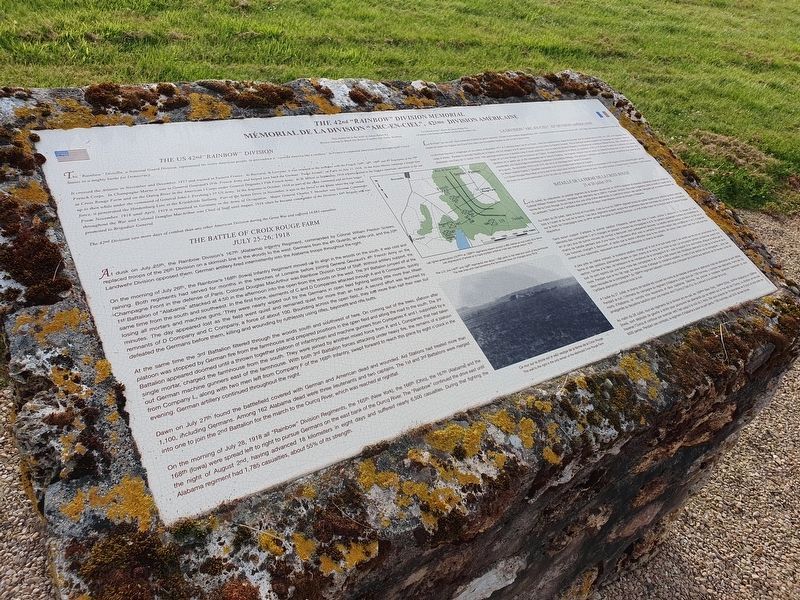
The 42nd "Rainbow" Division Memorial
The Battle of Croix Rouge Farm
Photographed by J. Makali Bruton, June 8, 2024
1. The 42nd "Rainbow" Division Memorial

This memorial is the work of James Butler R.A.
Bronze casting by Black Isle Bronze Foundry Ltd., Nairn, Scotland
The US 42nd "Rainbow" Division
The "Rainbow Division, a National Guard Division, represented the entire American people. In provenance it "covered America like a rainbow.” In France it committed Americans from throughout the United States to a mighty battle for Democracy.
It crossed the Atlantic in November and December, 1917 and trained in Eastern France. At Baccarat, in Lorraine, it was twinned in the trenches with the French 12th, 14th , 164th and 4th Regiments of the Vith French Corps. In Champagne-Marne it was in General Gouraud's IVth French Army and helped turn back the German "Peace Assault” on Paris on July 15, 1918. In the Aisne-Marne campaign it fought here at Croix Rouge Farm and on the Ourcq River in the American I Corps under General Degoutte’s VIth French Army. At St. Mihiel in September, 1918 it participated in the biggest American operation of the war up to then while under the command of General John J. Pershing's 1st US Army. In the Argonne in October,
this page online
The 42nd Division saw more days of combat than any other American Division during the Great War and suffered 14,683 casualties.
The Battle of Croix Rouge Farm
July 25-26, 1918
At dusk on July 25th, the Rainbow Division's 167th (Alabama) Infantry Regiment, commanded by Colonel William Preston Screws, replaced troops of the 26th Division on a skirmish line in the woods to the west. Germans from the 4th Guards, an elite unit, and the 10th Landwehr Division opposed them. German artillery fired intermittently into the Alabama troops throughout the night.
On the morning of July 26th, the Rainbow's 168th (Iowa)
Photographed by J. Makali Bruton, June 8, 2024
2. The 42nd "Rainbow" Division Memorial
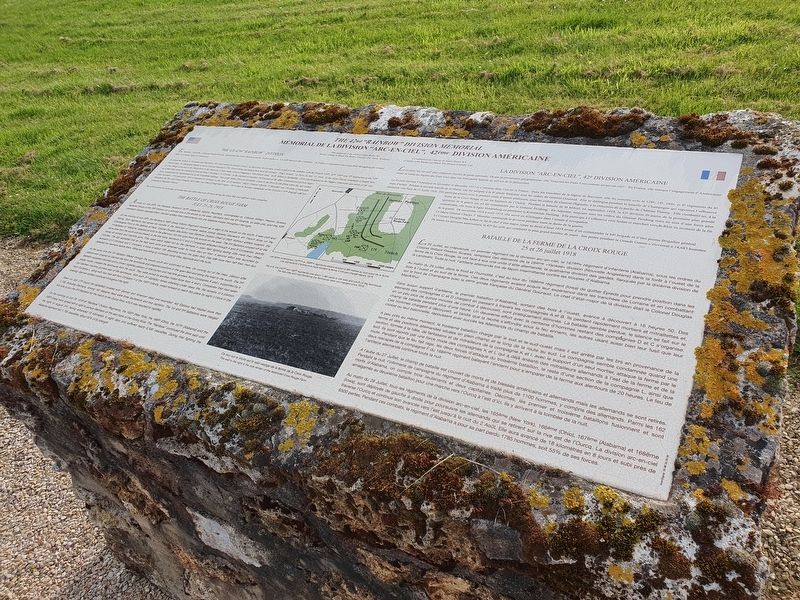
This additional view of the marker shows the French text with greater clarity.
At the same time the 3rd Battalion
Photographed by J. Makali Bruton, June 8, 2024
3. The 42nd "Rainbow" Division Memorial
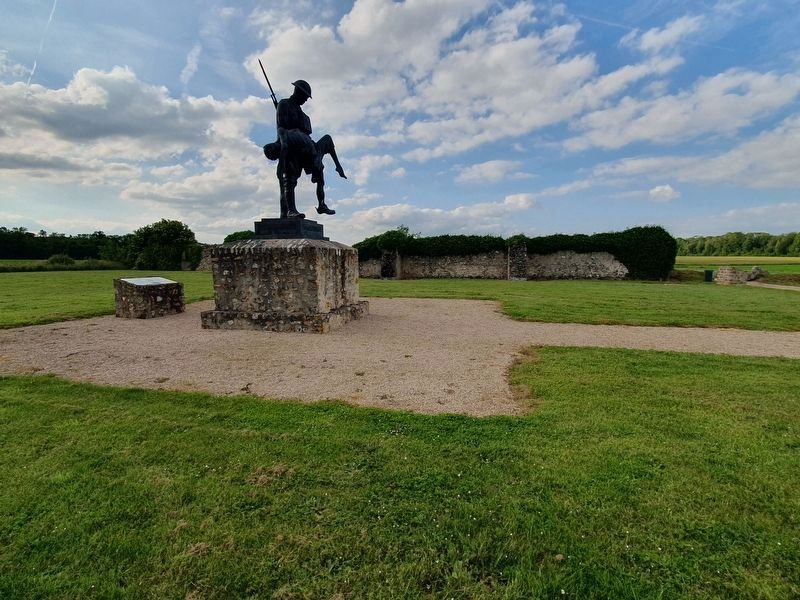
The wall behind the memorial in this view is the only remnant of the Croix Rouge farm.
Dawn on July 27th found the battlefield covered with German and American dead and wounded. Aid Stations had treated more than 1,100, including Germans. Among 162 Alabama dead were three lieutenants and two captains. The 1st and 3rd Battalions were merged into one to join the 2nd Battalion for the march to the Ourcq River, which was reached at nightfall.
On the morning of July 28, 1918 all "Rainbow" Division Regiments, the 165th (New York), the 166th (Ohio), the 167th (Alabama) and the 168th (Iowa) were spread left to right to pursue Germans on the east bank of the Ourcq River. The "Rainbow" continued the drive east until the night of August 2nd, having advanced 18 kilometers in eight days and suffered nearly 6,500 casualties. During that fighting the Alabama regiment had 1,785 casualties, about 55% of its strength.
The U.S. line (167th and 168th regiments) was about 1,000 yards to the west and south of the farmhouse. The tree lines and road bordering the farmhouse have not changed since 1918.
This wall to the right is the only remain of the destroyed Croix Rouge Farm.
Mémorial de la Division "Arc-en-Ciel, 42ème Division Américaine
Ce memorial est l'oeuvre de James Butler R.A.
La statue a été fondue par Black Isle Bronze Foundry Ltd.,
La Division “Arc-en-Ciel”, 42e Division Americaine
La division “arc-en-ciel” etait composée d'unités de garde nationale. De par sa provenance grave venant de toutes les régions des Etats-Unis dans une formidable bataille au service de la democracie.
La division traversa l’Atlantique en novembre et décembre 1917 et s'entraina dans l'est de la France. Dans les tranchées de la région de Baccarat, elle fut jumelée avec le 128e, 14e, 164e, et 4e régiments du 6e corps d’armée. Pendant la seconde bataille de la Marne, elle fut intégrée à la 4e armée française sous les ordres du Général Gouraud. Elle se distingua pendant la bataille de Champagne qui repoussa l'offensive allemande vers Paris du 15 Juillet 1918. Elle participa ensuite avec le premier corps d'armée américain, sous les ordres du Général Degoutte, à la réduction de la poche de Château Thierry. Elle combattit ici, à la ferme de la Croix Rouge et sur les hauteurs de l’Ourcq. Pendant la bataille de St Mihiel, en septembre 1918, la 42e division fit partie de la premiere plus grand operatoin de la guerre qui ait été commandée par le General Pershing. En Argonne, toujours sous les ordres du Général Pershing mais au sein d’une force plus considérable, elle força la ligne Hindenburg en pénétrant la Kriemhilde Stellung. Elle participa à l'offensive vers Sedan et marchait vers le Rhin au moment de la fin de la guerre. De novembre 1918 à avril 1919, elle servit en Allemagne dans l'armée d'occupation.
Le Major Général Charles T. Menoher commanda la division pendant toute la durée de la guerre. Le Colonel Douglas MacArthur en fut le chef d'état major jusqu'au mois d'hout 1918 avant d'en commander la 84e brigade et d'être promu Brigadier général. De toutes les divisions américaines, la 42e fut celle qui combattit le plus grand nombre de jours. Ses pertes pendant la Grande Guerre s'élevèrent à 14,683 hommes.
Bataille de la Ferme de la Croix Rouge
25 et 26 juillet 1918
Le 25 Juillet, au crépuscule, un premier régiment de la division arc-en-ciel, le 167ème régiment d'infanterie (Alabama), sous les ordres du Colonel William Preston Screws, remplace des éléments de la 26ème «Yankee division (Nouvelle Angleterre) dans la forêt à l'ouest de la ferme de la Croix Rouge. Ils ont face à eux une unité d'élite allemande, la quatrième division des gardes, flanquée par la dixième division de la Landwehr. Toute la nuit, l'artillerie allemande tire de façon intermittente contre les troupes d'Alabama.
Au matin du 26 juillet, dans le froid et l'humidité, c'est au tour du 168ème régiment (Iowa) de quitter Epieds pour prendre position dans les bois à l'ouest et au sud de la ferme. Ces deux régiments avaient acquis leur expérience dans les tranchées de Lorraine et en combattant sur le front de Champagne avec la 4ème armée française du Général Gouraud. Le chef d'état-major de la division était le Colonel Douglas MacArthur.
Sans aucun support d'artillerie, le premier bataillon d'Alabama, sortant des bois à l'ouest, avance à découvert à 16 heures 50. Des éléments des compagnies C et D chargent en passant à travers les compagnies A et B. Ils perdent rapidement mortiers et mitraillettes et, en un peu plus de quinze minutes de combat à découvert, sont pratiquement éliminés. La bataille semble perdue, le silence se fait sur le champ de bataille pendant plus d'une heure. Un deuxième effort avec la centaine d'hommes restant des compagnies D et C s'organise. Ces hommes chargent à découvert, et tandis que la moitié s'effondre sous le feu ennemi, les autres usant aussi bien leur fusil que leur crosse ou leur baïonnette, repoussent avec succès les Allemands du champ de bataille.
A peu près au même moment, le troisième bataillon charge par le sud et le sud-ouest mais il est arrêté par les tirs en provenance de la ferme et des positions allemandes situées en plein champ et le long de la route au sud. La compagnie semble condamnée quand une section, formée à la hate, de fantassins et de mitrailleurs de la compagnie K et I, avec le support d'un seul mortier, attaque la ferme par le sud. Ils sont rejoints par une force mixte des compagnies K et L qui a déjà anéanti des mitrailleurs allemands à l'est de la ferme et de la route. Pendant que le feu fait rage, les deux forces d'attaque du troisième bataillon, le reste d'une section de la compagnie L, ainsi que deux rescapés de la compagnie F du 168ème régiment balayent l'ennemi pour s'emparer de la ferme aux alentours de 20 heures. Le feu de l'artillerie allemande continue toute la nuit.
A l'aube du 27 Juillet, le champ de bataille est couvert de morts et de blessés américains et allemands mais les allemands se sont retirés. Pendant la nuit, l'infirmerie de campagne du régiment d'Alabama à traité plus de 1100 hommes, y compris des allemands. Parmi les 162 morts d'Alabama, on compte trois lieutenants et deux capitaines. Décimés, les premier et troisième bataillons fusionnent et sont amalgamés au deuxième bataillon pour une marche vers l'Ourcq à l'est d'ici. Ils y arrivent à la tombée de la nuit.
Au matin du 28 Juillet, tous les régiments de la division arc-en-ciel, les 165ème (New York), 166ème (Ohio), 167ème (Alabama) et 168ème (Iowa), sont déployés de gauche à droite pour poursuivre les allemands qui se retirent sur la rive est de l'Ourcq. La division arc-en-ciel traverse l'Ourcq et continue son avancée vers l'est jusqu'à la nuit du 2 Août. Elle aura avancé de 18 kilomètres en 8 jours et subi près de 6500 pertes. Pendant ces combats, le régiment d'Alabama a pour sa part perdu 1785 hommes, soit 55% de ses forces.
Les lignes américaines (1676me et 168me régiments) étaient environ à 900 metres au sud ouest de la ferme. Les alignements d'arbres et la route bordant la ferme n'ont pas changé depuis 1918
Ce mur sur la droite est le seul vestige de la ferme de la Croix Rouge.
Topics. This memorial is listed in this topic list: War, World I. A significant historical month for this entry is April 1919.
Location. 49° 7.957′ N, 3° 31.284′ E. Memorial is in Fère-en-Tardenois, Hauts-de-France (Upper France), in Aisne. It is on La Croix Rouge (Route D3) north of Route A4, on the left when traveling north. Touch for map. Memorial is in this post office area: Fère-en-Tardenois, Hauts-de-France 02130, France. Touch for directions.

Regionally, it is in the North Atlantic Region, Europe, the European Union, Atlantic Europe, the Schengen Area, Western Europe, a coastal Mediterranean country, and the Western World. Historically, it finds itself in what was once a French colony and also the Roman Empire.
Other nearby markers. At least 8 other markers are within 10 kilometers of this marker, measured as the crow flies: Rainbow Soldier (here, next to this marker); James Butler, R.A., M.B.E. (here, next to this marker); The Battle of the Ourcq River (within shouting distance of this marker); Oise-Aisne American Cemetery and Memorial (approx. 7.9 kilometers away); Oisne-Aisne American Memorial (approx. 8.1 kilometers away); World War Memorial (approx. 8.8 kilometers away); Lieutenant Quentin Roosevelt Memorial Fountain (approx. 9.5 kilometers away); Lieutenant Quentin Roosevelt (approx. 9.5 kilometers away). Touch for a list and map of all markers in Fère-en-Tardenois.
Also see . . . 42nd Infantry Division at Wikipedia. (Submitted on July 5, 2024.)
Credits. This page was last revised on July 5, 2024. It was originally submitted on July 5, 2024, by J. Makali Bruton of Washington, District of Columbia. This page has been viewed 324 times since then and 55 times this year. Photos: 1, 2, 3. submitted on July 5, 2024, by J. Makali Bruton of Washington, District of Columbia.
