
Albert in Somme, Upper France, France — Western Europe
La Basilique Notre Dame de Brebières
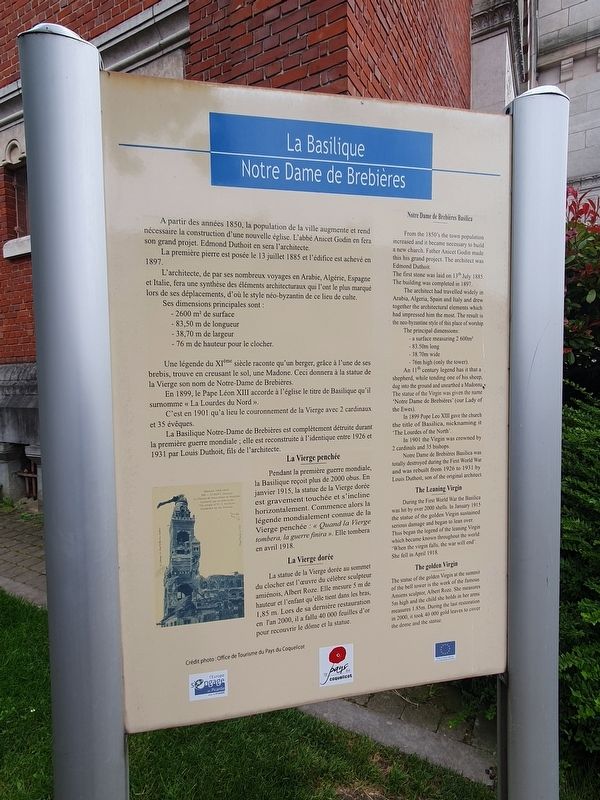
Photographed by J. Makali Bruton, June 12, 2024
1. La Basilique Notre Dame de Brebières Marker

A partir des années 1850, la population de la ville augmente et rend nécessaire la construction d'une nouvelle église. L'abbé Anicet Godin en fera son grand projet. Edmond Duthoit en sera l'architecte.
La première pierre est posée le 13 juillet 1885 et l'édifice est achevé en 1897.
L'architecte, de par ses nombreux voyages en Arabie, Algérie, Espagne et Italie, fera une synthèse des éléments architecturaux qui l'ont le plus marqué lors de ses déplacements, d'où le style néo-byzantin de ce lieu de culte.
Ses dimensions principales sont :
- 2600 m² de surface
- 83,50 m de longueur
- 38,70 m de largeur
- 76 m de hauteur pour le clocher.
Une légende du XIe siècle raconte qu'un berger, grâce à l'une de ses brebis, trouve en creusant le sol, une Madone. Ceci donnera à la statue de la Vierge son nom de Notre-Dame de Brebières.
En 1899, le Pape Léon XIII accorde à l'église le titre de Basilique qu'il surnomme « La Lourdes du Nord ».
C'est en 1901 qu'a lieu le couronnement de la Vierge avec 2 cardinaux et 35 évêques.
La Basilique Notre-Dame de Brebières est complètement détruite durant la première guerre mondiale; elle est reconstruite à l'identique entre 1926 et 1931 par Louis Duthoit, fils de l'architecte.
La Vierge penchée
Pendant la première guerre mondiale, la Basilique reçoit plus de 2000 obus. En janvier 1915, la statue de la Vierge dorée est gravement touchée et s'incline horizontalement. Commence alors la légende mondialement connue de la Vierge penchée : « Quand la Vierge tombera, la guerre finira ». Elle tombera en avril 1918.
La Vierge dorée
La statue de la Vierge dorée au sommet du clocher est l'œuvre du célèbre sculpteur amiénois, Albert Roze. Elle mesure 5 m de hauteur et l'enfant qu'elle tient dans les bras, 1,85 m. Lors de sa dernière restauration en l'an 2000, il a fallu 40 000 feuilles d'or pour recouvrir le dôme et la statue.
Crédit photo: Office de Tourisme du Pays du Coquelicot
Notre Dame de Brebieres Basilica
From the 1850's the town population increased and it became necessary to build a new church. Father Anicet Godin made this his grand project. The architect was Edmond Duthoit.
The first stone was laid on 13 July 1885. The building was completed in 1897.
The architect had travelled widely in Arabia, Algeria, Spain and Italy and drew together the architectural elements which had impressed him the most. The result is the neo-byzantine style of this place of worship.
The principal dimensions:
- a surface measuring 2 600m²
- 83.50m long
- 38.70m wide
- 76m high (only the tower).
An 11th century legend has it that a shepherd, while tending one of his sheep, dug into the ground and unearthed a Madonna. The statue of the Virgin was given the name "Notre Dame de Brebières" (Our Lady of the Ewes).
In 1899 Pope Leo XIII gave the church the title of Basilica, nicknaming it "The Lourdes of the North".
In 1901 the Virgin was crowned by 2 cardinals and 35 bishops.
Notre Dame de Brebières Basilica was totally destroyed during the First World War and was rebuilt from 1926 to 1931 by Louis Duthoit, son of the original architect.
The Leaning Virgin
During the First World War the Basilica was hit by over 2000 shells. In January 1915 the statue of the Golden Virgin sustained serious damage and began to lean over. Thus began the legend of the leaning Virgin which became known throughout the world: "When the virgin falls, the war will end”. She fell in April 1918.
The Golden Virgin
The statue of the golden Virgin at the summit of the bell tower is the work of the famous Amiens sculptor, Albert Ree. She measures 5m high and the child she holds in her arms measures 1.85m. During the last restoration in 2000, it took 40 000 gold leaves to cover the dome and the statue.
Topics.
this page online
Location. 50° 0.228′ N, 2° 38.867′ E. Marker is in Albert, Hauts-de-France (Upper France), in Somme. It is on Rue Dumont north of Route D4929, on the right when traveling north. Touch for map. Marker is at or near this postal address: 1 Rue Dumont, Albert, Hauts-de-France 80300, France. Touch for directions.

Regionally, it is in the North Atlantic Region, Europe, the European Union, Atlantic Europe, the Schengen Area, Western Europe, a coastal Mediterranean country, and the Western World. Historically, it finds itself in what was once a French colony and also the Roman Empire.
Other nearby markers. At least 8 other markers are within 3 kilometers of this marker, measured as the crow flies: Musée Somme 1916 (within shouting distance of this marker); French Forces of the Interior Battalion 7/2 (about 180 meters away, measured in a direct line); La gare d’Albert (approx. 0.3 kilometers away); Albert A Ses Morts (approx. 0.4 kilometers away); Toulet (approx.

Photographed by J. Makali Bruton, June 10, 2024
2. La Basilique Notre Dame de Brebières and Marker
The marker is low and to the left of the basilica.
Also see . . . Basilica of Our Lady of Brebières at Wikipedia. (Submitted on July 5, 2024.)
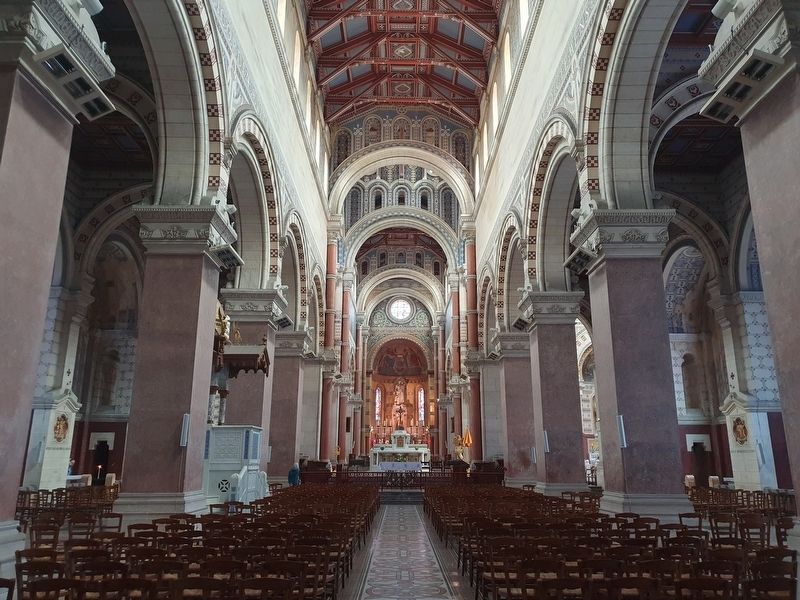
Photographed by J. Makali Bruton, June 12, 2024
3. An interior view of La Basilique Notre Dame de Brebières
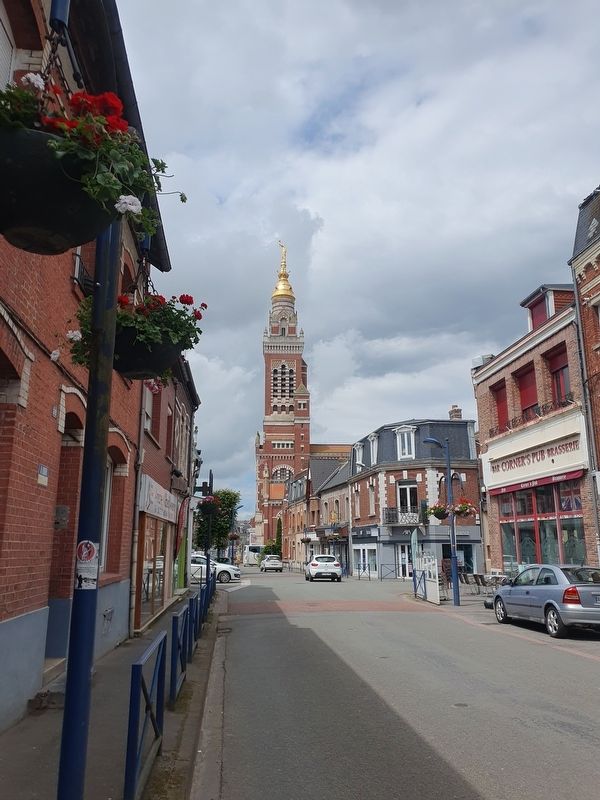
Photographed by J. Makali Bruton, June 12, 2024
4. La Basilique Notre Dame de Brebières
Credits. This page was last revised on July 5, 2024. It was originally submitted on July 5, 2024, by J. Makali Bruton of Washington, District of Columbia. This page has been viewed 162 times since then and 24 times this year. Photos: 1, 2, 3, 4. submitted on July 5, 2024, by J. Makali Bruton of Washington, District of Columbia.
