Portola Valley in San Mateo County, California — The American West (Pacific Coastal)
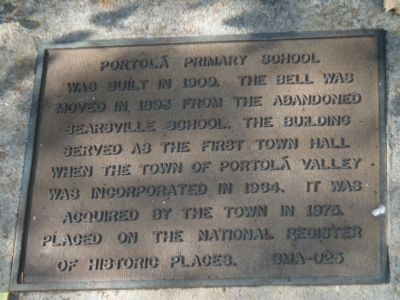
Portola Primary School
Photographed by I.G.V.Atajar, November 9, 2009
1. Portola Primary School Marker
[Second Marker:]
Topics. This historical marker is listed in these topic lists: Communications • Education • Government & Politics. A significant historical year for this entry is 1909.
Location. 37° 22.922′ N,
this page online

Regionally, this marker is in California’s San Francisco Bay Area, in Silicon Valley, and on the Coast Ranges. It is also on the American Pacific Coast. Globally, it is in North America, on the Ring of Fire, on the Pacific Rim, in the Western Hemisphere, in the Western World, and in the Anglosphere. Historically, it finds itself in what was once New Spain and also Mexico’s Alta California.
Other nearby markers. At least 8 other markers are within 3 miles of this marker, measured as the crow flies: Hallidie Tramway (approx. 0.2 miles away); Our Lady of the Wayside (approx. 0.3 miles away); Town of Searsville (approx. 1.7 miles away); Casa de Tableta (approx. 2 miles away); First Saw Mill (approx. 2.2 miles away); The Chinese Walls (approx. 2.7 miles away); Folger Stable c.1905 (approx. 2.7 miles away); St. Denis Church and Cemetery
Photographed by I.G.V.Atajar, November 9, 2009
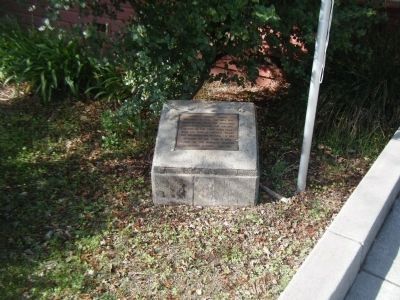
2. Portola Primary School Marker
Regarding Portola Primary School. The building is currently being used as office space for the Portola Valley Elementary School District.
Photographed by I.G.V.Atajar, November 9, 2009
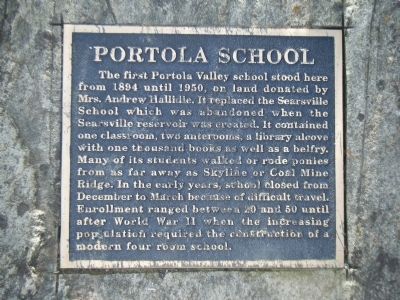
3. A Second Portola Primary School Marker
Photographed by I.G.V.Atajar, November 9, 2009
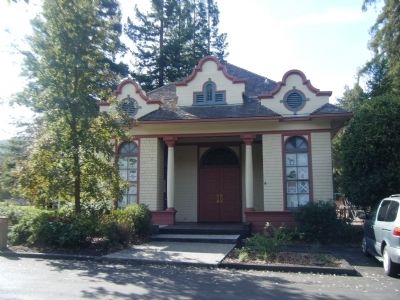
4. Portola Primary School
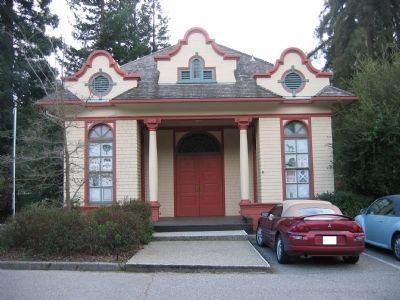
February 21, 2007
5. Portola School
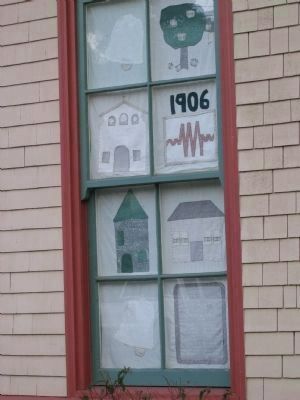
February 21, 2007
6. Student Quilt Art on Display in the Schoolhouse Window
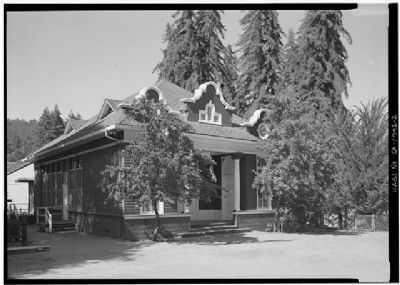
Library of Congress, Photographer Unknown
7. Portola Primary School
From the Statement of Significance-LOC
The Portola Valley schoolhouse is one of the few remaining turn-of-the-century examples of Mission Revival-styled schools. Its wood construction and use of shingles present a unique expression of this popular style. The architect freely interpreted the popular style with the use of false front curvilinear gables faced with redwood ship-lap and semi-circular fanlights above the front windows and recessed doorway. The exterior is sheathed in cedar shingles and redwood siding lumbered locally. This manipulation of regional materials in a conspicuous effort to execute the style on a small scale resulted in a uniquely attractive design. Built as a one room school house, it remains almost entirely unaltered, and continues to service the neighboring larger school. Its survival is threatened, however, due to its location in the San Andreas rift zone.
[Editor's Note: The "neighboring larger school" mentioned has been torn down due to not meeting earthquake safety codes.]
Click for more information.
The Portola Valley schoolhouse is one of the few remaining turn-of-the-century examples of Mission Revival-styled schools. Its wood construction and use of shingles present a unique expression of this popular style. The architect freely interpreted the popular style with the use of false front curvilinear gables faced with redwood ship-lap and semi-circular fanlights above the front windows and recessed doorway. The exterior is sheathed in cedar shingles and redwood siding lumbered locally. This manipulation of regional materials in a conspicuous effort to execute the style on a small scale resulted in a uniquely attractive design. Built as a one room school house, it remains almost entirely unaltered, and continues to service the neighboring larger school. Its survival is threatened, however, due to its location in the San Andreas rift zone.
[Editor's Note: The "neighboring larger school" mentioned has been torn down due to not meeting earthquake safety codes.]
Click for more information.
Credits. This page was last revised on January 9, 2025. It was originally submitted on December 1, 2009, by I.G.V.Atajar of San Jose, California. This page has been viewed 1,359 times since then and 22 times this year. Photos: 1, 2, 3, 4. submitted on December 1, 2009, by I.G.V.Atajar of San Jose, California. 5, 6, 7. submitted on December 1, 2009. • Syd Whittle was the editor who published this page.
