
Bouresches in Aisne, Upper France, France — Western Europe
La Bataille de Bouresches
The Battle of Bouresches
Photographed by J. Makali Bruton, June 8, 2024
1. La Bataille de Bouresches Marker

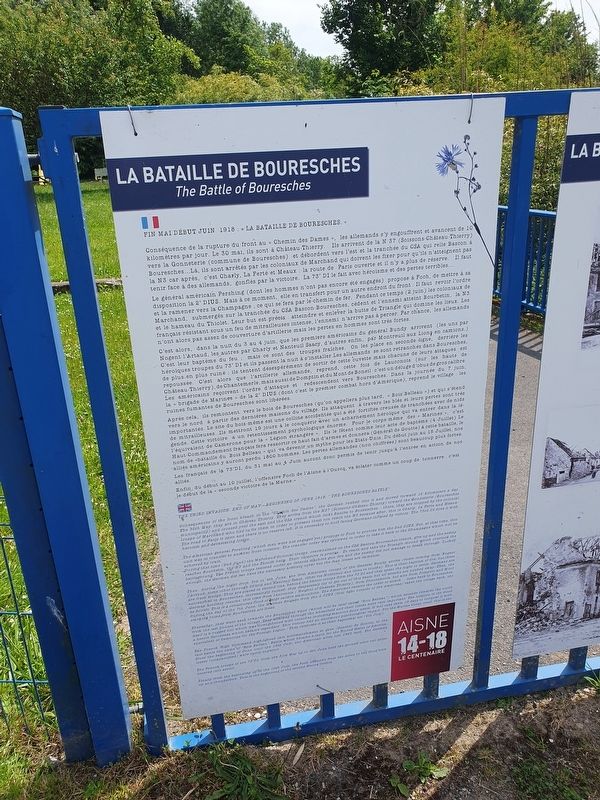
Fin Mai Debut Juin 1918: La Bataille de Bouresches
Conséquence de la rupture du front au Chemin des Dames, les allemands s'y engouffrent et avancent de 10 kilomètres par jour. Le 30 mai, ils sont à Château-Thierry. Is arrivent de la 37 (Soissons-Chateau-Thierry) vers la Gonneterie (commune de Bouresches) et débordent vers l'est et la tranchée du CA qui relie Bascon a Bouresches... Là, ils sont arrétés par les coloniaux de Marchand qui doivent les fixer pour qu'ils n'atteignent pas la N3 car après, c'est Charly. La Ferté et Meaux: la route de Paris ouverte et il n'y a plus de réserve. Il faut tenir face à des allemands, gonflés par la victoire. La 73o DI le fait avec heroisme et des pertes terribles...
Le général américain Pershing (dont les hommes n'ont pas encore été engagés) propose à Foch, de mettre à sa disposition la 2o DIUS. Mais à ce moment, elle en transfert pour un autre endroit du front: Il faut revoir l'ordre et la ramener vers la Champagne: ce qui se fera par le chemin de fer. Pendant ce temps (2 juin) les coloniaux de Marchand, submergés sur la tranchée du CSA Basson Bouresches,
this page online
C’est alors, dans la nuit du 3 au 4 juin, que les premiers américains du général Bundy arrivent (les uns par Nogent l'Artaud, les autres par Charly et Nanteuil Saacy, d'autres enfin, par Montreuil aux Lions en camions.) C'est leur baptême du feu: mais ce sont des troupes fraiches. On les place en seconde ligne, derriere les héroiques troupes du 73" DI et ils passent la nuit à s'installer. Les allemands se sont retranches dans Bouresches, de plus en plus ruiné: ila tentent désespérément de sortir de cette cuvette mais chacune de leurs ataques est repoussée. C'est alors que l'artillerie allemande, reprend, cette fois de Lauconois (sur les hauts de Chateau-Thierry), de Chantemerle, mais aussi de Domptin et du Mont de Boneil: c'est un deluge d'obus de gros calibre. Les américains
Photographed by J. Makali Bruton, June 8, 2024
2. La Bataille de Bouresches Marker
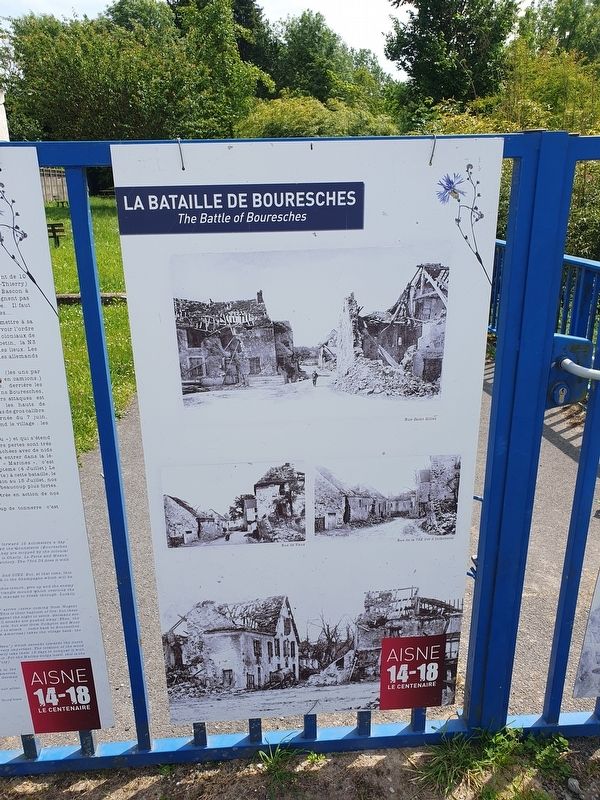
The marker's second panel includes photos of damage from the battle.
Après cela, ils remontent vers le bois de Bouresches (qu'on appellers plus tard Bois Belleau) et qui s’etend vers le nord à partir des dernières maisons du village. Ils attaquent à travers les bles et leurs pertes sont tres importantes. Le site du bois même est use colline accidentée qui a été fortifiée creusée de tranchées avec de nids de mitrailleuses. Ils mettront 19 jours a le conquérir avec un acharnement heroique qui va entrer dans la legende. Cette victoire a un retentissement paychologique énorme. Pour le corps meme des Marines c’est l’equivalent de Camerone pour la Legion extrangere. Ils le fétent comme leur acte de bapteme (4 Juillet) Le Haut-Commandement français fera ressortir ce haut fait d'armes et donnera (General de Goutte) a cette bataille, le nom de bataille du Bois Belleau qui va devenir un mythe pour les Etats-Unis. Du debut juin au 15 Juillet, nos allies américains y auront
Photographed by J. Makali Bruton, June 8, 2024
3. La Bataille de Bouresches Marker - Place Saint-Lubin en 1919
Les français de la 73o DI, du 31 main au 4 Juin auront donc permis de tenir jusqu'a l’entrée en action de nos allies.
Enfin, du début au 10 juillet, l'offensive Foch de l'Aisne a l'Ourcq, va eclater comme un coup de tonnerre: c’est le début de la seconde victoire de la Marne.
Rue Saint Gilles ∙ Rue de Vaux ∙ Rue de la 73E Div d’Infanterie
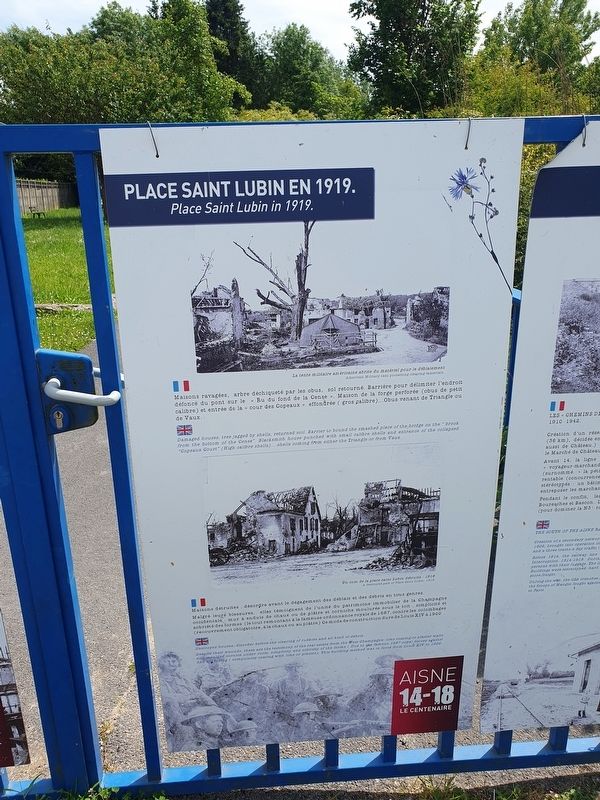
Place Saint Lubin en 1919
Maisons ravagées, arbre déchiqueté par les obus, sol retourné. Barrière pour déliminer l'endroit défoncé du pont sur le Ru du fond de la Cense. Maison de la forge perforée (obus de petit calibre) et entrée de la cour des Copeaux effondrée (gros calibre)...Obus venant de Triangle ou de Vaux.
La tente militaire americaine abrite du materiel pour le deblaiement
Maisons détruites: désordre avant le dégagement des déblais et des debris en tous genres. Malgré leurs blessures, elles témoignent de l'unité du patrimoine immobilier de la Champagne occidentale: mur a enduis de chaux ou de platre et corniche mouluree sous le toit: simplicite et sobriete des formes (le toutremontant a la
Photographed by J. Makali Bruton, June 8, 2024
4. La Bataille de Bouresches Marker - Le CSA
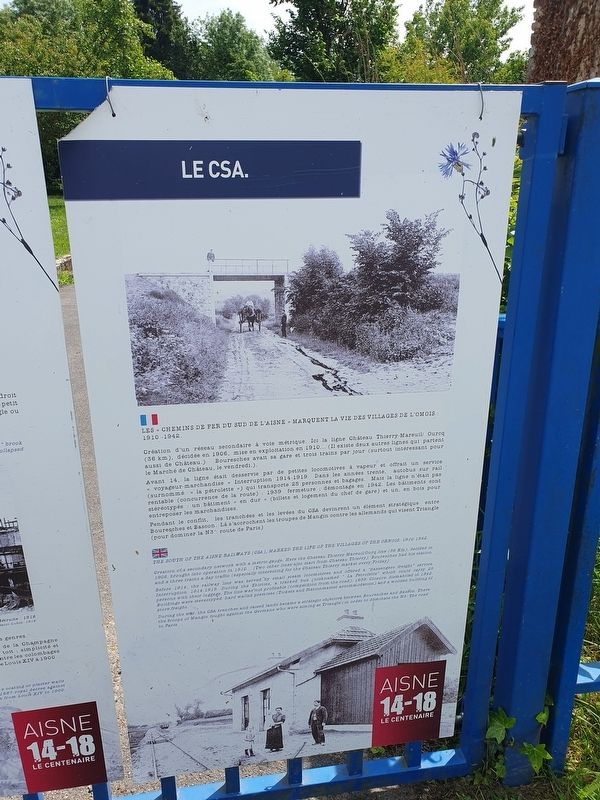
Le CSA.
Les Chemins de Fer du Sud de l’Aisne marquent la vide des villages de l’Omois
1910-1942.
Création d'un réseau secondaire à voie métrique. Ici la ligne Château Thierry-Mareuil/ Ourcq (36 km), décidée en 1906, mise en exploitation en 1910... (Il existe deux autres lignes qui partent aussi de Château.) Bouresches avait sa gare et trois trains par jour (surtout intéressant pour le Marché de Château, le vendredi.).
Avant 14, la ligne était desservie par de petites locomotives à vapeur et offrait un service « voyageur-marchandise » Interruption 1914-1919 Dans les années trente, autobus sur rail (surnommé la pétrolette ») qui transporte 25 personnes et bagages. Mais la ligne n'était pas rentable (concurrence de la route): 1939 fermeture démontage en 1942. Les bâtiments sont stéréotypés un bâtiment en dur (billets et logement du chef de gare) et un, en bois pour entreposer les marchandises.
Pendant le conflit, les tranchées et les levées du CSA devinrent un élément
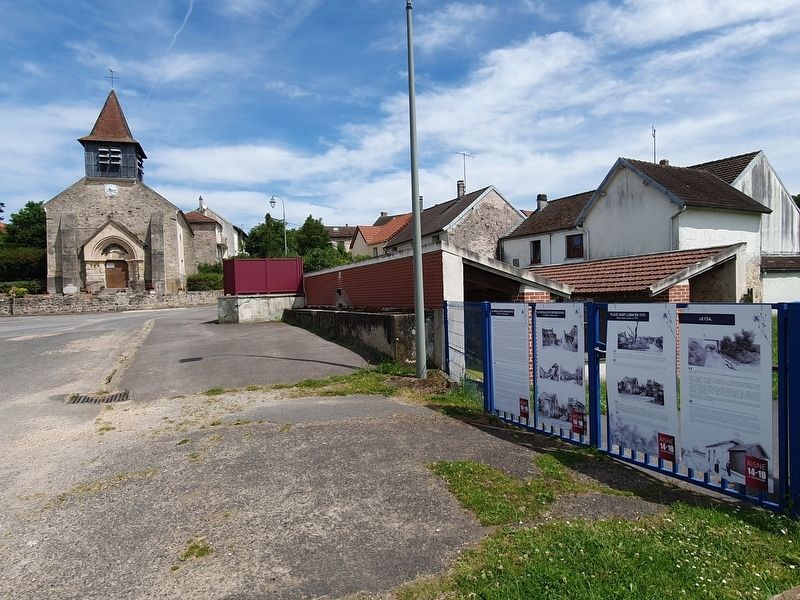
Photographed by J. Makali Bruton, June 8, 2024
5. La Bataille de Bouresches Marker
The Third Invasion. End of May - Beginning of June 1918: "The Bouresches Battle".
Consequences of the front breach in the "Chemin des Dames", the German rushed into it and moved forward 10 kilometers a day. The 30th May, they are in Château Thierry. They arrive from the N37 (Soissons-Château-Thierry) toward the Gonneterie (Bouresches municipality) and crossed over the east and the CSA trench which links Bascon to Bouresches....there, they are stopped by the colonial troops of Marchand who had to fix them in order to prevent them ton reach the N3 because after, this is Charly, La Ferte and Meaux: The road to Paris is open and there is no reserve left. It is necessary to hold facing Germans inflated by victory. The 73rd DI does it with heroism and-devastating losses....
The American general Pershing (which men were not engaged yet) propose to Foch to provide him the 2nd DIUS. But, at that time, this unit was in transfer to another front location: The transfer order was reviewed in order to take it back to the Champagne which will be achieved by train.
During that time (2nd June) the Marchand Colonial troops, overwhelmed on the CSA Bascon-Bouresches trench, give up and the enemy reaches Bourbetin, the N3 and the Thiolet helm. Their objective is precise: To reach and take the Triangle mound which overlook the battleground. The French troops resisted under an intense machine gun fire and the enemy did not manage to break through. Luckily enough, the German did not have the necessary artillery cover but the men losses are immense.
Then, during the night from 3rd to 4th June, the first American troops of the General Bundy arrive (some coming from Nogent Artaud, some other through Charly and Nanteuil Saacy, other via Montreuil aux lions in trucks). This is their baptism of fire; but these are fresh troops. They are placed in second line, behind the heroic troops from the 73 DI and they spent the night to settle. Germans are entrenched in Bouresches, increasingly ruined; they desperately try to get out of this basin but all attacks are pushed away. Then, the German artillery resume, this time from Lauconois (Heights of Chateau Thierry), from Chantemerle, but also from Domptin and Mont de Bonell: This is a continuous flood of large calibre ammunition. The Americans receive the order to attack...come back to Bouresches. During the day of the 7th June, the Marines Brigade from the 2 DIUS (first fight outside of the Americas) takes the village back: the smoking ruins from Bouresches are freed.
Thereafter, they went back towards the Bouresches wood (which will be later called "Bois Belleau") which extends towards the north from the last houses of the village. They attacked through the wheatfield and their losses were very important. The location of the wood itself is a rugged hill which was strengthened with trenches including machine guns nests. It will take them 19 days to conquer it with a heroic fierceness which became legendary. This victory had an enormous psychological impact For the Marine Corps itself, this is the equivalent of Camerone for the Foreign Legion. They celebrate it as their baptismal act (4th July).
The French High Command highlighted this accomplishment et gave (General de Goutte) to the this battle the name of "Bois Belleau" Battle which became a myth for the United States of America. Since the beginning of June until the 18th July, our American allies lost 1800 men. The German losses (unquantified) were vastly superior.
The French troops of the 73 DI, from the 31st May up to 4th June held the ground until our allies entered into action.
Finally from the beginning up to the 10th July, the Foch offensive from the Aisne to the Ourq blew up as a thunderbolt: This is the beginning of the second Marne victory.
Rue Saint Gilles ∙ Rue de Vaux ∙ Rue de la 73E Div d’Infanterie
Damaged houses, tree jagged by shells, returned soil. Barrier to bound the mashed the smashed piece of the bridge on the "brook from the bottom of the Cense. Blacksmith house punched with small calibre shells and entrance of the collapsed "Copeaux Court" (High calibre shells)...shells coming from either the Triangle or from Vaux.
American Military tent protecting clearing materials.
Place Saint Lubin in 1919
Destroyed houses, disorder before the clearing of rubbles and all kind of debris. Despite their wounds, these are the testimony of the real estate from the West Champagne: lime coating or plaster walls and moulded cornice under roofs: simplicity and sobriety of the forms (Due to the famous 1687 royal decree against half timbering (compulsory coating with lime or plaster). This building method was in force from Louis XIV to 1900.
The CSA
The South of the Aisne Railways (CSA), marked the life of the villages of the Ornois: 1910-1942.
Creation of a secondary network with a metric-gauge. Here the Chateau Thierry-Mareuil/Ourq line (36 Km), decided in 1906, brought into operation in 1910... (Two other lines also start from Chateau Thierry). Bouresches had his station and a three trains a day traffic (especially interesting for the Chateau Thierry market every Friday.
Before 1914, the railway line was served by small steam locomotives and offered a "passengers freight" service. Interruption 1914-1919. During the Thirties, a tracked bus (nicknamed "La Petrolette" which could carry 25 persons with their luggage. The line was not profitable (competition from the road): 1939: Closure; dismantled in 1942. Buildings were stereotyped: hard walled premises (Tickets and Stationmaster accommodation) and a wooden building to storefreight.
During the war, the CSA trenches and raised lands became a strategic objective between Bouresches and Bascon. There the troops of Mangin fought against the Germans who were aiming at Triangle (in order to dominate the N3: The road to Paris.
Topics. This memorial is listed in these topic lists: Railroads & Streetcars • War, World II. A significant historical month for this entry is June 1918.
Location. 49° 3.738′ N, 3° 18.493′ E. Memorial is in Bouresches, Hauts-de-France (Upper France), in Aisne. It is at the intersection of Place Saint-Lubin and Route D1390, on the right when traveling east on Place Saint-Lubin. Touch for map. Memorial is in this post office area: Bouresches, Hauts-de-France 02400, France. Touch for directions.

Regionally, it is in the North Atlantic Region, Europe, the European Union, Atlantic Europe, the Schengen Area, Western Europe, a coastal Mediterranean country, and the Western World. Historically, it finds itself in what was once a French colony and also the Roman Empire.
Other nearby markers. At least 8 other markers are within 3 kilometers of this marker, measured as the crow flies: Eglise en 1919 (within shouting distance of this marker); Un Peu de Histoire / Invasion des Cosaques (within shouting distance of this marker); Belleau Wood Marine Memorial (approx. 1.8 kilometers away); Belleau Wood USMC Operations Map (approx. 1.8 kilometers away); Belleau Wood Medal of Honor Recipients (approx. 1.8 kilometers away); Belleau Wood USMC Interpretive Panel #1 (approx. 1.8 kilometers away); Belleau Wood USMC Interpretive Panel #2 (approx. 1.8 kilometers away); Belleau Wood USMC Interpretive Panel #3 (approx. 1.8 kilometers away). Touch for a list and map of all markers in Bouresches.
Credits. This page was last revised on July 8, 2024. It was originally submitted on July 7, 2024, by J. Makali Bruton of Washington, District of Columbia. This page has been viewed 629 times since then and 47 times this year. Photos: 1, 2, 3, 4, 5. submitted on July 7, 2024, by J. Makali Bruton of Washington, District of Columbia.
