Gourdsville in Limestone County, Alabama — The American South (East South Central)
Gourdsville ⎯⎯⎯ Gilbertsboro
Courtesy of Limestone County Historical Society, March 6, 2017
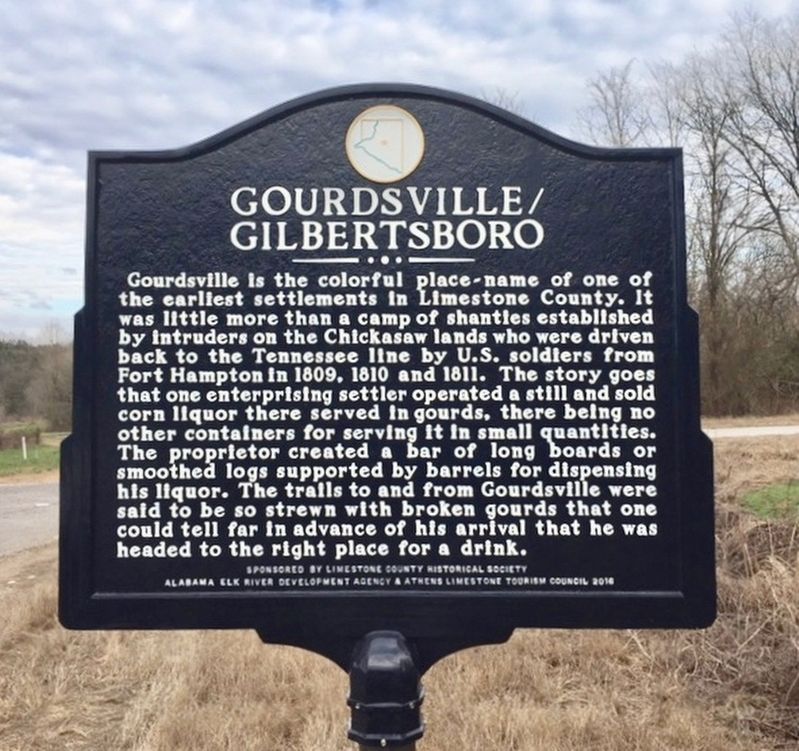
1. Gourdsville Marker
Inscription.
Gourdsville, also, Gilbertsboro. .
Gourdsville / Gilbertsboro. Gourdsville is the colorful place-name of one of the earliest settlements in Limestone County. It was little more than a camp of shanties established by intruders on the Chickasaw lands who were driven back to the Tennessee line by U.S. soldiers from Fort Hampton in 1809, 1810 and 1811. The story goes that one enterprising settler operated a still and sold corn liquor there served in gourds, there being no other containers for serving it In small quantities. The proprietor created a bar of long boards or smoothed logs supported by barrels for dispensing his liquor. The trails to and from Gourdsville were said to be so strewn with broken gourds that one could tell far in advance of his arrival that he was headed to the right place for a drink.,
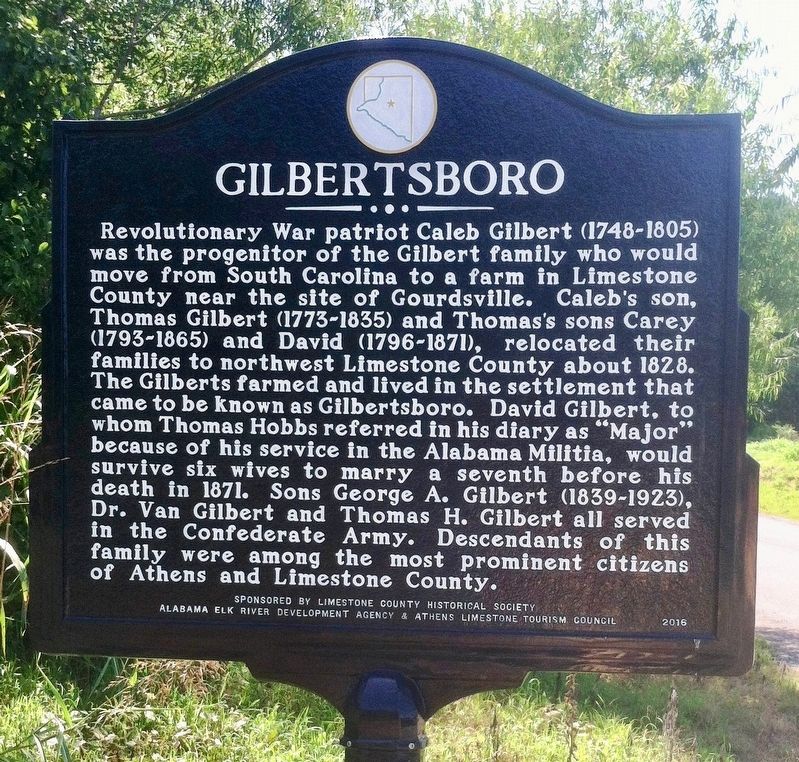
Gilbertsboro. Revolutionary War patriot Caleb Gilbert (1748-1805) was the progenitor of the Gilbert family who would move from South Carolina to a farm in Limestone County near the site of Gourdsville. Caleb's son, Thomas Gilbert (1773-1835) and Thomas's sons Carey (1793-1865) and David (1796-1871), relocated their families to northwest Limestone County about 1828. The Gilberts farmed and lived in the settlement that came to be known as Gilbertsboro. David Gilbert, to whom Thomas Hobbs referred in his diary as "Major" because of his service in the Alabama Militia, survive six wives to marry a seventh before his death in 1871. Sons George A. Gilbert (1839-1923), Dr. Van Gilbert and Thomas H. Gilbert all served in the Confederate Army. Descendants of this family were among the most prominent citizen of Athens and Limestone County.
Gourdsville / Gilbertsboro
Gourdsville is the colorful place-name of one of the earliest settlements in Limestone County. It was little more than a camp of shanties established by intruders on the Chickasaw lands who were driven back to the Tennessee line by U.S. soldiers from Fort Hampton in 1809, 1810 and 1811. The story goes that one enterprising settler operated a still and sold corn liquor there served in gourds, there being no other containers for serving it In small quantities. The proprietor created a bar of long boards or smoothed logs supported by barrels for dispensing his liquor. The trails to and from Gourdsville were said to be so strewn with broken gourds that one could tell far in advance of his arrival that he was headed to the right place for a drink.
Gilbertsboro
Revolutionary War patriot Caleb Gilbert (1748-1805) was the progenitor of the Gilbert family who would move from South Carolina to a farm in Limestone County near the site of Gourdsville. Caleb's son, Thomas Gilbert (1773-1835) and Thomas's sons Carey (1793-1865) and David (1796-1871), relocated their families to northwest Limestone County about 1828. The Gilberts farmed and lived in the settlement that came to be known as Gilbertsboro. David Gilbert, to whom Thomas Hobbs referred in his diary as
Click or scan to see this page online
"Major" because of his service in the Alabama Militia, survive six wives to marry a seventh before his death in 1871. Sons George A. Gilbert (1839-1923), Dr. Van Gilbert and Thomas H. Gilbert all served in the Confederate Army. Descendants of this family were among the most prominent citizen of Athens and Limestone County.
Erected 2016 by Limestone County Historical Society, Alabama Elk River Development Agency & Athens Limestone Tourism Council.
Location. 34° 59.364′ N, 87° 5.412′ W. Marker is in Gourdsville, Alabama, in Limestone County. It can be reached from Gardner Hollow Road west of Shoal Creek Road, on the right when traveling west. Touch for map. Marker is at or near this postal address: 13078 Gardner Hollow Road, Lester AL 35647, United States of America. Touch for directions.

Regionally, this marker is in North Alabama and in the Huntsville Metropolitan Area. It is also in the American South, specifically in the Deep South, in Appalachia, and specifically in Southern Appalachia. Globally, it is in North America, a Gulf of Mexico state, the Western Hemisphere, the Western World, and the Anglosphere. Historically, it finds itself in what was once the original Cherokee Nation, the territory of the Mississippian Culture, one of the Confederate States of America, and the Antebellum South.
More about this marker. Sometime on the 18th or 19th of April, 2019, this marker, along with another marker about 5 miles away, was stolen. The 80-pound metal markers cost the Limestone County Historical Society $2,700 each to make and the Society hopes for their return.
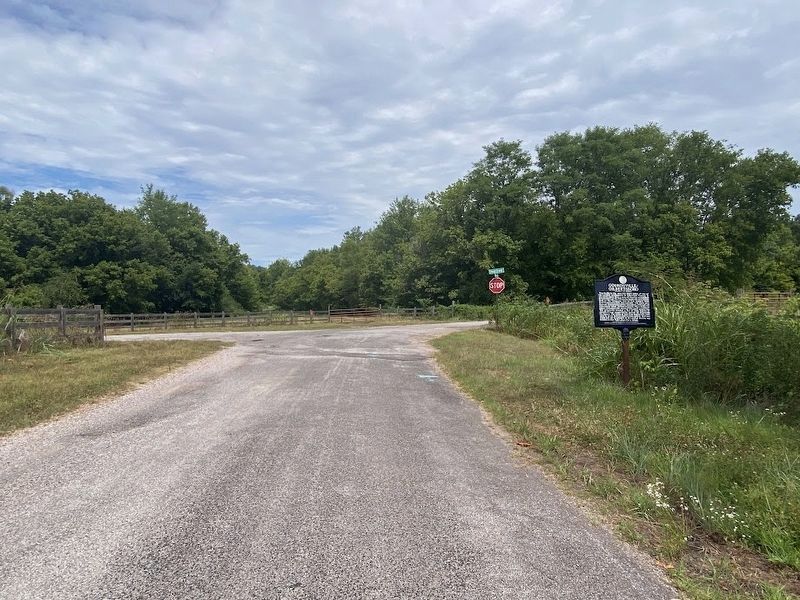
Update: An Ardmore, Alabama man was arrested on June 16th in connection with the theft of this, and two other Limestone County historical markers. The markers were subsequently recovered from a storage unit.
Photographed by Darren Jefferson Clay, July 7, 2024
3. Gourdsville / Gilbertsboro Marker
Credits. This page was last revised on July 11, 2024. It was originally submitted on April 24, 2019, by Mark Hilton of Montgomery, Alabama. This page has been viewed 1,640 times since then and 113 times this year. Last updated on July 7, 2024, by Darren Jefferson Clay of Duluth, Georgia. Photos:1, 2. submitted on April 24, 2019, by Mark Hilton of Montgomery, Alabama. 3. submitted on July 7, 2024, by Darren Jefferson Clay of Duluth, Georgia. • J. Makali Bruton was the editor who published this page.
