Manitou Springs in El Paso County, Colorado — The American Mountains (Southwest)
Miramont Castle
Photographed by Mark Parker, July 2, 2024
1. Miramont Castle Marker
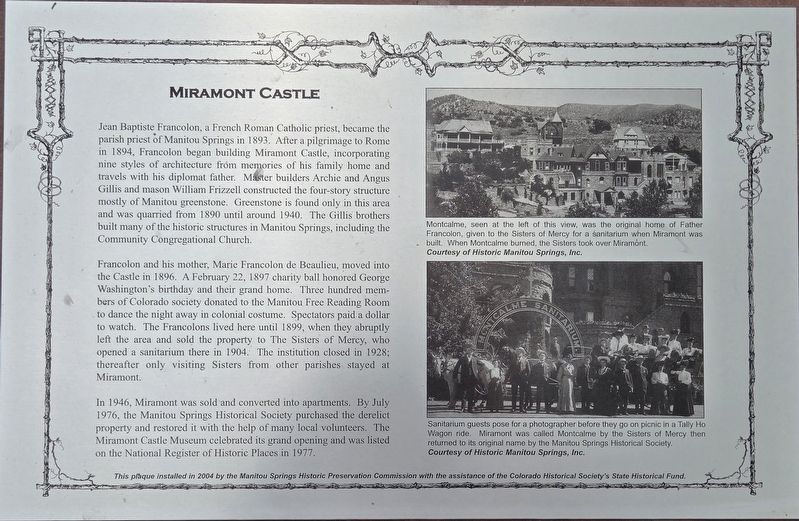
Jean Baptiste Francolon, a French Roman Catholic priest, became the parish priest of Manitou Springs in 1893. After a pilgrimage to Rome in 1894, Francolon began building Miramont Castle, incorporating nine styles of architecture from memories of his family home and travels with his diplomat father. Master builders Archie and Angus Gillis and mason William Frizzell constructed the four-story structure mostly of Manitou greenstone. Greenstone is found only in this area and was quarried from 1890 until around 1940. The Gillis brothers built many of the historic structures in Manitou Springs including the Community Congregational Church.
Francolon and his mother, Marie Francolon de Beaulieu, moved into the Castle in 1896. A February 22, 1897 charity ball honored George Washington's birthday and their grand home. Three hundred members of Colorado society donated to the Manitou Free Reading Room to dance the night away in colonial costume. Spectators paid a dollar to watch. The Francolons lived here until 1899, when they abruptly left the area and sold the property to The Sisters of Mercy, who opened a sanitarium there in
this page online
In 1946, Miramont was sold`and converted into apartments. By July 1976, the Manitou Springs Historical Society purchased the derelict property and restored it with the help of many local volunteers. The Miramont Castle Museum celebrated its grand opening and was listed on the National Register of Historic Places in 1977.
Captions
Montcalme, seen at the left of this view, was the original home of Father Francolon, given to the Sisters of Mercy for a sanitarium when Miramont was built. When Montcalme burned, the Sisters took over Miramont. Courtesy of Historic Manitou Springs, Inc.
Sanitarium guests pose for a photographer before they go on picnic in a Tally Ho Wagon ride. Miramont was called Montcalme by the Sisters of Mercy then returned to its original name by the Manitou Springs Historical Society. Courtesy of Historic Manitou Springs, Inc.
Erected 2004 by Manitou Springs Historic Preservation Commission, Colorado Historical Society's State Historic Fund.
Topics. This historical marker is listed
Photographed by Mark Parker, July 2, 2024
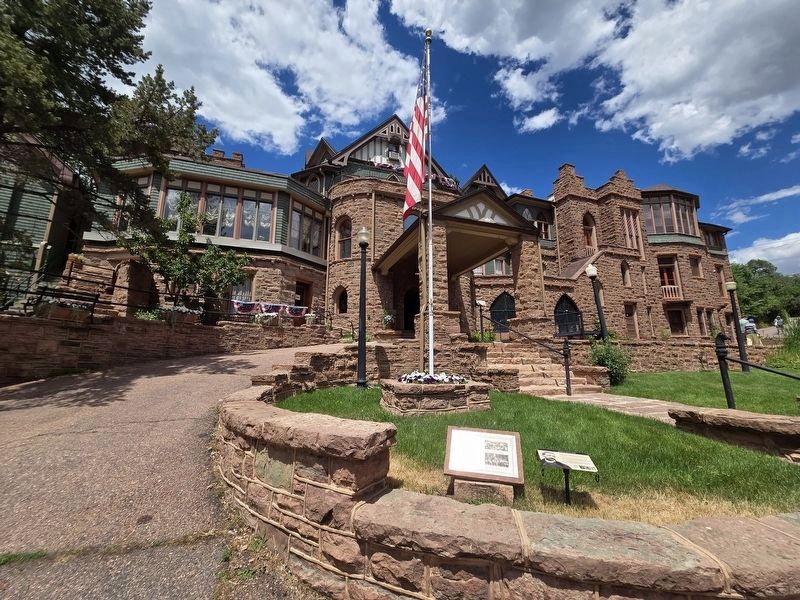
2. Miramont Castle and Marker
Location. 38° 51.555′ N, 104° 55.359′ W. Marker is in Manitou Springs, Colorado, in El Paso County. It can be reached from the intersection of Capitol Hill Avenue and Montcalm Street. Touch for map. Marker is at or near this postal address: 9 Capitol Hill Ave, Manitou Springs CO 80829, United States of America. Touch for directions.

Regionally, this marker is in the Front Range and in Pikes Peak Region. It is also in the American Mountain West. Globally, it is in North America, the Rocky Mountains, the Western Hemisphere, the Western World, and the Anglosphere. Historically, it finds itself in what was once the Comanchería.
Other nearby markers. At least 8 other markers are within walking distance of this marker: Architect of Miramont Castle (a few steps from this marker); Our Lady of Perpetual Help (within shouting distance of this marker); Our Lady of Perpetual Help Catholic Church (about 300 feet away, measured in a direct line); Colliers (about 700 feet away); Visionary Philanthropist
Photographed by Mark Parker, July 2, 2024
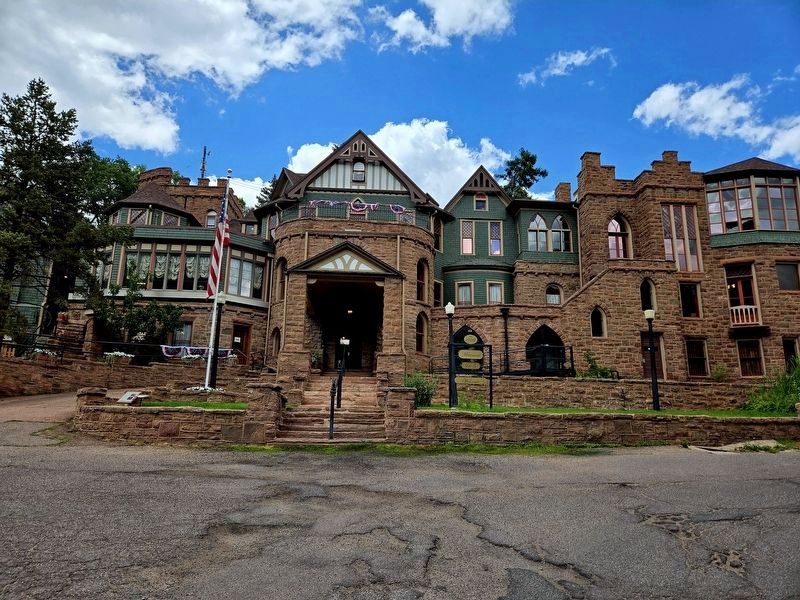
3. Miramont Castle from the intersection of Capitol Hill Avenue and Montcalm Street
More about this marker. Montcalm Street and Capitol Hill Avenue split left and right, respectively with a traffic circle immediately ahead that circles to the front portico. The marker is at the front of the planter in the traffic circle to the left of the stone staircase leading to the main entrance.
Credits. This page was last revised on July 10, 2024. It was originally submitted on July 9, 2024, by Mark Parker of Hickory, North Carolina. This page has been viewed 352 times since then and 34 times this year. Photos: 1, 2, 3. submitted on July 9, 2024, by Mark Parker of Hickory, North Carolina. • J. Makali Bruton was the editor who published this page.
