West Colorado Springs in Manitou Springs in El Paso County, Colorado — The American Mountains (Southwest)
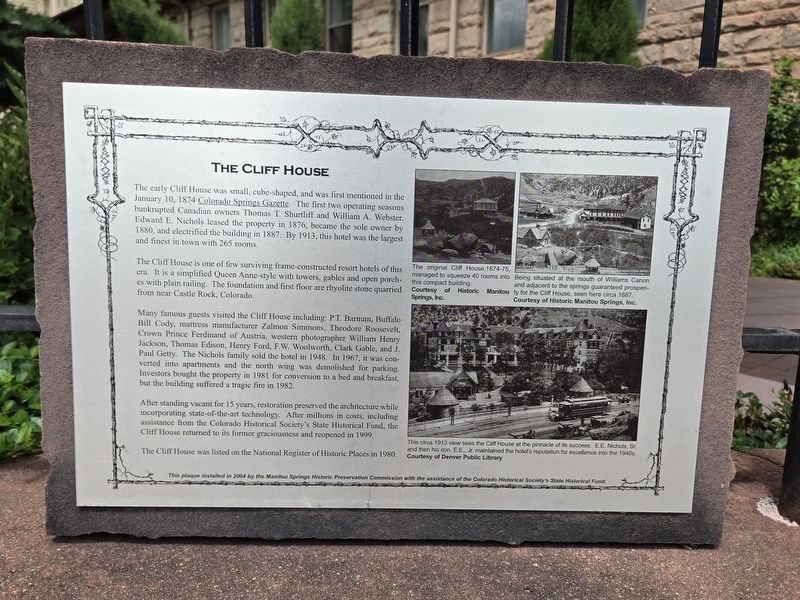
The Cliff House
Photographed by Mark Parker, July 2, 2024
1. The Cliff House Marker
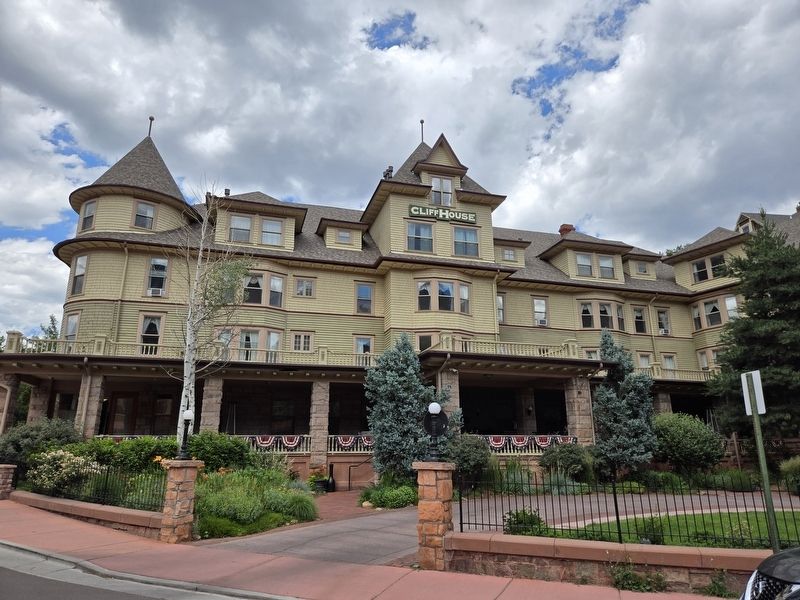
The Cliff House is one of few surviving frame-constructed resort hotels of this era. It is a simplified Queen Anne-style with towers, gables and open porches with plain railing. The foundation and first floor are rhyolite stone quarried from near Castle Rock, Colorado.
Many famous guests visited the Cliff House including: P.T. Barnum, Buffalo Bill Cody, mattress manufacturer Zalmon Simmons, Theodore Roosevelt, Crown Prince Ferdinand of Austria, western photographer William Henry Jackson, Thomas Edison, Henry Ford, F.W. Woolworth, Clark Gable, and J. Paul Getty. The Nichols family sold the hotel in 1948. In 1967, it was converted into apartments and the north wing was demolished for parking. Investors bought the property in 1981 for conversion to a bed and breakfast, but the building suffered a tragic fire in 1982.
After standing vacant for 15 years, restoration
this page online
The Cliff House was listed on the National Register of Historic Places in 1980.
(photo captions)
Top center:The original Cliff House,1874-75, managed to squeeze 40 rooms into this compact building. Courtesy of Historic Manitou Springs Inc.
Top right: Being situated at the mouth of Williams Canon and adjacent to the springs guaranteed prosperity for the Cliff House, seen here circa 1887. Courtesy of Historic Manitou Springs, Inc.
Bottom right: This circa 1913 view sees the Cliff House at the pinnacle of its success. E.E. Nichols, Sr. and then his son, E.E., Jr. maintained the hotel's reputation for excellence into the 1940s. Courtesy of Denver Public Library
Erected 2004 by Manitou Springs Historic Preservation Commission, Colorado Historical Society's State Historic Fund.
Topics. This historical marker is listed in these topic lists: Architecture • Industry & Commerce. A significant historical date for this entry is January 10, 1874.
Location. 38° 51.565′ N, 104° 55.05′ W. Marker is in Manitou Springs, Colorado, in El Paso
Photographed by Mark Parker, July 2, 2024
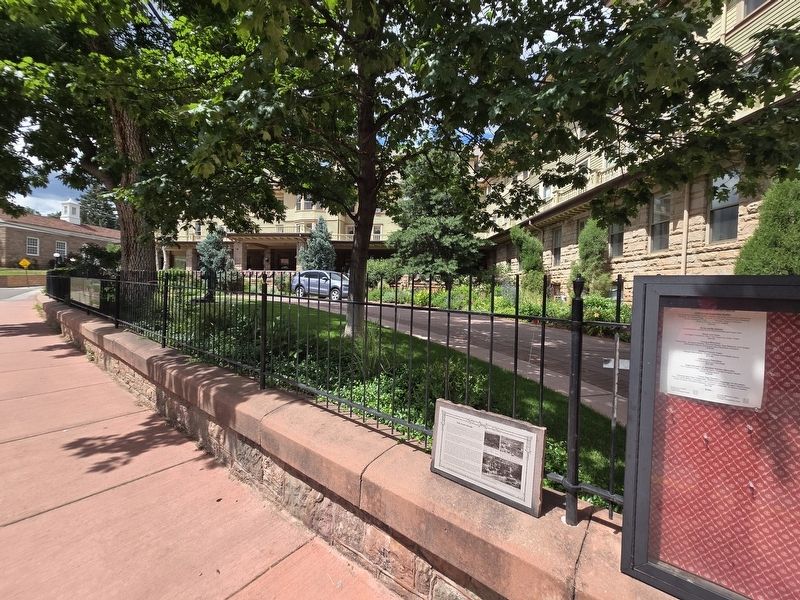
2. The Cliff House Marker and circle driveway

Regionally, this marker is in the Front Range and in Pikes Peak Region. It is also in the American Mountain West. Globally, it is in North America, the Rocky Mountains, the Western Hemisphere, the Western World, and the Anglosphere. Historically, it finds itself in what was once the Comanchería.
Other nearby markers. At least 8 other markers are within walking distance of this marker: Ogilbee House (within shouting distance of this marker); Sacred Waters (within shouting distance of this marker); Manitou Springs Post Office (within shouting distance of this marker); A Benefactor's Legacy (within shouting distance of this marker); Ute Pass Trail (within shouting distance of this marker); A Town Built on Mineral Water Resources (about 300 feet away, measured in a direct line); Nolon House (about 300 feet away); Spa Building (about 300 feet away). Touch for a list and map of all markers in Manitou Springs.
More about this marker. Marker on the iron fence near the driveway
Photographed by Mark Parker, July 2, 2024
3. The Cliff House
Photographed by Mark Parker, July 2, 2024
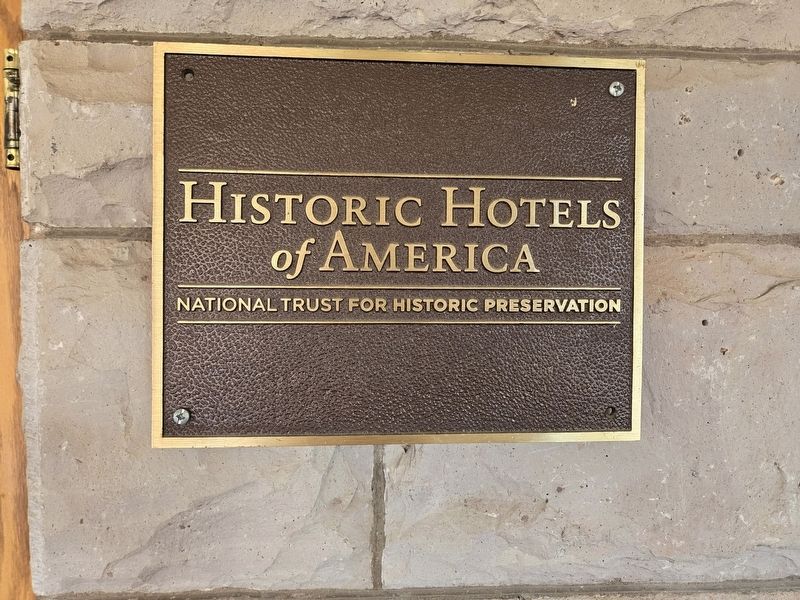
4. Historic Hotels of America plaque near lobby entrance
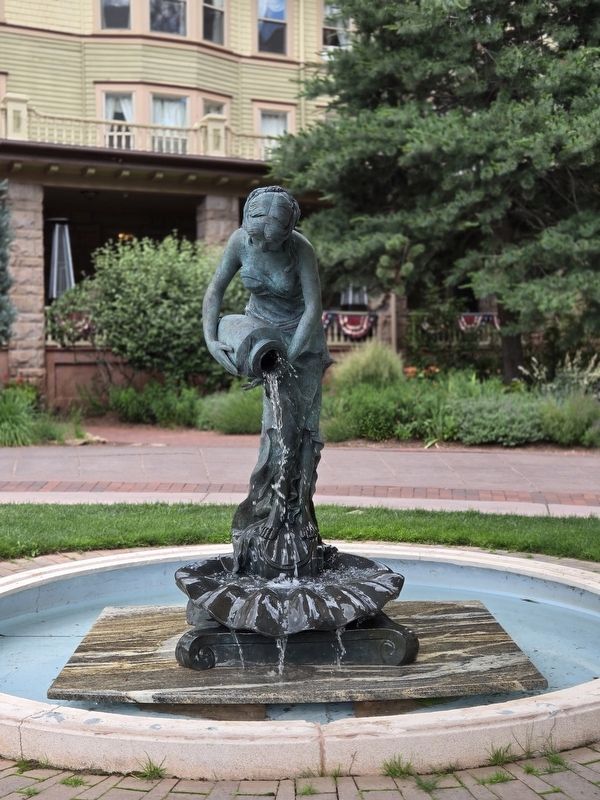
Photographed by Mark Parker, July 2, 2024
5. Fountain at the circle driveway at The Cliff House
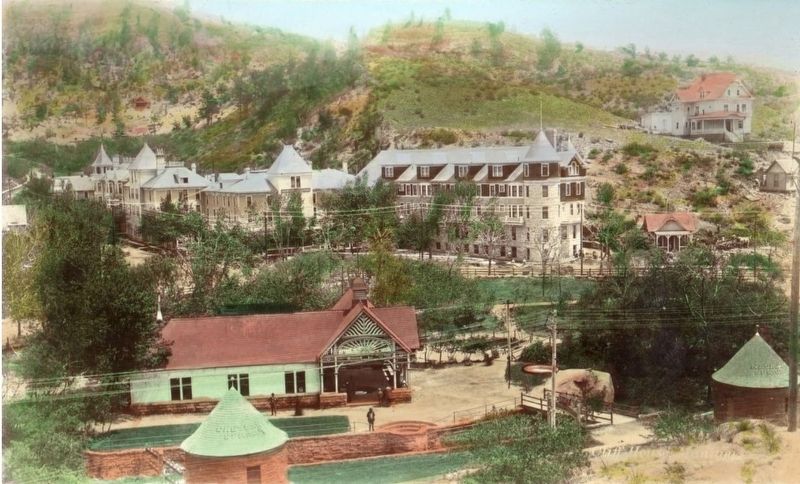
W.E. Hook Publishing Company (courtesy Denver Public Library), circa 1895
6. Cliff House, Manitou Springs
View of the Cliff House and Soda Spring Pavilion in Manitou Springs, Colorado.
Credits. This page was last revised on July 10, 2024. It was originally submitted on July 10, 2024, by Mark Parker of Hickory, North Carolina. This page has been viewed 390 times since then and 76 times this year. Photos: 1, 2, 3, 4, 5. submitted on July 10, 2024, by Mark Parker of Hickory, North Carolina. 6. submitted on July 10, 2024. • Andrew Ruppenstein was the editor who published this page.
