
Keifers in Allegany County, Maryland — The American Northeast (Mid-Atlantic)
Breaking Through a Mountain
Chesapeake and Ohio Canal National Historical Park
| — | National Park Service, U.S. Department of the Interior | — |
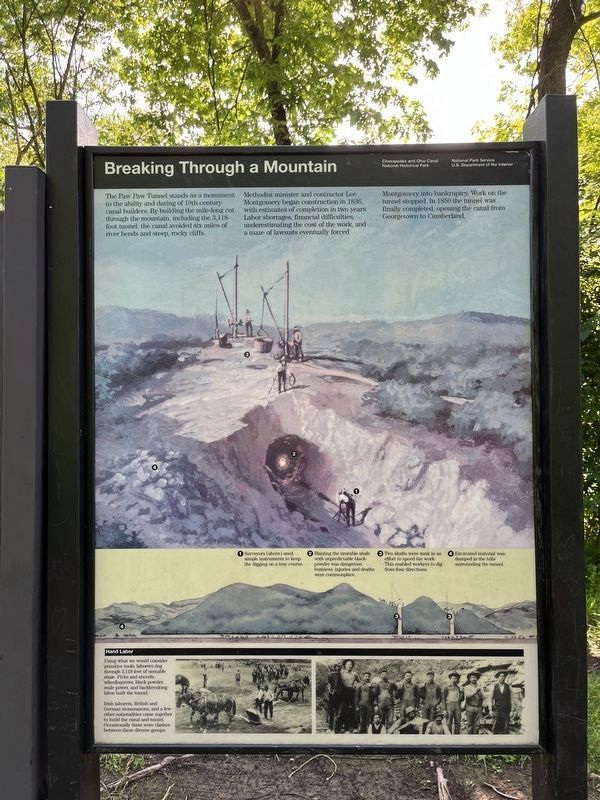
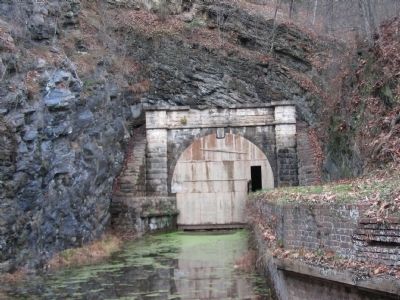
The Paw Paw Tunnel stands as a monument to the ability and daring of 19th century canal builders. By building the mile-long cut through the mountain, including the 3,118-foot tunnel, the canal avoided six miles of river bends and steep, rocky cliffs.
Methodist minister and contractor Lee Montgomery began construction in 1836, with estimates of completion in two years. Labor shortages, financial difficulties, underestimating the cost of the work, and a maze of lawsuits eventually forced Montgomery into bankruptcy. Work on the tunnel stopped. In 1850 the tunnel was finally completed, opening the canal from Georgetown to Cumberland.
Hand Labor
Using what we would consider primitive tools, laborers dug through 3,118 feet of unstable shale. Picks and shovels, wheelbarrows, black powder, mule power, and backbreaking labor built the tunnel.
Irish laborers, British and German stonemasons, and a few other nationalities came together to build the canal and tunnel. Occasionally there were clashes between these diverse groups.
Erected by National Park Service, U.S. Department of the Interior.
Topics and series. This historical
this page online
Location. 39° 33.004′ N, 78° 27.777′ W. Marker is in Keifers, Maryland, in Allegany County. It can be reached from Old Town Road (State Highway 51), on the right when traveling east. Located along the Chesapeake and Ohio Canal towpath trail, about 500 yards from the parking lot off Old Town Road. Touch for map. Marker is in this post office area: Oldtown MD 21555, United States of America. Touch for directions.

Regionally, this marker is in Western Maryland. It is also in the American Mid-Atlantic, in Appalachia, and specifically in Northern Appalachia. Globally, it is in North America, the Western Hemisphere, the Western World, and the Anglosphere. Historically, it finds itself in what was once one of the original Thirteen Colonies.
Other nearby markers. At least 8 other markers are within 2 miles of this marker, measured as the crow flies: Going Against the Grain (here, next to this marker); Paw Paw Tunnel Hill Trail
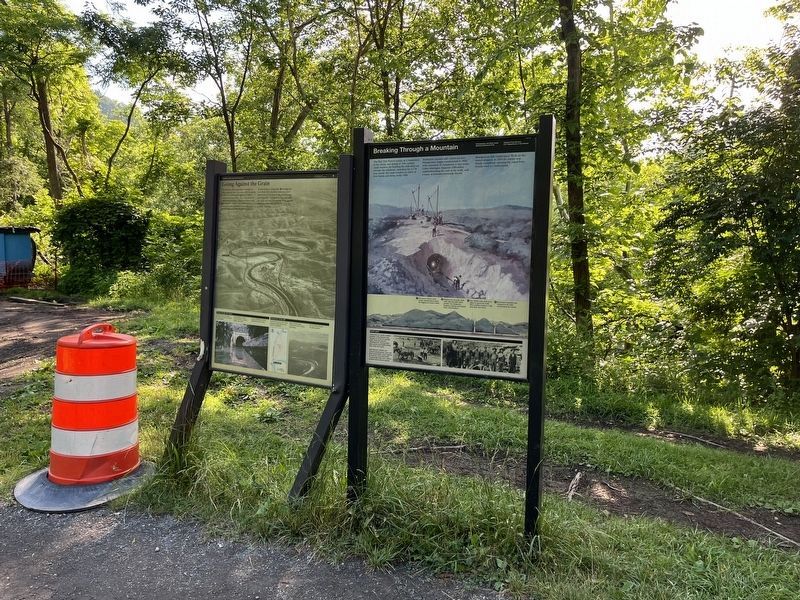
More about this marker. In the center is a depiction of work on the tunnel with keyed captions:
(1) Surveyors used simple instruments to keep the digging on a true course.
(2) Blasting the unstable shale with unpredictable black-powder was dangerous business; injuries and deaths were commonplace.
(3) Two shafts were sunk in an effort to speed the work. This enabled workers to dig from four directions.
(4) Excavated material was dumped in the hills surrounding the tunnel.
Also see . . .
1. Paw Paw Tunnel. Wikipedia entry (Submitted on January 2, 2024, by Larry Gertner of New York, New York.)
2. Paw Paw Tunnel. Maryland
Photographed by Craig Swain, November 27, 2009
3. Breaking Through a Mountain Marker
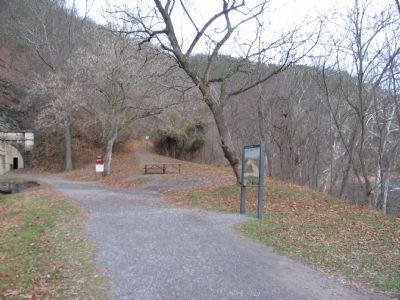
This is a marker before the adjacent marker was installed.
3. Chesapeake & Ohio National Historical Park. National Park Service website entry (Submitted on September 23, 2019.)
Photographed by Craig Swain, November 27, 2009
4. South End of the Tunnel
Photographed by Craig Swain, November 27, 2009
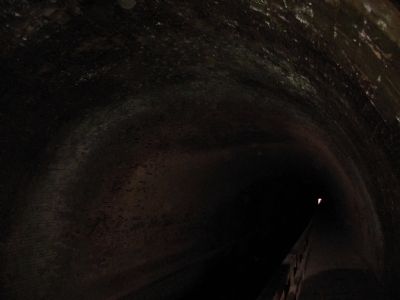
5. Interior of the Tunnel
Photographed by Craig Swain, November 27, 2009
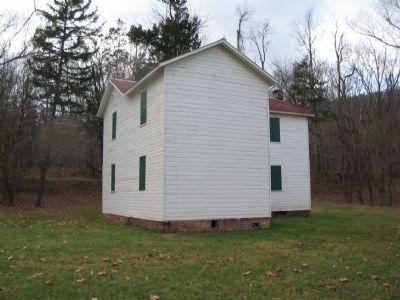
6. Section Superintendent's House
Located south of the tunnel is a house once occupied by the superintendent of this section of the canal.
Photographed by Craig Swain, November 27, 2009
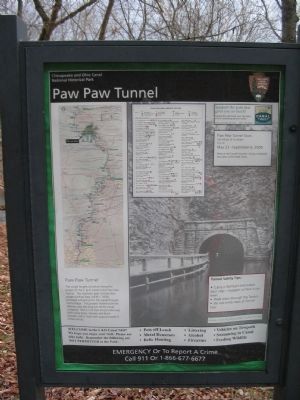
7. Paw Paw Tunnel Information Kiosk
The paragraph on the lower left provides some details of the tunnel:
The single largest structure along the length of the C & O Canal is the Paw Paw Tunnel. The fourteen year construction project at Paw Paw (1836-1850), provided a shortcut for the canal through Sorrel Ridge. This project tested both laborers and the finances of the canal company. The 3,118 foot long tunnel was build using picks, shovels and black powder and is lined with approximately 6 million bricks
The single largest structure along the length of the C & O Canal is the Paw Paw Tunnel. The fourteen year construction project at Paw Paw (1836-1850), provided a shortcut for the canal through Sorrel Ridge. This project tested both laborers and the finances of the canal company. The 3,118 foot long tunnel was build using picks, shovels and black powder and is lined with approximately 6 million bricks
Credits. This page was last revised on January 2, 2024. It was originally submitted on December 4, 2009, by Craig Swain of Leesburg, Virginia. This page has been viewed 1,537 times since then and 29 times this year. Photos: 1, 2. submitted on June 13, 2022, by Devry Becker Jones of Washington, District of Columbia. 3, 4, 5, 6, 7. submitted on December 4, 2009, by Craig Swain of Leesburg, Virginia.
