Manitou Springs in El Paso County, Colorado — The American Mountains (Southwest)
Our Lady of Perpetual Help
Photographed by Mark Parker, July 2, 2024
1. Our Lady of Perpetual Help Marker
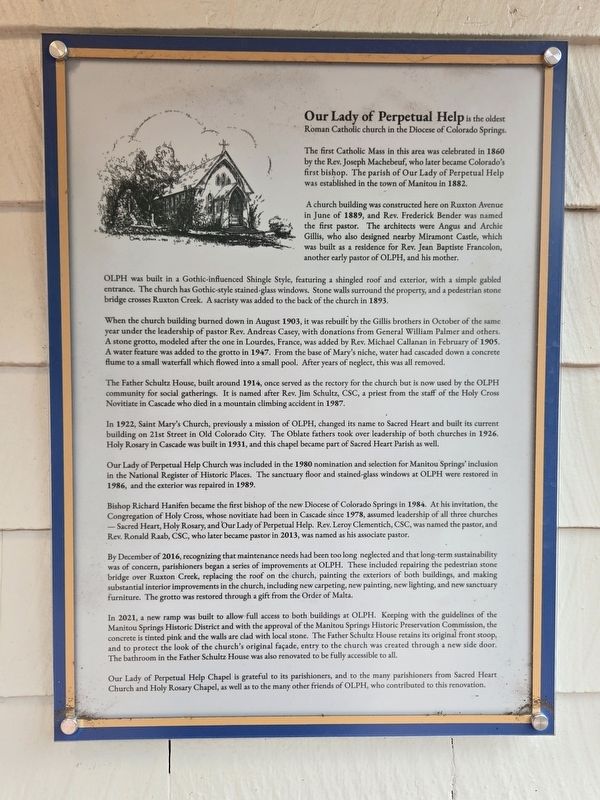
The first Catholic Mass in this area was celebrated in 1860 by the Rev. Joseph Machebeuf, who later became Colorado's first bishop. The parish of Our Lady of Perpetual Help was established in the town of Manitou in 1882.
A church building was constructed here on Ruxton Avenue in June of 1889, and Rev. Frederick Bender was named the first pastor. The architects were Angus and Archie Gillis, who also designed nearby Miramont Castle, which was built as a residence for Rev. Jean Baptiste Francolon, another early pastor of OLPH, and his mother.
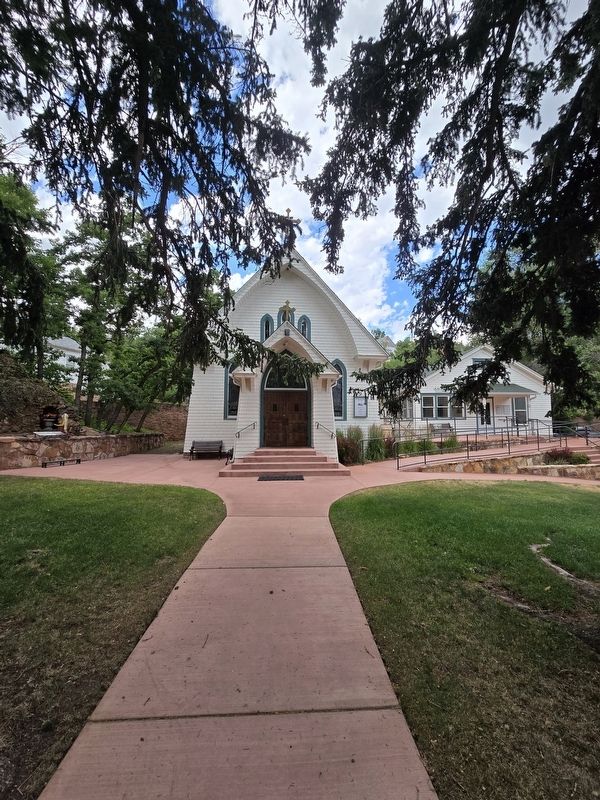
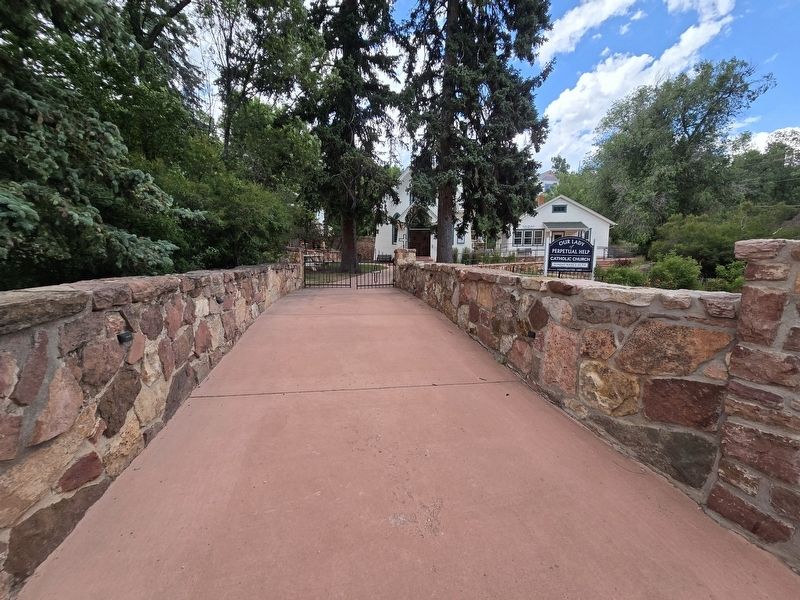
OLPH was built in a Gothic-influenced Shingle Style, featuring a shingled roof and exterior, with a simple gabled entrance. The church has Gothic-style stained-glass windows. Stone walls surround the property, and a pedestrian stone bridge crosses Ruxton Creek. A sacristy was added to the back of the church in 1893.
When the church building burned down in August 1903, it was rebuilt by the Gillis brothers in October of the same year under the leadership of pastor Rev. Andreas
this page online
The Father Schultz House, built around 1914, once served as the rectory for the church but is now used by the OLPH community for social gatherings. It is named after Rev. Jim Schultz, CSC, a priest from the staff of the Holy Cross Novitiate in Cascade who died in a mountain climbing accident in 1987.
In 1922, Saint Mary's Church, previously a mission of OLPH, changed its name to Sacred Heart and built its current building on 21st Street in Old Colorado City. The Oblate fathers took over leadership of both churches in 1926. Holy Rosary in Cascade was built in 1931, and this chapel became part of Sacred Heart Parish as well.
Our Lady of Perpetual Help Church was included the 1980 nomination and selection for Manitou Springs' inclusion in
Photographed by Mark Parker, July 2, 2024
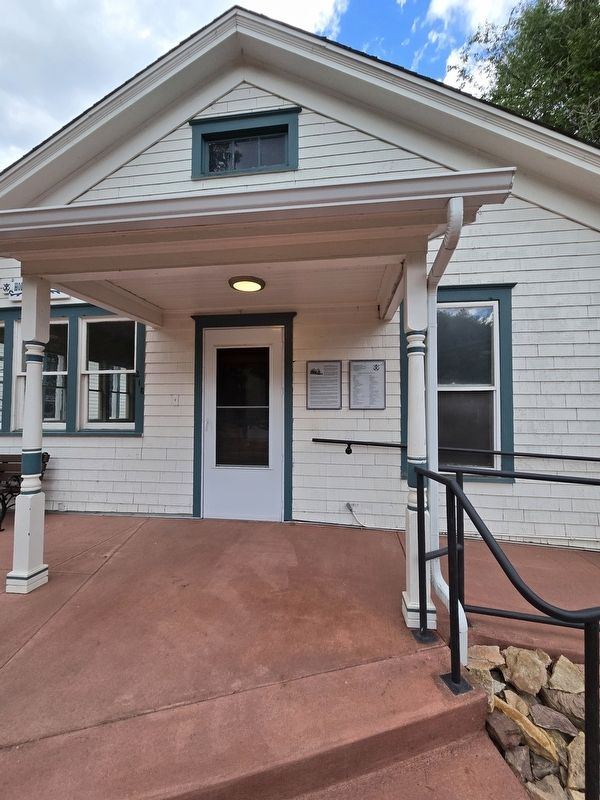
2. Fellowship hall with the marker to the right of the entrance
Bishop Richard Hanifen became the first bishop of the new Diocese of Colorado Springs in 1984. At his invitation, the Congregation of Holy Cross, whose novitiate had been in Cascade since 1978, assumed leadership of all three churches Sacred Heart, Holy Rosary, and Our Lady of Perpetual Help. Rev. Leroy Clementich, CSC was named the pastor, and Rev. Ronald Raab, CSC, who later became pastor in 2013, was named as his associate pastor.
By December of 2016, recognizing that maintenance needs had been too long neglected and that long- term sustainability was of concern, parishioners began a series of improvements at OLPH. These included repairing the pedestrian stone bridge over Ruxton Creek, replacing the roof on the church, painting the exteriors of both buildings, and making substantial interior improvements in the church, including new carpeting, new painting, new lighting, and new sanctuary furniture. The grotto was restored through a gift from the Order of Malta.
In 2021,
Photographed by Mark Parker, July 2, 2024
3. Our Lady of Perpetual Help Catholic Church
Replica grotto to the far left. Sanctuary in the center. Holy Cross Hall to the right.
Our Lady of Perpetual Help Chapel is grateful to its parishioners, and to the many parishioners from Sacred Heart Church and Holy Rosary Chapel, as well as to the many other friends of OLPH, who contributed to this renovation.
Topics. This historical marker is listed in these topic lists: Architecture • Religion & Religious Structures • Settlements & Settlers. A significant historical year for this entry is 1882.
Location. 38° 51.547′ N, 104° 55.403′ W. Marker is in Manitou Springs, Colorado, in El Paso County. It can be reached from the intersection of Ruxton Avenue and Church Street,
Photographed by Mark Parker, July 2, 2024
4. Stone bridge at Our Lady of Perpetual Help crossing Ruxton Creek

Regionally, this marker is in the Front Range and in Pikes Peak Region. It is also in the American Mountain West. Globally, it is in North America, the Rocky Mountains, the Western Hemisphere, the Western World, and the Anglosphere. Historically, it finds itself in what was once the Comanchería.
Other nearby markers. At least 8 other markers are within walking distance of this marker: Our Lady of Perpetual Help Catholic Church (within shouting distance of this marker); Miramont Castle (within shouting distance of this marker); Architect of Miramont Castle (within shouting distance of this marker); Colliers (approx. 0.2 miles away); Visionary Philanthropist (approx. 0.2 miles away); Spa Building (approx. ¼ mile away); A Town Built on Mineral Water Resources (approx. ¼ mile away); A Benefactor's Legacy (approx. ¼ mile away). Touch for a list and map of all markers in Manitou Springs.
Regarding Our Lady of Perpetual Help. Marker is at the fellowship hall (Holy Cross Hall) to the east of the church's sanctuary. The posting is to the right of the entrance
Credits. This page was last revised on July 13, 2024. It was originally submitted on July 12, 2024, by Mark Parker of Hickory, North Carolina. This page has been viewed 228 times since then and 28 times this year. Photos: 1, 2, 3, 4. submitted on July 12, 2024, by Mark Parker of Hickory, North Carolina. • Andrew Ruppenstein was the editor who published this page.
