
Downtown in Colorado Springs in El Paso County, Colorado — The American Mountains (Southwest)
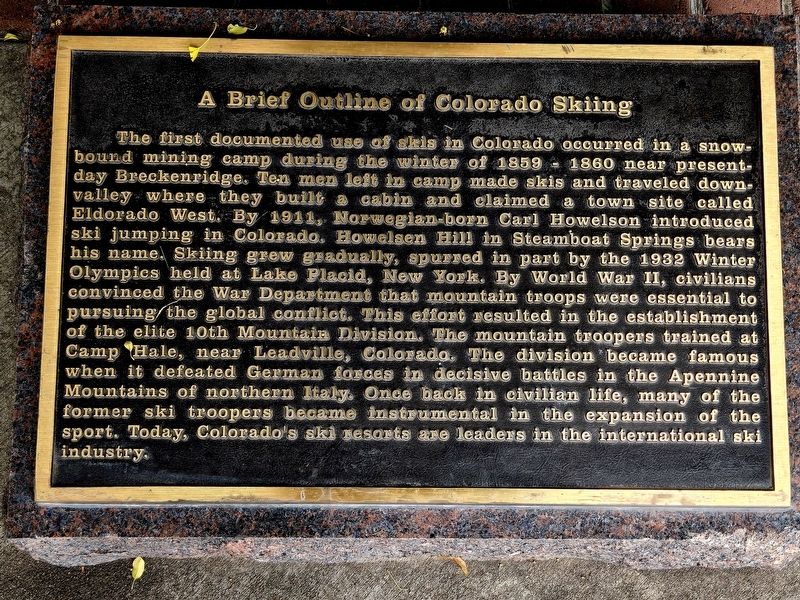
A Brief Outline of Colorado Skiing
Photographed by Mark Parker, July 3, 2024
1. A brief outline of Colorado Skiing Marker
The first documented use of skis in Colorado occurred in a snowbound mining camp during the winter of 1859-1860 near present-day Breckenridge. Ten men left in camp made skis and traveled down-valley where they built a cabin and claimed a town site called Eldorado West.
By 1911, Norwegian-born Carl Howelson introduced ski jumping in Colorado. Howelsen Hill in Steamboat Springs bears his name! Skiing grew gradually, spurred in part by the 1982 Winter Olympics held at Lake Placid, New York.
By World War II, civilians convinced the War Department that mountain troops were essential to pursuing the global conflict. This effort resulted in the establishment of the elite 10th Mountain Division. The mountain troopers trained at Camp Hale, near Leadville, Colorado. The division became famous when it defeated German forces in decisive battles in the Apennine Mountains of northern Italy.
Once back in civilian life, many of the former ski troopers became instrumental in the expansion of the sport. Today, Colorado's ski resorts are leaders in the international ski industry.
Erected 2001 by Lieutenant Colonel Chandler
this page online
Topics and series. This historical marker is listed in these topic lists: Entertainment • Settlements & Settlers • Sports • War, World II. In addition, it is included in the Norwegian-Americans series list. A significant historical year for this entry is 1859.
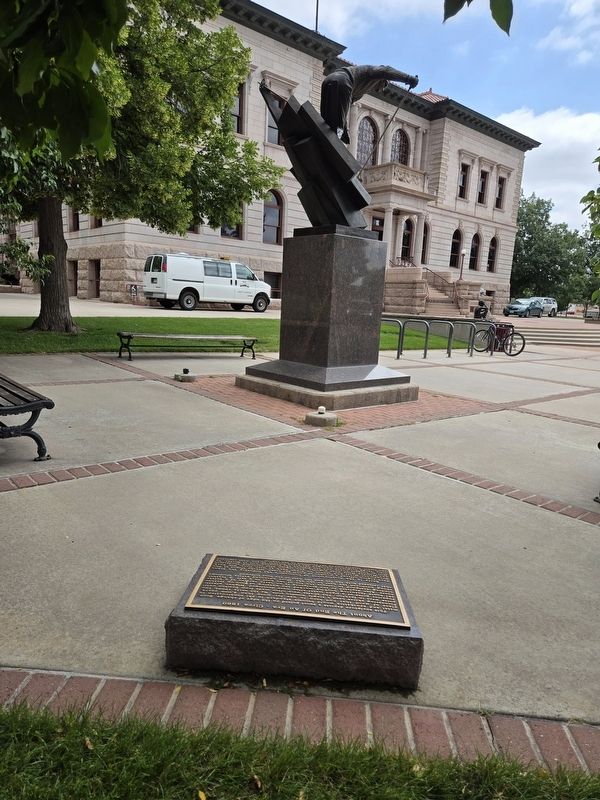
Location. 38° 49.803′ N, 104° 49.389′ W. Marker is in Colorado Springs, Colorado, in El Paso County. It is in Downtown. It can be reached from South Tejon Street near East Vermijo Avenue, on the right when traveling north. The marker stands on the grounds of the Colorado Springs Pioneer Museum (formerly the El Paso County Courthouse). Touch for map. Marker is at or near this postal address: 215 S Tejon St, Colorado Springs CO 80903, United States of America. Touch for directions.

Regionally, this marker is in Colorado’s Front Range and in Pikes Peak Region. It is also in the American Mountain West. Globally, it is in North America, the Rocky Mountains, the Western Hemisphere, the Western World, and the Anglosphere. Historically, it finds itself in what was once the Comanchería.
Other nearby markers. At least 8 other markers

Photographed by Mark Parker, July 3, 2024
2. The End of an Era - Circa 1960 (subject marker is behind and to the right at ground level)
The sculpture is a gift to the citizens of Colorado Springs from Lieutenant Colonel Chandler W. and Melitta E. Bergen. The monument recognizes a century of skiing in Colorado and honors those who pioneered the sport. Dedicated 2001 A.D.
George W. Lindeen, Sculptor
George W. Lindeen, Sculptor
More about this marker. The marker is part of the display about Colorado skiing. From the Skier statue, the marker is behind and to the right at ground level.
Also see . . .
1. Karl Frithjof Hovelsen (23 March 1877 – 13 September 1955). This article contains a brief biography of Karl Hovesen. The spelling of the name is misspelled on both the marker and this site. (Norwegian surnames typlically end in EN, not ON (Submitted on May 16, 2025, by Luci j Baker Johnson of Seattle, Washington.)
2. A native of Holdrege, Nebraska, Lundeen was a Fulbright-Hayes Scholar. An extensive
Photographed by Mark Parker, July 3, 2024
3. About the End of an Era - Circa 1960 (behind and to the left of the Skier statue)
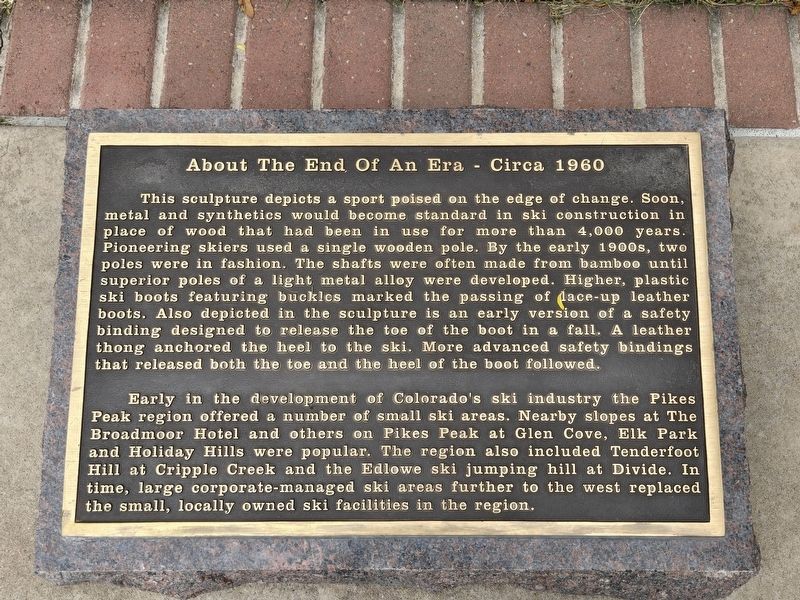
This sculpture depicts a sport poised on the edge of change. Soon metal and synthetics would become standard in ski construction in place of wood that had been in use for more than 4,000 years. Pioneering skiers used a single wooden pole. By the early 1900s, two poles were in fashion. The shafts were often made from bamboo until superior poles of a light metal alloy were developed. Higher, plastic ski boots featuring buckles marked the passing of lace-up leather boots. Also depicted in the sculpture is an early version of a safety binding designed to release the toe of the boot in a fall. A leather thong anchored the heel to the ski. More advanced safety bindings that released both the toe and the heel of the boot followed.
Early in the development of Colorado's ski industry the Pikes Peak region offered a number of small ski areas. Nearby slopes at The Broadmoor Hotel and others on Pikes Peak at Glen Cove, Elk Park and Holiday Hills were popular. The region also included Tenderfoot Hill at Cripple Creek and the Edlowe ski jumping hill at Divide. In time, large corporate-managed ski areas further to the west replaced the small, locally owned ski facilities in the region.
Early in the development of Colorado's ski industry the Pikes Peak region offered a number of small ski areas. Nearby slopes at The Broadmoor Hotel and others on Pikes Peak at Glen Cove, Elk Park and Holiday Hills were popular. The region also included Tenderfoot Hill at Cripple Creek and the Edlowe ski jumping hill at Divide. In time, large corporate-managed ski areas further to the west replaced the small, locally owned ski facilities in the region.
Photographed by Mark Parker, July 3, 2024
4. Colorado Springs Pioneer Museum in the background of the Colorado Skiing markers and statue
Credits. This page was last revised on June 30, 2026. It was originally submitted on July 12, 2024, by Mark Parker of Hickory, North Carolina. This page has been viewed 259 times since then and 32 times this year. Photos: 1, 2, 3, 4. submitted on July 12, 2024, by Mark Parker of Hickory, North Carolina. • Devry Becker Jones was the editor who published this page.
