
Downtown in Colorado Springs in El Paso County, Colorado — The American Mountains (Southwest)
On This Spot
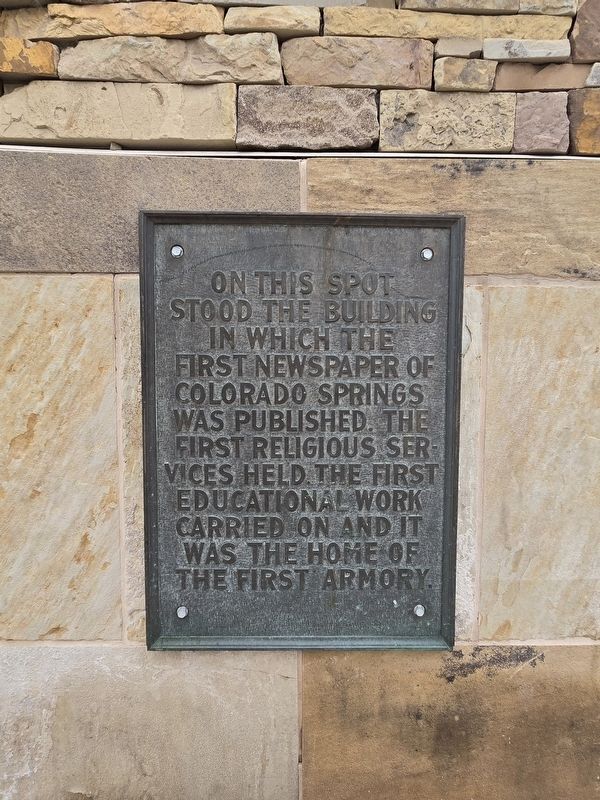
Photographed by Mark Parker, July 3, 2024
1. First Newspaper of Colorado Springs Marker
Topics. This historical marker is listed in these topic lists: Communications • Education • Religion & Religious Structures • Settlements & Settlers.
Location. 38° 49.957′ N, 104° 49.405′ W. Marker is in Colorado Springs, Colorado, in El Paso County. It is in Downtown. It is at the intersection of South Tejon Street and East Colorado Avenue, on the right when traveling north on South Tejon Street. Location is at the United States Olympic and Paralympic Committee Building. Touch for map. Marker is at or near this postal address: 29 South Tejon Street, Colorado Springs CO 80903, United States of America. Touch for directions.

Regionally, this marker is in Colorado’s Front Range and in Pikes Peak Region. It is also in the American Mountain West. Globally, it is in North America, the Rocky Mountains, the Western Hemisphere, the Western
this page online
Other nearby markers. At least 8 other markers are within walking distance of this marker: Spencer Penrose (about 500 feet away, measured in a direct line); Hank (about 500 feet away); City of Fountain Colony Founded (about 600 feet away); The First Stake of the Fountain Colony (about 600 feet away); William Seymour 1843-1920 (about 600 feet away); Colorado Springs Post Office and Federal Courthouse (about 700 feet away); Dominico (Nick) T. Venetucci (about 700 feet away); Katherine Lee Bates (approx. 0.2 miles away). Touch for a list and map of all markers in Colorado Springs.
More about this marker. Marker is at the bottom right corner of US Olympic and Paralympic building on ground level facing South Tejon Street.
Also see . . . Colorado Springs Gazette (Colorado Springs Pioneers Museum).
Excerpt: Just a year after William Jackson Palmer founded the city, he founded a newspaper originally named Out West.(Submitted on July 12, 2024.)
In its 149-year history, The Gazette took on five different names and four locations — each symbolic of broaderchanges in the community.Photographed by Mark Parker, July 3, 20242. On This Spot Marker at corner post of building
When the city was small, The Gazette was small. It was started in a two-story frame house on the northeast corner of what is now Tejon Street and Colorado Avenue, where the U.S. Olympic Committee now sits.
In that simpler era, when the budding city had just 2,000 residents and a subscription to the four-page weekly Gazette cost $3 per year, the building was divided up. Palmer had his office in the front. The newsroom/ printing plant was in the middle room, and the paper’s editor/publisher/printer/reporter, J. E. Liller, lived in the back room with his wife. Upstairs was the town meeting room where the church services were held, the first school’s classes were held, the fire department was organized and the town militia met when there was news of Indian raids.

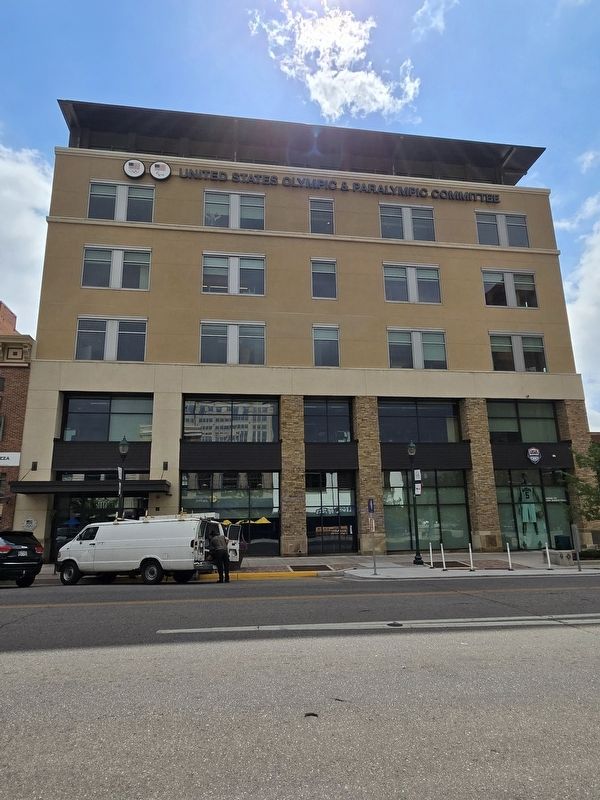
Photographed by Mark Parker, July 3, 2024
3. United States Olympic and Paralympic Committee Building facing South Tejon Street
Marker located at far bottom right corner
Credits. This page was last revised on July 12, 2024. It was originally submitted on July 12, 2024, by Mark Parker of Hickory, North Carolina. This page has been viewed 244 times since then and 32 times this year. Photos: 1, 2, 3. submitted on July 12, 2024, by Mark Parker of Hickory, North Carolina. • Andrew Ruppenstein was the editor who published this page.
