Bury St Edmunds in Suffolk, England, United Kingdom — Northwestern Europe (the British Isles)
St Edmunds Abbey

Photographed by Ray Gurganus, March 27, 2024
1. St Edmunds Abbey Marker
Patron Saint
Edmund was King of East Anglia in the 9th century. With his heroic defence of his Christian faith and subsequent violent murder at the hands of the Danes, King Edmund was quickly honoured as a saint. Before St George gained popularity, St Edmund was seen as one of the first patron saints of England.
Erected by English Heritage.
Topics. This historical marker is listed in this topic list: Religion & Religious Structures.
Location. 52° 14.675′ N, 0° 43.145′ E. Marker is in Bury St Edmunds, England, in Suffolk. It can be reached from no nearby street. Touch for map. Marker is in this post office area: Bury St Edmunds, England IP33 1RS, United Kingdom. Touch for directions.

Regionally, this marker is in East Anglia. Globally, it is on the Atlantic Ocean, in the North Atlantic Region, in Europe,
this page online
Other nearby markers. At least 8 other markers are within walking distance of this marker: The Abbot's Palace (within shouting distance of this marker); The Chapter House (within shouting distance of this marker); Cnut's Church and its Successor (within shouting distance of this marker); The Heart of the Church (within shouting distance of this marker); The Cloister (within shouting distance of this marker); The Great Court (about 90 meters away, measured in a direct line); The Eastern End (about 90 meters away); The Magna Carta (about 90 meters away). Touch for a list and map of all markers in Bury St Edmunds.
Photographed by Ray Gurganus, March 27, 2024
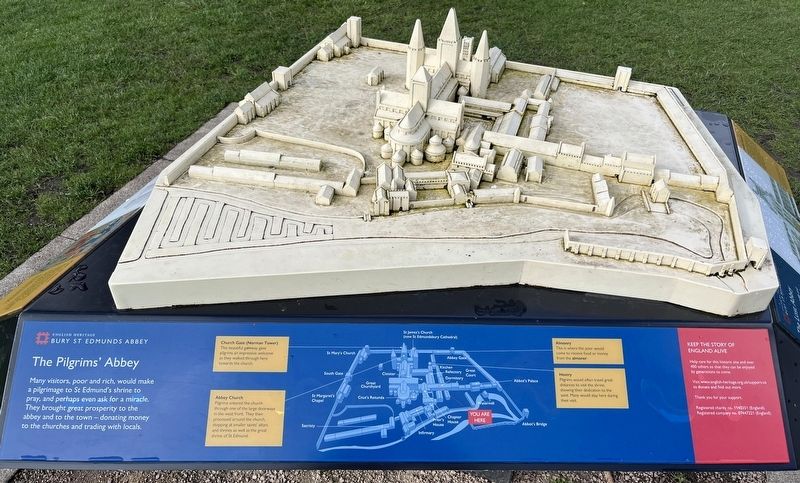
2. The Pilgrim's Abbey
Many visitors, poor and rich, would make a pilgrimage to St Edmund's shrine to pray, and perhaps even ask for a miracle. They brought prosperity to the abbey and to the town - donating money to the churches and trading with locals.

Photographed by Ray Gurganus, March 27, 2024
3. The Lost Abbey
It is hard to imagine the scale and splendour of the lost abbey church. It was roughly twice the size of St Edmundsbury Cathedral but after its closure, any valuable building materials were taking away and anything else was left to gradually decay.
Rubble Remains
The flint ruins that you see today were never meant to be seen. The flint was the rubble core between two layers of the finest limestone that was stripped away and sold after the abbey's closure. The fallen rubble covered much of the remaining walls which were only revealed after excavation.
Rubble Remains
The flint ruins that you see today were never meant to be seen. The flint was the rubble core between two layers of the finest limestone that was stripped away and sold after the abbey's closure. The fallen rubble covered much of the remaining walls which were only revealed after excavation.

Photographed by Ray Gurganus, March 27, 2024
4. The Monks' Abbey
Over 100 monks and servants lived and worked in the abbey. The senior monks had extra responsibilities to ensure that they day-to-day activities of the abbey went smoothly.
Credits. This page was last revised on June 24, 2026. It was originally submitted on July 13, 2024, by Ray Gurganus of Washington, District of Columbia. This page has been viewed 107 times since then and 17 times this year. Photos: 1, 2, 3, 4. submitted on July 13, 2024, by Ray Gurganus of Washington, District of Columbia. • Andrew Ruppenstein was the editor who published this page.
Editor’s want-list for this marker. photo of the marker within its surroundings • Can you help?
