Hébuterne in Pas-de-Calais, Upper France, France — Western Europe
The British Front Line
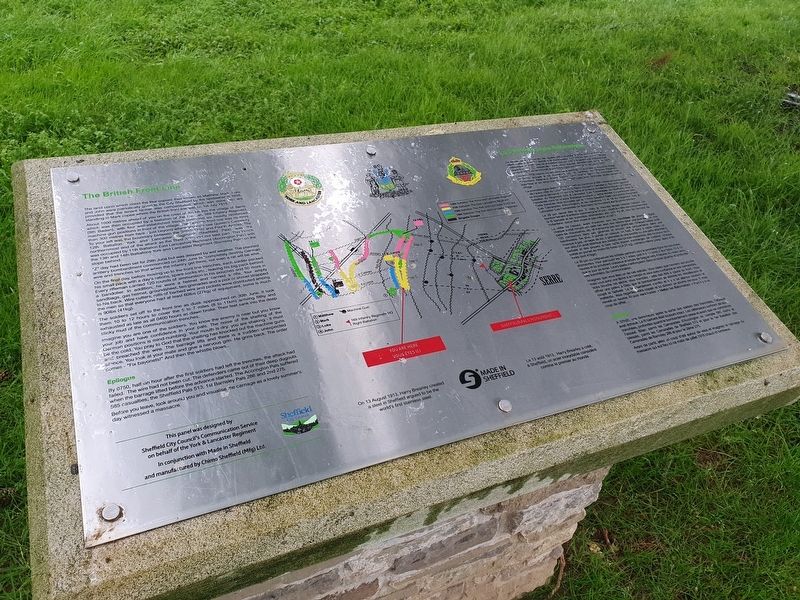
Photographed by J. Makali Bruton, June 10, 2024
1. The British Front Line Marker

The land upon which stood the four copses then known as Matthew, Mark, Luke and John were patriotically given to the City Sheffield by the landowner in 1928, provided that the tenant farmer was compensated, which was done. You are standing in Mark copse where the British front line was on 1st July 1916.
About 1000 metres ahead of you on the crest of hill lies the village of Serre which was then occupied by a battalion of the German 169 Infantry Regiment (8th Baden), with four well-established trench lines and six heavily reinforced machine gun positions in front of the village. The German front-line was no more than 300 metres from here - just beyond where you now see Queen's Cemetery. To your left was the boundary between the British Third and Fourth Armies. The 12th Battalion York and Lancaster Regiment (Sheffield Pals) was the northernmost end of the attack as the Third Army did not take part. This trench was occupied by 11th Battalion East Lancashire Regiment (Accrington Pals) with the 13th and 14th Battalions York and Lancaster Regiment (Barnsley Pals) on the slope behind.
"Z" day
this page online
The soldiers set off to the front line as dusk approached on 30th June. It took them 10 to 12 hours to cover the 5 to 7 miles (8 to 11km) arriving filthy and exhausted as late as all 0400 hours as dawn broke. Their feet sank into the deep sticky mud of the communication trenches.
Imagine you are one of the soldiers. You know the enemy is

Photographed by J. Makali Bruton, June 10, 2024
2. The British Front Line Marker
This view shows the French text more clearly.
Epilogue
By 0750, half an hour after the first soldiers had left the trenches, the attack had failed. The wire had not been cut. The defenders came out of their deep dugouts when the barrage lifted before the advance started. The Accrington Pals suffered 585 casualties; the Sheffield Pals 513; 1st Barnsley Pals 286 and 2nd 275.
Before you leave, look around you and visualise the carnage as a lovely summer's day witnessed a massacre.
This panel was designed by Sheffield City Council's Communication Service on behalf of the York & Lancaster Regiment In conjunction with Made in Sheffield and manufactured by Chimo Sheffield (Mfg) Ltd.
La Première Ligne Britannique
Le terrain

Photographed by J. Makali Bruton, June 10, 2024
3. The British Front Line Marker
The marker can be seen between the park's gate and the cemetery signs.
A environ 1000 metres devant vous sur le sommet de la colline se trouve le village de Serre occupé à ce moment-là par un bataillon du 16ème Régiment d'infanterie Allemand (8ème Baden) avec quatre lignes de tranchées, bien installées et six emplacements de mitrailleuses bien renforcés situés devant le village.
La première ligne allemande se trouvait au maximum à 300 mètres de cet endroit - de l'autre côté du Cimetière de la Reine (Queen's Cemetery). Sur votre gauche se trouvait la démarcation entre la 3ème et la 4ème Armée Britannique. Le 12ème bataillon du Régiment York & Lancaster (Les Camarades de Sheffield) était à rextrémité nord de la zone d'attaque puisque la 3ème Armée n'y participait pas. Cette tranchée était occupée par le ème Bataillon East Lancashire Regiment (Les Camarades d'Accrington) et les bataillons 13 et 14 du Régiment York & Lancaster (Les Camarades de Barnsley) se trouvalent sur la pente derrière.
Le 29 juin devait être le jour 'Z’ mais le mauvais temps retarda l'assaut. Le bombardement d'artillerie commença le 24 juin, visant à « détruire complètement le fil barbelé et les tranchées allemandes afin qu'il n'y ait, lors de l'arrivée de l’infanterie, aucun être vivant et pas même un rat! »
La veille de l'assaut, avant d'avancer vers les tranchées de premi ligne, chaque soldat remplit son petit sac avec des rations pour une journéeur, une paire de chaussettes, etc. et n'emporta pas son grand sac. Chaque fusilier avait 120 cartouches dans ses gibernes et encore une cinquantaine dans une bandoulière. De plus, il portait un casque, un fusil, 4 sacs à sable vides, un masque à gaz, un tapis de sol, 2 grenades et une pioche ou une pelle attachée à son dos. On avait distribué aux soldats des pinces coupantes, des rouleaux de fil barbelé et des piquets si bien qu'ils étaient surchargés de matériel; chaque soldat en portait au moins 60 livres (soit 27 kg), certains même jusqu' donc à 90 livres (soit 41kgs).
Le 30 juin au crépuscule les soldats partirent vers la première ligne de tranchées allemandes. Pour parcourir les 5 à 7 miles (soit 8 à 11 kms) il leur fallut 10 à 12 heures et ils arrivérent crasseux et brisés de fatigue vers 4 heures du matin alors que le jour se levait. Leurs pieds s'enfonçaient dans la boue gluante et profonde des tranchées de communication.
Imaginez que vous êtes un de ces soldats. Vous savez que l'ennemi est proche mais vous avez une tâche à accomplir et vous avez confiance en vos camarades. Votre bouche est séche: vous tremblez - cela doit être à cause du froid. Vous offrez une prière à Dieu que le bombardement ait éliminé les mitrailleuses et coupé le barbelé. Le bombardement s'arrête et il y a un silence soudain et Inattendu. Vous regardez votre copain et lui donnez un sourire nerveux. Il vous renvoit un sourire. Et puis vient l'ordre: « Mettez les Balonnettes! » Puis il y a un coup de sifflet....
Epilogue
A 07h50, une demi-heure après la sortie des soldats des tranchées, l'attaque avait échoué. Le fil barbelé était toujours intact. Les défenseurs sortirent de leurs tranchées, profondes quand le bombardement cessa et avant que ne commence l'assaut. Bilan: parmi les Camarades d'Accrington on compta 585 morts et blessés; parmi les Camarades de Sheffield 513 et pour le 1er Bataillon des Camarades de Barnsley 286 et pour le 2ème 275.
Avant de partic, jetez un coup d'œil autour de vous et imaginez le carnage du massacre qui eut lieu ici ce matin de juillet 1916 chaud et lumineux.
Erected by Sheffield City Council.
Topics. This historical marker is listed in this topic list: War, World I. A significant historical date for this entry is July 1, 1916.
Location. 50° 6.355′ N, 2° 39.401′ E. Marker is in Hébuterne, Hauts-de-France (Upper France), in Pas-de-Calais. It is on Unnamed farm road south of Rue du Chateau d'Eau, on the right when traveling south. Touch for map. Marker is in this post office area: Hébuterne, Hauts-de-France 62111, France. Touch for directions.

Regionally, it is in the North Atlantic Region, Europe, the European Union, Atlantic Europe, the Schengen Area, Western Europe, a coastal Mediterranean country, and the Western World. Historically, it finds itself in what was once a French colony and also the Roman Empire.
Other nearby markers. At least 8 other markers are within 3 kilometers of this marker, measured as the crow flies: The Barnsley Pals (a few steps from this marker); Burnley and District Pals Memorial (a few steps from this marker); Chorley Pals (a few steps from this marker); Accrington Pals (a few steps from this marker); Sheffield World War Memorial (within shouting distance of this marker); Railway Hollow Cemetery (within shouting distance of this marker); Queen's Cemetery (about 120 meters away, measured in a direct line); Hunters Cemetery (approx. 3.1 kilometers away). Touch for a list and map of all markers in Hébuterne.
Credits. This page was last revised on July 13, 2024. It was originally submitted on July 13, 2024, by J. Makali Bruton of Washington, District of Columbia. This page has been viewed 138 times since then and 18 times this year. Photos: 1, 2, 3. submitted on July 13, 2024, by J. Makali Bruton of Washington, District of Columbia.
