
Newport in Newport County, Rhode Island — The American Northeast (New England)
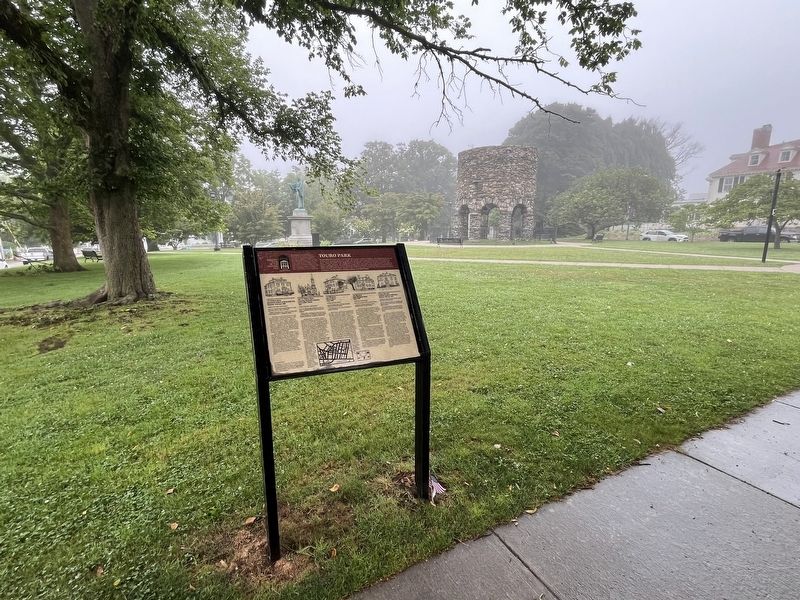
Touro Park
| — | Walking Tour of the Historic Hill | — |
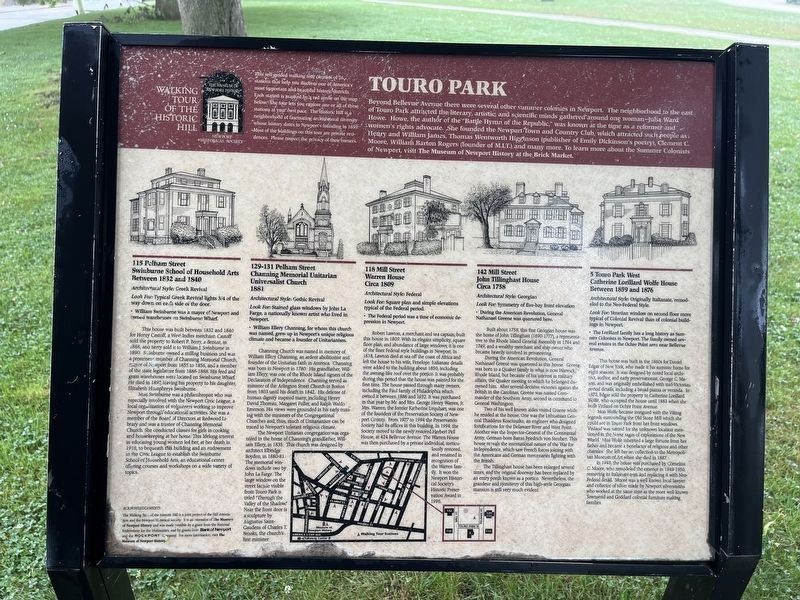
Beyond Bellevue Avenue there were several other summer colonies in Newport. The neighborhood to the east of Touro Park attracted the literary, artistic, and scientific minds gathered around one woman—Julia Ward Howe. Howe, the author of the "Battle Hymn of the Republic," was known at the time as a reformer and women's rights advocate. She founded the Newport Town and Country Club, which attracted such people as Henry and William James, Thomas Wentworth Higginson (publisher of Emily Dickinson's poetry), Clement C. Moore, William Barton Rogers (founder of M.I.T.) and many more. To learn more about the Summer Colonists of Newport, visit The Museum of Newport History at the Brick Market.
115 Pelham Street
Swinburne School of Household Arts
Between 1832 and 1840
Architectural Style: Greek Revival
Look For: Typical Greek Revival lights 3/4 of the way down on each side of the door.
• William Swinburne was a mayor of Newport and owned warehouses on Swinburne Wharf.
This house was built between 1832 and 1840 for Henry Castoff, a West Indie merchant. Castoff sold the property to Robert P. Berry, a dentist, in 1868,
this page online
Miss Swinburne was a philanthropist who was especially involved with the Newport Civic League, a local organization of volunteers working to improve Newport through educational activities. She was a member of the Board of Directors at Redwood Library and was a trustee of Channing Memorial Church. She conducted classes for girls in cooking and housekeeping at her home. This lifelong interest in educating young women led her, at her death in 1918, to bequeath this building and an endowment to the Civic League to establish the Swinburne School of Household Arts, an educational center offering courses and workshops on a wide variety of topics.
129-131 Pelham Street
Channing Memorial Unitarian Universalist Church
1881
Architectural Style: Gothic Revival
Look
• William Ellery Channing, for whom this church was named, grew up in Newport's unique religious climate and became a founder of Unitarianism.
Channing Church was named in memory of William Ellery Channing, an ardent abolitionist and founder of the Unitarian faith in America. Channing was born in Newport in 1780. His grandfather, William Ellery, was one of the Rhode Island signers of the Declaration of Independence. Channing served as minister of the Arlington Street Church in Boston from 1803 until his death in 1842. His defense of human dignity inspired many, including Henry David Thoreau, Margaret Fuller, and Ralph Waldo Emerson. His views were grounded in his early training with the ministers of the Congregational Churches and, thus, much of Unitarianism can be traced to Newport's tolerant religious climate.
The Newport Unitarian congregation was organized in the home of Channing's grandfather, William Ellery, in 1835. This church was designed by architect Elbridge Boyden, in 1880-81. The memorial windows include two by John La Farge.
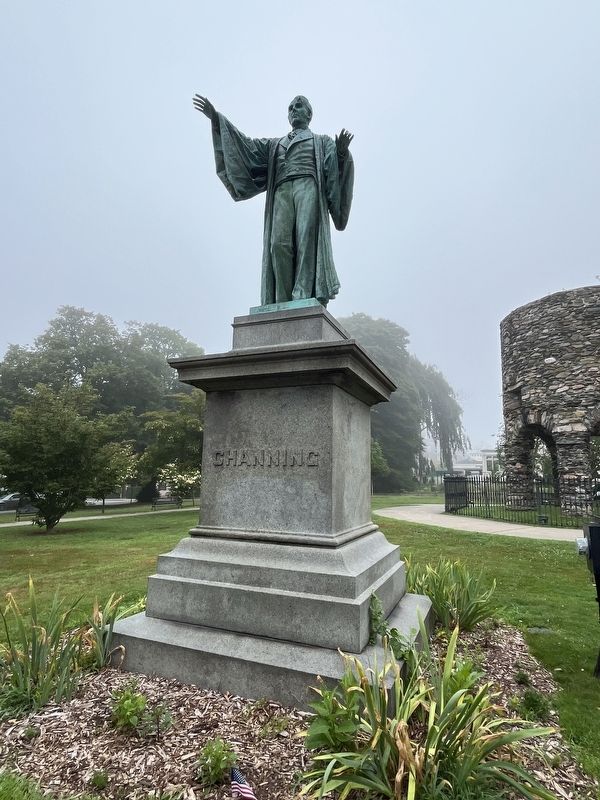
Photographed by Devry Becker Jones (CC0), July 10, 2024
3. Channing Statue in Touro Park
This statue stands on the grounds of Touro Park, facing Channing Memorial Unitarian Universalist Church.
118 Mill Street
Warren House
Circa 1809
Architectural Style: Federal
Look For: Square plan and simple elevations typical of the Federal period.
• The Federal period was a time of economic depression in Newport.
Robert Lawton, a merchant and sea captain, built this house in 1809. With its elegant simplicity, square floor plan, and abundance of large windows, it is one of the finer Federal style buildings in Newport. In 1818, Lawton died at sea off the coast of Africa and left the house to his wife, Penelope. Italianate details were added to the building about 1850, including the awning-like roof over the portico. It was probably during this period that the house was painted for the first time. The house passed through many owners, including the Paul family of Philadelphia which owned it between 1886 and 1932. It was purchased in that year by Mr. and Mrs. George Henry Warren, Jr. Mrs. Warren, the former Katherine Urquhart, was one of the founders of the Preservation Society of Newport County. From 1977 to 1994 the Preservation Society had its offices in this building. In 1994, the Society moved to the newly restored Herbert Pell House, at 424 Bellevue Avenue. The Warren House was then purchased by a private individual, meticulously restored, and renamed in recognition of the Warren family. It won the Newport Historical Society's Historic Preservation Award in 1996.
142 Mill Street
John Tillinghast House
Circa 1758
Architectural Style: Georgian
Look For: Symmetry of five-bay front elevation
• During the American Revolution, General Nathanael Greene was quartered here.
Built around 1758, this fine Georgian house was the home of John Tillinghast (1690-1777), a representative to the Rhode Island General Assembly in 1744 and 1749, and a wealthy merchant and ship owner who became involved in privateering.
During the American Revolution, General Nathanael Green was quartered in this house. Greene was born to a Quaker family in what is now Warwick, Rhode Island, but because of his interest in military affairs, the Quaker meeting to which he belonged disowned him. After several decisive victories against the British in the Carolinas, Greene was named Commander of the Southern Army, second in command to General Washington.
Two of his well known aides visited Greene while he resided at the house. One was the Lithuanian General Thaddeus Kosciuszko, an engineer who designed fortifications for the Delaware River and West Point. Another was the Inspector General of the Continental Army, German-born Baron Fredrich von Steuben. This house reveals the international nature of the War for Independence, which saw French forces joining with the Americans and German mercenaries fighting with the British.
The Tillinghast house has been enlarged several times, and the original doorway has been replaced by an entry porch known as a portico. Nevertheless, the grandeur and symmetry of this high-style Georgian mansion is still very much evident.
5 Touro Park West
Catherine Lorillard Wolfe House
Between 1859 and 1876
Architectural Style: Originally Italianate, remodeled to the Neo-Federal Style.
Look For: Venitian window on second floor more typical of Colonial Revival than of colonial buildings in Newport.
• Teh Lorillard family has a long history as Summer Colonists in Newport. The family owned several estates in the Ochre Point area near Bellevue Avenue.
This house was built in the 1860s for Daniel Edgar of New York, who made it his summer home for eight seasons. It was designed by noted local architect, author, and early preservationist, George C. Marson, and was originally embellished with mid-Victorian period details, including a broad piazza or veranda. In 1872, Edgar sold the property to Catherine Lorillard Wolfe, who occupied the house until 1883 when she built Vinland on Ochre Point Avenue.
Miss Wolfe became intrigued with the Viking legends surrounding the Old Stone Mill which she could see in Touro Park from her front windows. Vinland was named for the unknown location mentioned in the Norse sagas of explorations of the New World. Miss Wolfe inherited a large fortune from her father and became a benefactor of religious and other charities. She left her art collection to the Metropolitan Museum of Art when she died in 1887.
In 1948, the house was purchased by Cornelius C. Moore, who remodeled the exterior in 1949-1950, removing its Italianate trim and replacing it with Neo-Federal detail. Moore was a well known local lawyer and collector of silver made by Newport silversmiths who worked at the same time as the more well known Townsend and Goddard colonial furniture making families.
Erected by Newport Historical Society.
Topics and series. This historical marker is listed in these topic lists: Architecture • Arts, Letters, Music • Education • Religion & Religious Structures. In addition, it is included in the Unitarian Universalism (UUism) series list. A significant historical year for this entry is 1832.
Location. 41° 29.132′ N, 71° 18.579′ W. Marker is in Newport, Rhode Island, in Newport County. It is on Pelham Street just east of Touro Park Street West, on the left when traveling east. Touch for map. Marker is at or near this postal address: 5 Touro Park St W, Newport RI 02840, United States of America. Touch for directions.

Regionally, this marker is on Rhode Island’s Narragansett Bay and in Newport and Aquidneck Island. It is also in the American Northeast, in New England, and on the Eastern Seaboard. Globally, it is in the North Atlantic Region, North America, the Western Hemisphere, the Western World, and the Anglosphere. Historically, it finds itself in what was once one of the original Thirteen Colonies.
Other nearby markers. At least 8 other markers are within walking distance of this marker: Matthew Perry Monument (within shouting distance of this marker); The 2012 Shimoda Tomodachi Declaration (within shouting distance of this marker); a different marker also named Touro Park (within shouting distance of this marker); The League of American Wheelmen (within shouting distance of this marker); Redwood Library (about 400 feet away, measured in a direct line); Serenity Inn Newport (about 500 feet away); Pelham Street (about 500 feet away); Corné House (about 600 feet away). Touch for a list and map of all markers in Newport.
Credits. This page was last revised on July 14, 2024. It was originally submitted on July 14, 2024, by Devry Becker Jones of Washington, District of Columbia. This page has been viewed 350 times since then and 53 times this year. Photos: 1, 2, 3. submitted on July 14, 2024, by Devry Becker Jones of Washington, District of Columbia.
