Commercial Street Historic District in Springfield in Greene County, Missouri — The American Midwest (Upper Plains)
Springfield's Historic Jefferson Avenue Footbridge
Photographed by Duane and Tracy Marsteller, March 21, 2019
1. Springfield's Historic Jefferson Avenue Footbridge Marker
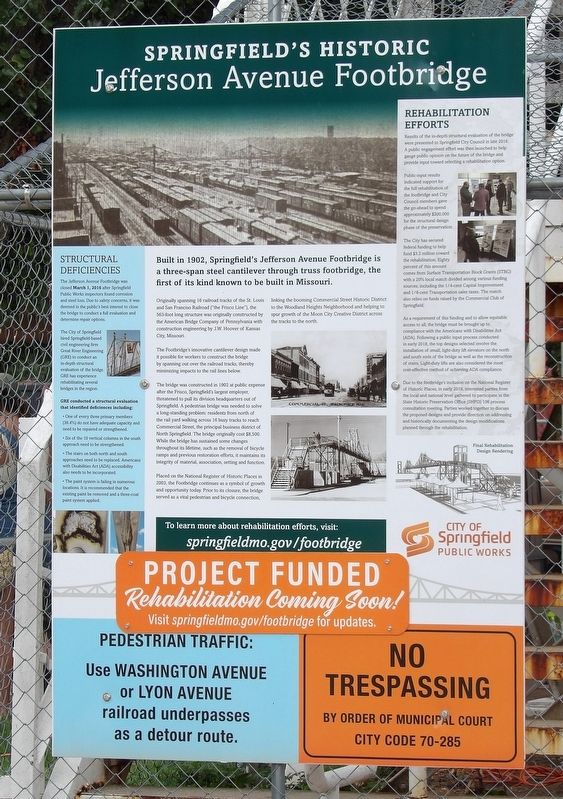
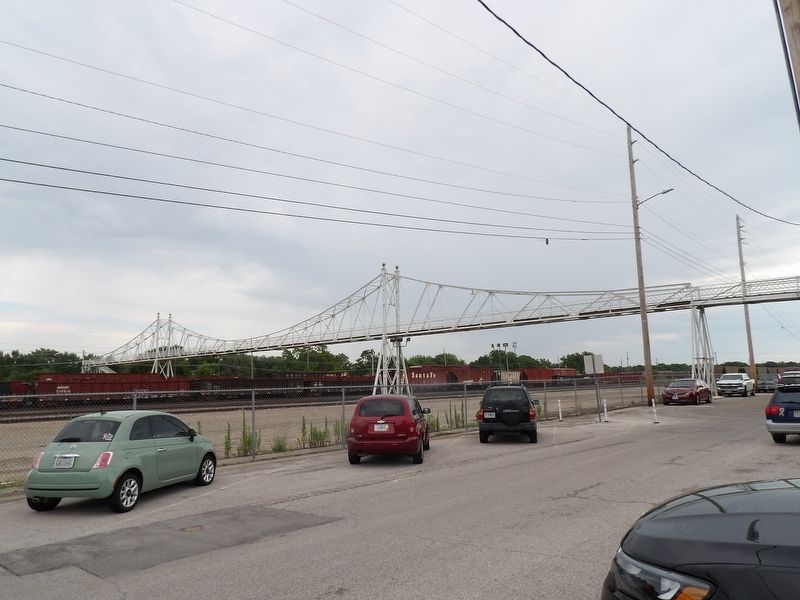
Originally spanning 16 railroad tracks of the St. Louis and San Francisco Railroad (“the Frisco Line”), the 563-foot long structure was originally constructed by the American Bridge Company of Pennsylvania with construction engineering by J.W. Hoover of Kansas City, Missouri.
The Footbridge's innovative cantilever design made it possible for workers to construct the bridge by spanning out over the railroad tracks, thereby minimizing impacts to the rail lines below.
The bridge was constructed in 1902 at public expense after the Frisco, Springfield's largest employer, threatened to pull its division headquarters out of Springfield. A pedestrian bridge was needed to solve a long-standing problem: residents from north of the rail yard walking across 16 busy tracks to reach Commercial Street, the principal business district of North Springfield. The bridge originally cost $8,500. While the bridge has sustained some changes throughout its lifetime,
this page online
Placed on the National Register of Historic Places in 2003, the Footbridge continues as a symbol of growth and opportunity today. Prior to its closure, the bridge served as a vital pedestrian and bicycle connection.
Structural deficiencies
The Jefferson Avenue Footbridge was closed March 1, 2016 after Springfield Public Works inspectors found corrosion and steel loss. Due to safety concerns, it was deemed in the public's best interest to close the bridge to conduct a full evaluation and determine repair options.
The City of Springfield hired Springfield-based civil engineering firm Great River Engineering (GRE) to conduct an in-depth structural evaluation of the bridge. GRE has experience rehabilitating several bridges in the region.
GRE conducted a structural evaluation that identified deficiencies including:
• One of every three primary members (36.4%) do not have adequate capacity and need to be repaired or strengthened.
• Six of the 10 vertical columns in the south approach
Photographed by Duane and Tracy Marsteller, June 29, 2024
2. Springfield's Historic Jefferson Avenue Footbridge Marker
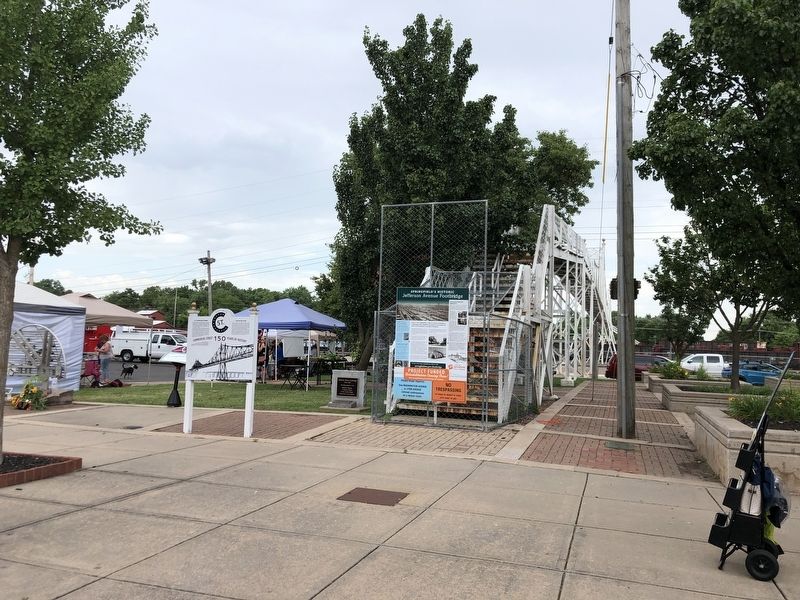
Featured marker is on the right.
• The stairs on both north and south approaches need to be replaced. Americans with Disabilities Act (ADA) accessibility also needs to be incorporated.
• The paint system is failing in numerous locations. It is recommended that the existing paint be removed and a three-coat paint system applied.
Rehabilitation Efforts
Results of the in-depth structural evaluation of the bridge were presented to Springfield City Council in late 2016. A public engagement effort was then launched to help gauge public opinion on the future of the bridge and provide input toward selecting a rehabilitation option.
Public-input results indicated support for the full rehabilitation of the footbridge and City Council members gave the go-ahead to spend approximately $200,000 for the structural design phase of the preservation.
The City has secured federal funding to help fund $3.2 million toward the rehabilitation. Eighty percent of this amount comes from Surface Transportation Block Grants (STBG) with a 20% local match divided among various funding sources, including the 1/4-cent Capital Improvement and 1/8-cent Transportation
Photographed by Duane and Tracy Marsteller, June 29, 2024
3. Jefferson Avenue Footbridge
As a requirement of this funding and to allow equitable access to all, the bridge must be brought up to compliance with the Americans with Disabilities Act (ADA). Following a public input process conducted in early 2018, the top designs selected involve the installation of small, light-duty lift elevators on the north and south ends of the bridge as well as the reconstruction of stairs. Light-duty lifts are also considered the most cost-effective method of achieving ADA compliance.
Due to the footbridge's inclusion on the National Register of Historic Places, in early 2019, interested parties from the local and national level gathered to participate in the State Historic Preservation Office (SHPO) 106 process consultation meeting. Parties worked together to discuss the proposed designs and provide direction on addressing and historically documenting the design modifications planned through the rehabilitation.
Erected by City of Springfield Public Works.
Topics and series. This historical marker is listed in these topic lists: Bridges & Viaducts • Railroads & Streetcars. In addition, it is included in the National Register of Historic Places (NRHP) series list. A significant historical year for this entry is 1902.
Location. 37° 13.795′ N, 93° 17.35′ W. Marker is in Springfield, Missouri, in Greene County. It is in the Commercial Street Historic District. It is at the intersection of East Commercial Street and North Jefferson Avenue, on the right when traveling west on East Commercial Street. Touch for map. Marker is at or near this postal address: 321 E Commercial St, Springfield MO 65803, United States of America. Touch for directions.

Regionally, this marker is in the American Ozarks, in the Lewis & Clark Corridor, and in the Corn Belt. Globally, it is in North America, the Western Hemisphere, the Western World, and the Anglosphere. Historically, it finds itself in what was once the territory of the Mississippian Culture, the Louisiana Purchase, and the Antebellum South.
Other nearby markers. At least 8 other markers are within walking distance of this marker: Commercial Street 150 Years of History (here, next to this marker); First Springfield Railroad (approx. 0.2 miles away); Bentley House (approx. 0.6 miles away); Indian Mounds (approx. 0.7 miles away); Fairbanks Hall (approx. 0.7 miles away); Tau Eta Gamma (local) (approx. 0.7 miles away); a different marker also named Fairbanks Hall (approx. ¾ mile away); Civil War Entrenchments (approx. 0.8 miles away). Touch for a list and map of all markers in Springfield.
Also see . . .
1. Jefferson Street Footbridge (PDF). National Register nomination for the bridge, which was listed in 2003. (Prepared by Robert Flanders and Oliva Hough, City of Springfield Department of Planning and Development; via National Archives) (Submitted on July 14, 2024, by Duane and Tracy Marsteller of Murfreesboro, Tennessee.)
2. Historic Jefferson Avenue Footbridge Rehabilitation. Project website. (City of Springfield, Missouri) (Submitted on July 14, 2024, by Duane and Tracy Marsteller of Murfreesboro, Tennessee.)
Credits. This page was last revised on July 14, 2024. It was originally submitted on July 14, 2024, by Duane and Tracy Marsteller of Murfreesboro, Tennessee. This page has been viewed 267 times since then and 47 times this year. Photos: 1, 2, 3. submitted on July 14, 2024, by Duane and Tracy Marsteller of Murfreesboro, Tennessee.
