Newport in Newport County, Rhode Island — The American Northeast (New England)
Bellevue Ave. at John St.
| — | Walking Tour of the Historic Hill | — |
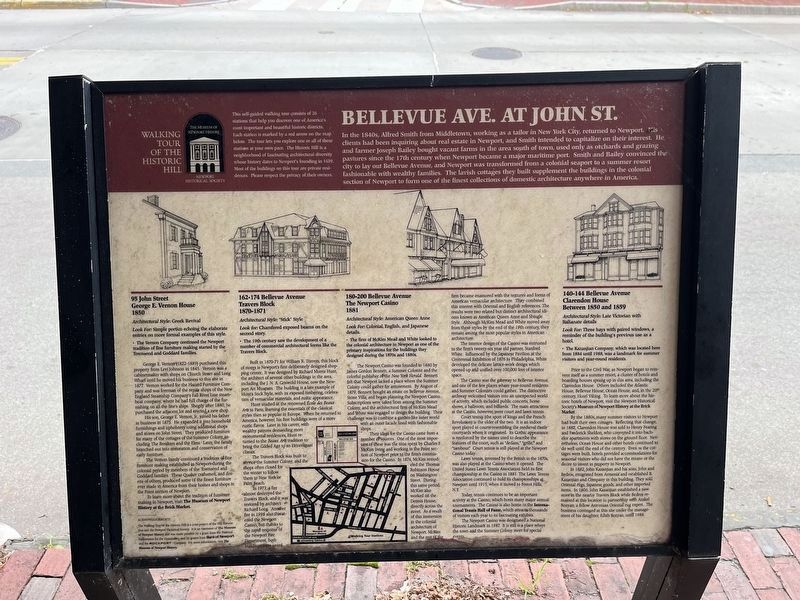
In the 1840s, Alfred Smith from Middletown, working as a tailor in New York City, returned to Newport. His clients had been inquiring about real estate in Newport, and Smith intended to capitalize on their interest. He and farmer Joseph Bailey bought vacant farms in the area south of town, used only as orchards and grazing pastures since the 17th century when Newport became a major maritime port. Smith and Bailey convinced the city to lay out Bellevue Avenue, and Newport was transformed from a colonial seaport to a summer resort fashionable with wealthy families. The lavish cottages they built supplement the buildings in the colonial section of Newport to form one of the finest collections of domestic architecture anywhere in America.
95 John Street
George E. Vernon House
1850
Architectural Style: Greek Revival
Look For: Simple portico echoing the elaborate entries on more formal examples of this style.
• The Vernon Company continued the Newport tradition of fine furniture making started by the Townsend and Goddard families.
George E. Vernon (1822-1889) purchased this property from Levi Johnson in 1845. Vernon
this page online
His son, George E. Vernon, Jr., joined his father in business in 1875. He expanded it into household furnishings and upholstery using additional shops and stores on John Street. They produced furniture for many of the cottages of the Summer Colony, including The Breakers and the Elms. Later, the family branched out into restoration and conservation of early furniture.
The Vernon family continued a tradition of fine furniture making established in Newport during the colonial period by members of the Townsend and Goddard families. These Quaker craftsmen, and dozens of others, produced some of the finest furniture ever made in America from their homes and shops in the Point section of Newport.
To learn more about the tradition
162-174 Bellevue Avenue
Travers Block
1870 - 1871
Architectural Style: "Stick" Style
Look for: Chamfered exposed beams on the second story.
• The 19th century saw the development of a number of commercial architectural forms like the Travers Block.
Built in 1870-71 for William R. Travers, this block of stores is Newport's first deliberately designed shopping center. It was designed by Richard Morris Hunt, the architect of several other buildings in the area, including the J. N. A. Griswold House, now the Newport Art Museum. The building is a late example of Hunt's Stick Style, with its exposed timbering, celebration of vernacular materials, and rustic appearance.
Hunt studied at the renowned École des Beaux Arts in Paris, learning the essentials of the classical styles then so popular in Europe. When he returned to America, however, his first buildings were of a more rustic flavor. Later in his career, with wealthy patrons demanding more monumental residences, Hunt returned to the Beaux Arts tradition to bring the Gilded Age to an extravagant climax.
The Travers Block was built to service the Summer Colony, and the shops often closed for the winter to follow them to New York or Palm Beach.
In 1973, a fire almost destroyed the Travers Block, and it was restored by architect Richard Long. Another fire in 1998 also threatened the Newport Casino, but thanks to the rapid response of the Newport Fire Department, both buildings were saved.
180-200 Bellevue Avenue
The Newport Casino
1881
Architectural Style: American Queen Anne
Look For: Colonial, English, and Japanese details.
• The firm of McKim Mead and White looked to the colonial architecture in Newport as one of the primary inspirations for the buildings they designed during the 1870s and 1880s.
The Newport Casino was founded in 1880 by James Gordon Bennett, a Summer Colonist and the colorful publisher of the New York Herald. Bennett felt that Newport lacked a place where the Summer Colony could gather for amusement. By August of 1879, Bennett bought an estate on Bellevue Avenue, Stone Villa, and began planning the Newport Casino. Subscriptions were taken from among the Summer Colony, and the architectural firm of McKim Mead and White was engaged to design the building. Their challenge was to combine a garden-like inner world with an outer facade lined with fashionable shops.
Their ideas for the Casino came from a number of sources. One of the most important of these was the time spent by Charles F. McKim living and working in the Point section of Newport prior to the firm's commission for the Casino. In 1874, McKim remodeled the Thomas Robinson House on Washington Street. During this same period, McKim also worked on the Dennis House, directly across the street. As a result of this immersion in the colonial architecture of Newport, McKim and the rest of the firm became enamored with the textures and forms of American vernacular architecture. They combined this interest with Oriental and English references. The results were two related but distinct architectural idioms known as American Queen Anne and Shingle Style. Although McKim Mead and White moved away from these styles by the end of the 19th century, they remain among the most popular styles in American architecture.
The interior design of the Casino was entrusted with the firm's twenty-six year old partner, Stanford White. Influenced by the Japanese Pavilion at the Centennial Exhibition of 1876 in Philadelphia, White developed the delicate lattice-work design which opened up and unified over 100,000 feet of interior space.
The Casino was the gateway to Bellevue Avenue and one of the few places where year-round residents and Summer Colonists could gather. The distinctive archway welcomed visitors into an unexpected world of activity, which included public concerts, horse shows, a ballroom, and billiards. The main attractions at the Casino, however, were court and lawn tennis.
Court tennis (the sport of kings and the French Revolution) is the older of the two. It is an indoor sport played in courts resembling the medieval castle courtyards where it originated. Its Gothic appearance is reinforced by the names used to describe the feature of the court, such as "dedans," "grille," and "tambour." Court tennis is till played at the Newport Casino today.
Lawn tennis, invented by the British in the 1870s, was also played at the Casino when it opened. The United States Lawn Tennis Association held its first championship at the Casino in 1881. The Lawn Tennis Association continued to hold its championships at Newport until 1915, when it moved to Forest Hills, N.Y.
Today, tennis continues to be an important activity at the Casino, which hosts many major annual tournaments. The Casino is also home to the International Tennis Hall of Fame, which attracts thousands of visitors each year to its fascinating exhibits.
The Newport Casino was designated a National Historic Landmark in 1987. It is still a place where the town and the Summer Colony meet for special events.
140-144 Bellevue Avenue
Clarendon House
Between 1850 and 1859
Architectural Style: Late Victorian with Italianate details.
Look For: Three bays with paired windows, a reminder of the building's previous use as a hotel.
• The Kazanjian Company, which was located here from 1884 until 1988, was a landmark for summer visitors and year-round residents.
Prior to the Civil War, as Newport began to reinvent itself as a summer resort, a cluster of hotels and boarding houses sprang up in this area, including the Clarendon House. Others included the Atlantic House, Bellevue House, Ocean House, and, in the 20th century, Hotel Viking. To learn more about this historic hotels of Newport, visit the Newport Historical Society's Museum of Newport History at the Brick Market.
By the 1880s, many summer visitors to Newport had built their own cottages. Reflecting that change, in 1882, Clarendon House was sold to Henry Fearing and Frederick Sheldon, who converted it into bachelor apartments with stores on the ground floor. Nevertheless, Ocean House and other hotels continued to do well until the end of the century. Even as the cottages were built, hotels provided accommodations for seasonal visitors who did not have the means or the desire to invest in property in Newport.
In 1882, John Kazanjian and his sons, John and Bedros, emigrated from Armenia and established B. Kazanjian and Company in this building. They sold Oriental rugs, Japanese goods, and other imported items. In 1906, John Kazanjian established a new store in the nearby Travers Block while Bedros remained at this location in partnership with Arakel Bozyan, a fellow Armenian Oriental rug expert. The business continued at this site under the management of his daughter, Edith Bozyan, until 1988.
Erected by Newport Historical Society.
Topics and series. This historical marker is listed in these topic lists: Architecture • Industry & Commerce • Settlements & Settlers • Sports. In addition, it is included in the National Historic Landmarks series list. A significant historical month for this entry is August 1879.
Location. 41° 29.045′ N, 71° 18.517′ W. Marker is in Newport, Rhode Island, in Newport County. It is at the intersection of Bellevue Avenue and John Street, on the left when traveling north on Bellevue Avenue. Touch for map. Marker is at or near this postal address: 127 Bellevue Ave, Newport RI 02840, United States of America. Touch for directions.

Regionally, this marker is on Rhode Island’s Narragansett Bay and in Newport and Aquidneck Island. It is also in the American Northeast, in New England, and on the Eastern Seaboard. Globally, it is in the North Atlantic Region, North America, the Western Hemisphere, the Western World, and the Anglosphere. Historically, it finds itself in what was once one of the original Thirteen Colonies.
Other nearby markers. At least 8 other markers are within walking distance of this marker: Christopher Columbus (within shouting distance of this marker); Touro Park (about 500 feet away, measured in a direct line); International Tennis Hall of Fame (about 500 feet away); The Newport Caino & Its Neighors: Commercial Development (about 500 feet away); The League of American Wheelmen (about 500 feet away); The 2012 Shimoda Tomodachi Declaration (about 600 feet away); Matthew Perry Monument (about 600 feet away); a different marker also named Touro Park (about 600 feet away). Touch for a list and map of all markers in Newport.
Other markers no longer nearby. International Tennis Hall of Fame (was about 500 feet away but has been replaced with another marker now near it); a different marker also named International Tennis Hall of Fame (was about 500 feet away but has been replaced with another marker now near it).
Credits. This page was last revised on July 15, 2024. It was originally submitted on July 15, 2024, by Devry Becker Jones of Washington, District of Columbia. This page has been viewed 402 times since then and 87 times this year. Photos: 1, 2. submitted on July 15, 2024, by Devry Becker Jones of Washington, District of Columbia.
