Tomahawk in Lincoln County, Wisconsin — The American Midwest (Great Lakes)
History of Baldwin Locomotive Works
⎯⎯⎯
Meet Old Engine Number 19
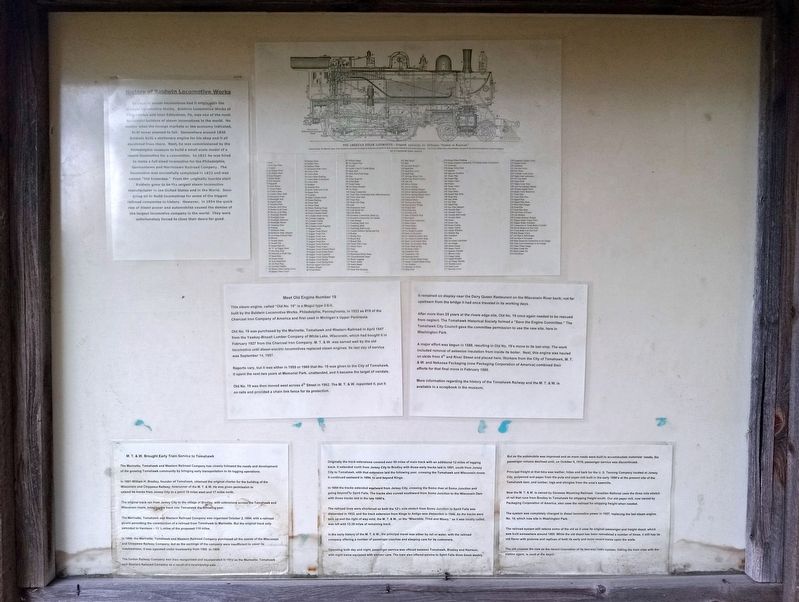
Photographed by McGhiever, September 23, 2023
1. History of Baldwin Locomotive Works / Meet Old Engine Number 19 Marker
The age of steam locomotives had it origin with the Baldwin Locomotive Works. Baldwin Locomotive Works of Philadelphia and later Eddystone, Pa, was one of the most successful builders of steam locomotives in the world. No matter what the foreign markets or the economy indicated, BLW never seemed to fail. Somewhere around 1830 Baldwin built a stationary engine for his shop and it all escalated from there. Next, he was commissioned by the Philadelphia museum to build a small scale model of a steam locomotive for a convention. In 1831 he was hired to make a full sized locomotive for the Philadelphia, Germantown and Morristown Railroad Company. The locomotive was succesfully [sic] completed in 1832 and was named "Old Ironsides." From the originally humble start Baldwin grew to be the largest steam locomotive manufacturer in the United States and in the World. Soon going on the Build locomotives for some of the biggest railroad companies in history. However, in 1954 the quick rise of diesel power and automobiles caused the demise of the largest locomotive company in the world. They were
this page online
This steam engine, called "Old No. 19" is a Mogul type 2-6-0, built by the Baldwin Locomotive Works, Philadelphia, Pennsylvania, in 1923 as #19 of the Charcoal Iron Company of America and first used in Michigan's Upper Peninsula.
Old No. 19 was purchased by the Marinette, Tomahawk and Western Railroad in April 1947 from the Yawkey-Bissell Lumber Company of White Lake, Wisconsin, which had bought it in February 1927 from the Charcoal Iron Company. M. T. & W. was served well by the old locomotive until diesel-electric locomotives replaced steam engines. Its last day of service was September 14, 1957.
Reports vary, but it was either in 1959 or 1960 that No. 19 was given to the City of Tomahawk. It spent the next two years at Memorial Park, unattended, and it became the target of vandals.
Old No. 19 was then moved west across 4ᵗʰ Street in 1962. The M. T. & W. repainted it, put it on rails and provided a chain link fence for its protection.
It remained on display near the Dairy Queen Restaurant on the Wisconsin River bank; not far

Photographed by McGhiever, September 23, 2023
2. Old Engine Number 19 and marker in Washington Park
After more than 25 years at the rivers edge site, Old No. 19 once again needed to be rescued from neglect. The Tomahawk Historical Society formed a "Save the Engine Committee." The Tomahawk City Council gave the committee permission to use the new site, here in Washington Park.
A major effort was begun in 1988, resulting in Old No. 19's move to its last stop. The work included removal of asbestos insulation from inside its boiler. Next, this engine was hauled on skids from 4ᵗʰ and River Street and placed here. Workers from the City of Tomahawk, M. T. & W. and Nekoosa Packaging (now Packaging Corporation of America) combined their efforts for that final move in February 1980.
More information regarding the history of the Tomahawk Railway and the M. T. & W. is available in a scrapbook in the museum.
The Marinette, Tomahawk and Western Railroad Company has closely followed the needs and development of the growing Tomahawk community by bringing early transportation to its logging operations.
In 1891 William H. Bradley, founder of Tomahawk, obtained the original charter for the building of the Wisconsin and Chippewa Railway, forerunner of the M. T. & W. He was given permission to extend its tracks from Jersey City to a point 18 miles west and 17 miles north.
The original track ran from Jersey City to the village of Bradley, with extensions across the Tomahawk and Wisconsin rivers, bringing the track into Tomahawk the following year.
The Marinette, Tomahawk and Western Railroad Company was organized on October 2, 1894, with a railroad patent permitting the construction of a railroad from Tomahawk to Marinette. But the original track only extended to Harrison – 13½ miles of the proposed 110 miles.
In 1898, the Marinette, Tomahawk and Western Railroad Company purchased all the assets of the Wisconsin and Chippewa Railway Company, but as the earnings of the company were insufficient to cover its indebtedness, it was operated under trusteeship from 1906 to 1909.
The former Railway Company was then reorganized and incorporated in 1912 as the Marinette, Tomahawk and Western Railroad Company as a result of receivership sale.
Originally the track extensions covered over 50 miles of main track with an additional 12 miles of logging track. It extended north from Jersey City to Bradley with those early tracks laid in 1891, south from Jersey City to Tomahawk, with that extension laid the following year, crossing the Tomahawk and Wisconsin rivers. It continued eastward in 1894, to and beyond Kings.
In 1894 the tracks extended westward from Jersey City, crossing the Somo river at Somo Junction and going beyond to Spirit Falls. The tracks also curved southward from Somo Junction to the Wisconsin Dam with those tracks laid in the late 1890's.
The railroad lines were shortened as both the 12½ mile stretch from Somo Junction to Spirit Falls was disbanded in 1932, and the track extension from Kings to Antigo was disbanded in 1946. As the tracks were torn up and the right of way sold, the M. T. & W., or the "Miserable, Tired and Weary," as it was locally called, was left with 13.39 miles of remaining track.
In the early history of the M. T. & W., the principal travel was either by rail or water, with the railroad company offering a number of passenger coaches and sleeping cars for its customers.
Operating both day and night, passenger service was offered between Tomahawk, Bradley and Harrison, with night trains equipped with sleeper cars. The train also offered service to Spirit Falls three times weekly.
But as the automobile was improved and as more roads were built to accommodate motorists' needs, the passenger volume declined until, on October 9, 1918, passenger service was discontinued.
Principal freight at that time was leather, hides and bark for the U. S. Tanning Company located at Jersey City, pulpwood and paper from the pulp and paper mill built in the early 1890's at the present site of the Tomahawk dam, and lumber, logs and shingles from the area's sawmills.
Now the M. T. & W. is owned by Genesee Wyoming Railroad. Canadian National uses the three mile stretch of rail that runs from Bradley to Tomahawk for shipping freight south. Our old paper mill, now owned by Packaging Corporation of America, also uses the railroad for shipping freight when needed.
The system was completely changed to diesel locomotive power in 1957, replacing the last steam engine, No. 19, which now sits in Washington Park.
The railroad system still retains some of the old as it uses the original passenger and freight depot, which was built somewhere around 1900. While the old depot has been remodeled a number of times, it still has its old flavor with pictures and replicas of both its early and more recent trains upon the walls.
The old crosses the new as the recent innovation of its two-way radio system, linking the train crew with the station agent, is used at the depot.
Erected by Tomahawk Area Historical Society.
Topics. This historical marker is listed in these topic lists: Industry & Commerce • Railroads & Streetcars. A significant historical year for this entry is 1923.
Location. 45° 28.406′ N, 89° 43.708′ W. Marker is in Tomahawk, Wisconsin, in Lincoln County. It can be reached from the intersection of North 4th Street and East Washington Avenue, on the right when traveling north. The marker is in Washington Park, at the southwest corner of the train shed. Touch for map. Marker is at or near this postal address: 18 East Washington Avenue, Tomahawk WI 54487, United States of America. Touch for directions.

Regionally, this marker is in Northern Wisconsin. It is also in the American Midwest and in the Corn Belt. Globally, it is in North America, the Great North Woods, the Western Hemisphere, the Western World, and the Anglosphere. Historically, it finds itself in what was once the territory of the Mississippian Culture and also the Northwest Territory.
Other nearby markers. At least 4 other markers are within walking distance of this marker: Tomahawk Boat Manufacturing Company (within shouting distance of this marker); The Kwahamot Water Ski Club (within shouting distance of this marker); M4A3 Sherman Medium Tank (approx. 0.2 miles away); Lake Ice Bear (approx. 0.4 miles away).
Credits. This page was last revised on December 7, 2024. It was originally submitted on July 17, 2024, by McGhiever of Minneapolis, Minnesota. This page has been viewed 737 times since then and 160 times this year. Photos: 1, 2. submitted on July 17, 2024, by McGhiever of Minneapolis, Minnesota.
