Susteren in Echt-Susteren, Limburg, Netherlands — Northwestern Europe
Susteren Slachtoffers Tweede Wereldoorlog
⎯⎯⎯
Victims of WWII
Photographed by Andrew Ruppenstein, July 14, 2024
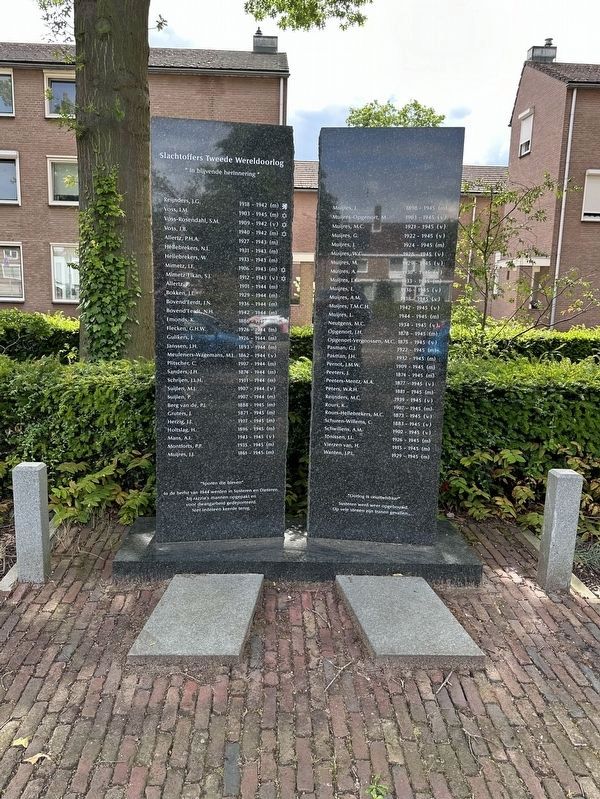
1. Susteren Slachtoffers Tweede Wereldoorlog / Victims of WWII Memorial
Slachtoffers Tweede Wereldoorlog
(Victims of World War II)
"In blijvende herinnering"
(“In eternal memory”)
Reijnders, J.G. 1918-1942 (m)
Voss, I.M. 1903-1945 (m) ✶
Voss-Rosendahl, S.M. 1909-1942 (v) ✶
Voss, I.B. 1940-1942 (m) ✶
Allertz, P.H.A. 1927-1943 (m)
Hellebrekers, N.L. 1931-1943 (m)
Hellebrekers, W. 1933-1943 (m)
Mimetz, I.F. 1906-1943 (m) ✶
Mimetz-Elkan, S.J. 1912-1943 (v) ✶
Allertz, F. 1901-1944 (m)
Bokken, J.L. 1929-1944 (m)
Bovend'Eerdt, J.N. 1936-1944 (m)
Bovend'Eerdt, N.H. 1942-1944 (m)
Emonds, K. 1886-1944 (m)
Flecken, G.H.W. 1926-1944 (m)
Gulikers, J. 1926-1944 (m)
Janssen, J.H. 1893-1944 (m)
Meuleners-Wagemans, M.J. 1862-1944 (v)
Plitscher, C. 1907-1944 (m)
Sanders, J.H. 1874-1944 (m)
Schrijen, J.L.H. 1911-1944 (m)
Suijlen, M.J. 1907-1944 (v)
Suijlen, P. 1907-1944 (m)
Berg van de, P.J. 1888-1945 (m)
Gruters, J. 1871-1945 (m)
Herzig, JJ. 1917-1945 (m)
Holtslag, H. 1896-1945 (m)
Mans, A.I. 1943-1945 (v)
Montforts, P.P.
this page online
Muijres, J.J. 1861-1945 (m)
"Sporen die bleven"
("Traces that remained")
In de herfst van 1944 werden in Susteren en Dieteren bij razzia's mannen opgepakt en voor dwangarbeid gedeporteerd. Niet iedereen keerde terug.
(In the autumn of 1944, men were arrested during raids in Susteren and Dieteren and deported for forced labor. Not everyone returned.)
Muijres, J. 1898-1945 (m)
Muijres-Opgenort, M. 1903-1945 (v)
Muijres, M.C. 1921-1945 (v)
Muijres, G. 1922-1945 (v)
Muijres, J. 1924-1945 (m)
Muijres, W.C. 1928-1945 (v)
Muijres, M. 1929-1945 (v)
Müijres, A. 1930-1945 (v)
Muijres, L.G. 1933-1945 (m)
Muijres, L. 1936-1945 (v)
Muijres, A.M. 1938-1945 (v)
Muijres, T.M.C.H. 1942-1945 (v)
Muijres, L. 1944-1945 (m)
Neutgens, M.C. 1934-1945 (v)
Opgenort, J.H. 1878-1945 (m)
Opgenort-Vergoossen, M.C. 1875-1945 (v)
Pasman, G.J. 1922-1945 (m)
Pasman, J.H. 1932-1945 (m)
Pernot, J.M.W. 1909-1945 (m)
Peeters, J. 1874-1945 (m)
Peeters-Mentz, M.A. 1877-1945 (v)
Peters, W.R.H. 1881-1945 (m)
Reijnders, M.C.
Photographed by Andrew Ruppenstein, July 14, 2024
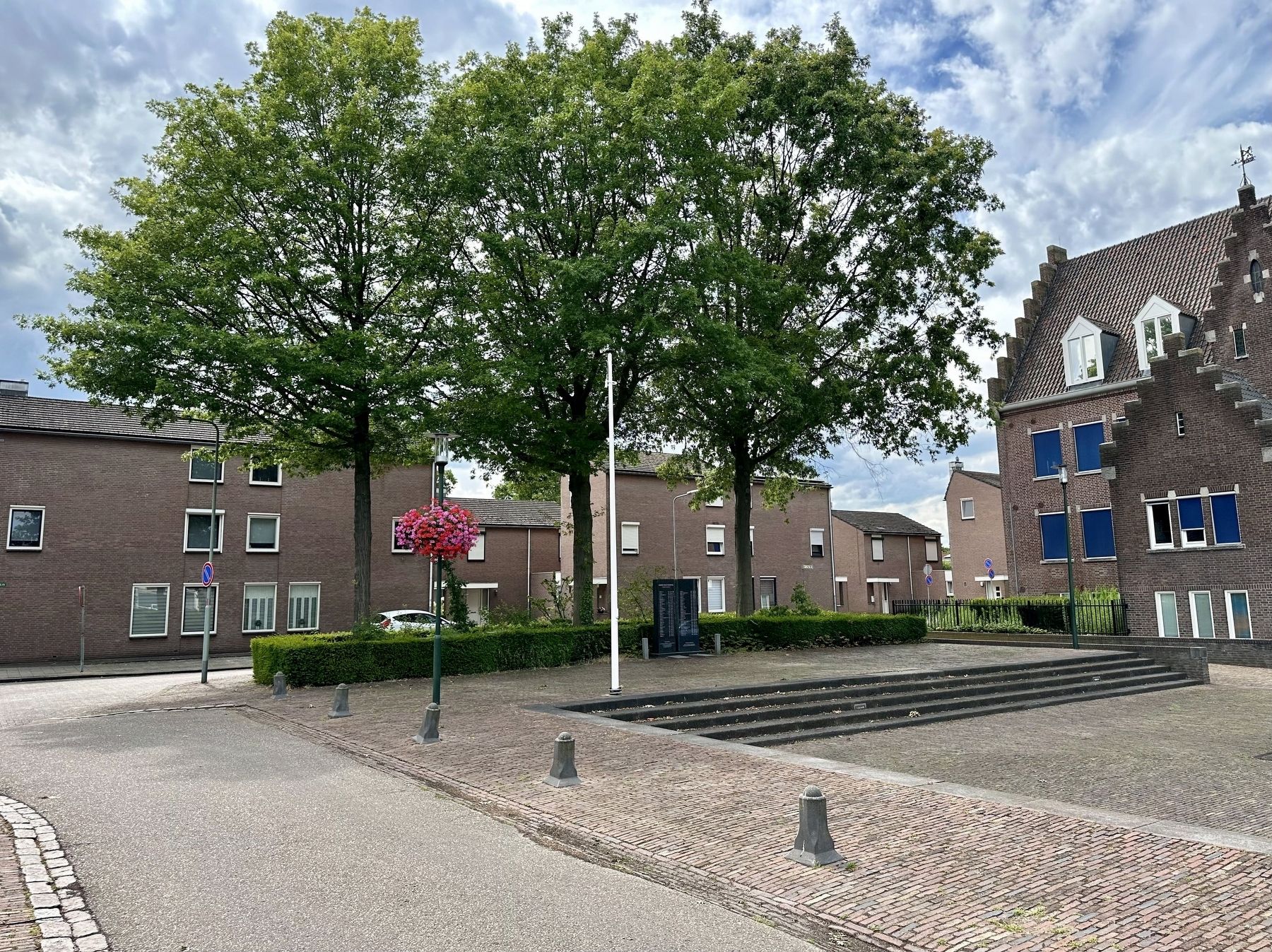
2. Susteren Slachtoffers Tweede Wereldoorlog / Victims of WWII Memorial
Rours, K. 1907-1945 (m).
Rours-Hellebrekers, M.C. 1873-1945 (v)
Schuren-Willems, C. 1883-1945 (v)
Schwillens, A.M. 1902-1945 (v)
Tönissen, J.L. 1926-1945 (m)
Vierzen van, H. 1915-1945 (m)
Wanten, J.P.L. 1929-1945 (m)
“Oorlog is onuitwisbaar”
(“The scars of war do not fade”)
Susteren werd weer opgebouwd.
Op vele stenen zijn tranen gevallen...
(Susteren was rebuilt. Many tears were shed.)
Topics. This memorial is listed in this topic list: War, World II.
Location. 51° 3.973′ N, 5° 51.18′ E. Memorial is in Susteren, Limburg, in Echt-Susteren. It is on Raadhuisplein, on the left when traveling north. Touch for map. Memorial is in this post office area: Susteren, Limburg 6114 MR, Netherlands. Touch for directions.

Regionally, it is in Europe, the European Union, Atlantic Europe, the Benelux Low Countries, the Schengen Area, Western Europe, and the Western World. Historically, it finds itself in what was once the Roman Empire and specifically also the Holy Roman Empire.
Other nearby markers. At least 8 other markers are within 16 kilometers of this marker, measured as the crow flies: Susteren World War II Liberation Memorial (about 90 meters away, measured in a direct line); Kazemat / Casemate (approx. 1.4 kilometers away); Grenze? Was soll‘s! / Border? What the heck! (approx. 2 kilometers away in Germany); Das Ende des Ersten Weltkrieges errinnert / The End of the First World War Commemorated (approx. 2 kilometers away in Germany); Restaurant “De Lindeboom” (approx. 14.7 kilometers away); Hell on Wheels (approx. 14.7 kilometers away); Hervormde Pastorie / Reformed Parsonage (approx. 14.8 kilometers away); Voormalige Bakkerij / Former Bakery (approx. 14.8 kilometers away). Touch for a list and map of all markers in Susteren.
More about this memorial. Key: ✶ = Jewish, m = male, v = female.
Also see . . . Susteren Oorlogsmonument (Nationaal Comité 4en5mei, in Dutch). This page about this memorial provides an extended explanation concerning the forced labor raids that are mentioned on the marker.
Excerpt (in translation): At the end of the Second World War, almost all German boys and men were enlisted in the army. That is why the occupying forces took the decision in the autumn of 1944 to force more than 3,000 boys and men from the area between Maas and Peel in Limburg to work in factories, on railways and on farms in Germany. The first and largest roundup took place on Sunday, October 8. 2,000 boys and men were forcibly rounded up and arrested. During the smaller raids that followed in the following weeks, more than 1,000 male residents from the area between Maas and Peel were arrested.(Submitted on July 21, 2024.)
The situation of most forced laborers was bad: poor housing, hunger, cold and poor hygiene. In addition, they lived in great uncertainty about their own lives and those of their relatives left behind, and there was a permanent fear of Allied bombing of the factories in which they were employed. After the liberation, more than six months later, it turned out that 120 forced laborers had not survived their employment. The rest returned home, often mentally and physically broken.
The raids of October and November 1944 have gone down in history as the Great Church Raid, because a large number of the men were arrested on Sunday morning, October 8, when they left their church after mass. Those who were forced from their beds or taken off the streets by the occupying forces in the following weeks also belong to the group of victims of the Great Church Raid. In memory of this event and in recognition of the suffering inflicted on the more than 3,000 deportees, a series of monuments (consisting of plaques and a number of monuments) has been erected in 45 villages in North and Central Limburg. After the liberation, this event became a forgotten war tragedy.
Credits. This page was last revised on July 21, 2024. It was originally submitted on July 21, 2024, by Andrew Ruppenstein of Lamorinda, California. This page has been viewed 139 times since then and 29 times this year. Photos: 1, 2. submitted on July 21, 2024, by Andrew Ruppenstein of Lamorinda, California.
